

2026 Toyota C-HR Review: The Small SUV Finally Gets the Power It Deserves
Many years ago, I drove the original Toyota C-HR at its debut. Its styling was unusual, and I appreciated Toyota’s willingness to make a little crossover that didn’t look like every other little crossover. It even handled rather well. Unfortunately, every time I began to enjoy it, the powertrain reminded me that fun was apparently optional. The engine felt anemic, the continuously variable transmission drained what enthusiasm remained, and it lacked all-wheel drive. The rear seat was tight, too. It was a crossover that seemed reluctant to do several of the things people buy crossovers to do.
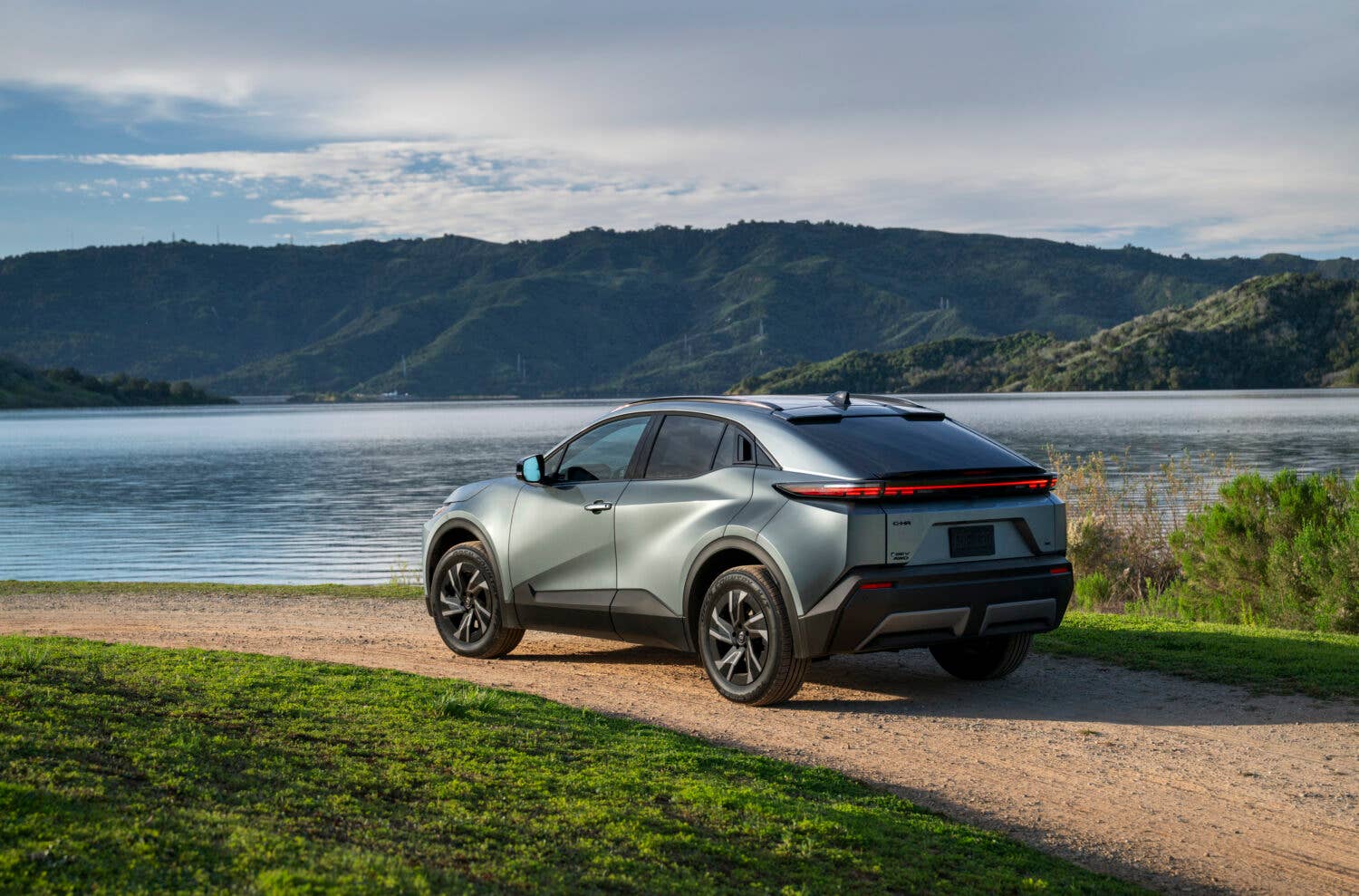
The new C-HR is quite a different animal. It’s electric, larger and equipped with all-wheel drive as standard. It has 338 horsepower, which is a number I never imagined associating with this nameplate. Toyota offers it in two trims: the $37,000 SE and the $39,000 XSE, before delivery and other charges. Both have the same dual-motor powertrain. So, at last, buying the less expensive C-HR doesn’t mean accepting the automotive equivalent of a stern lecture about patience.
Toyota
Powertrain and performance
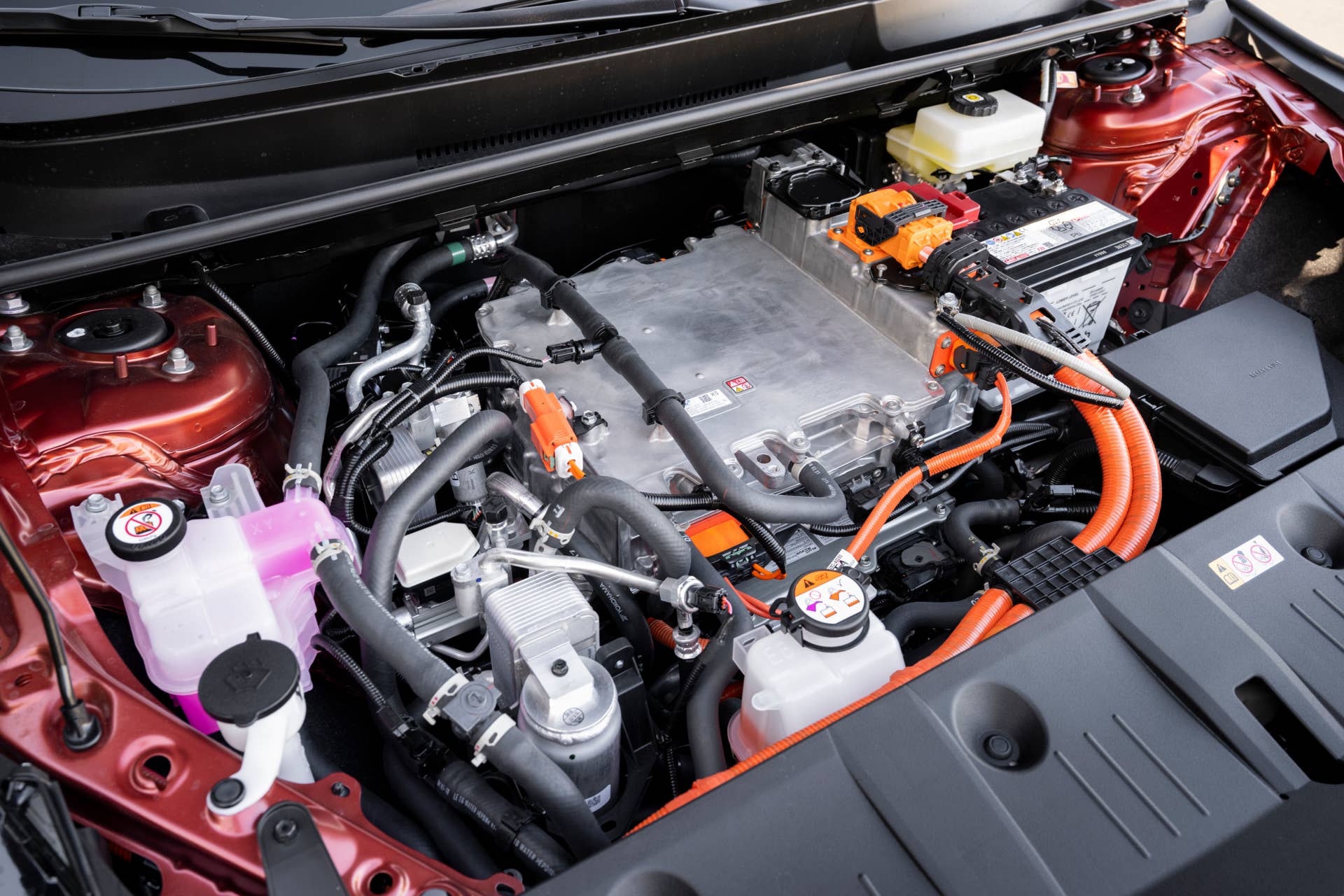
Both versions use a 74.7-kWh battery and produce a combined 338 horsepower. Toyota estimates a 4.9-second run from zero to 60 mph. That puts the new C-HR’s acceleration in a completely different universe from the old one. It also makes the starting price interesting: you’re getting a quick, dual-motor electric crossover for less than $40,000. The original C-HR asked me to celebrate its handling while overlooking its engine. This one has enough power to let the chassis join the conversation.
I don’t want to declare it a sports car because the number on a stopwatch looks exciting. Plenty of EVs launch hard and become less interesting once the road bends. Toyota says it tuned the C-HR’s springs, dampers and anti-roll bars, while the battery sits low in the vehicle. The original showed that Toyota could make a C-HR handle; the question for this one is whether the steering and suspension make use of all that newfound power. Either way, I’m glad the accelerator finally has a meaningful relationship with the styling.
Range is where the two trims separate. The SE wears 18-inch wheels and has an EPA-estimated range of 287 miles. The XSE gets 20-inch wheels and a 273-mile rating. That’s a 14-mile penalty for the dressier version, with no additional horsepower in return. I understand wanting the larger wheels. I also understand looking at them every time you plan a longer drive and asking whether they were worth it.
Charging equipment is competitive. The C-HR has a native NACS port, an 11-kW onboard AC charger and battery preconditioning, which can prepare the pack for a DC fast-charging stop. Toyota says a 10% to 80% charge takes around 30 minutes under ideal conditions. The company also includes a dual-voltage charging cable and a NACS-to-CCS adapter. Those are useful details for a buyer who wants to charge at home and have more options on the road. Naturally, “under ideal conditions” is doing some work in that charging estimate; the weather, battery temperature and charger itself still get a vote.
View the 2 images of this gallery on the
original article
Exterior and interior design
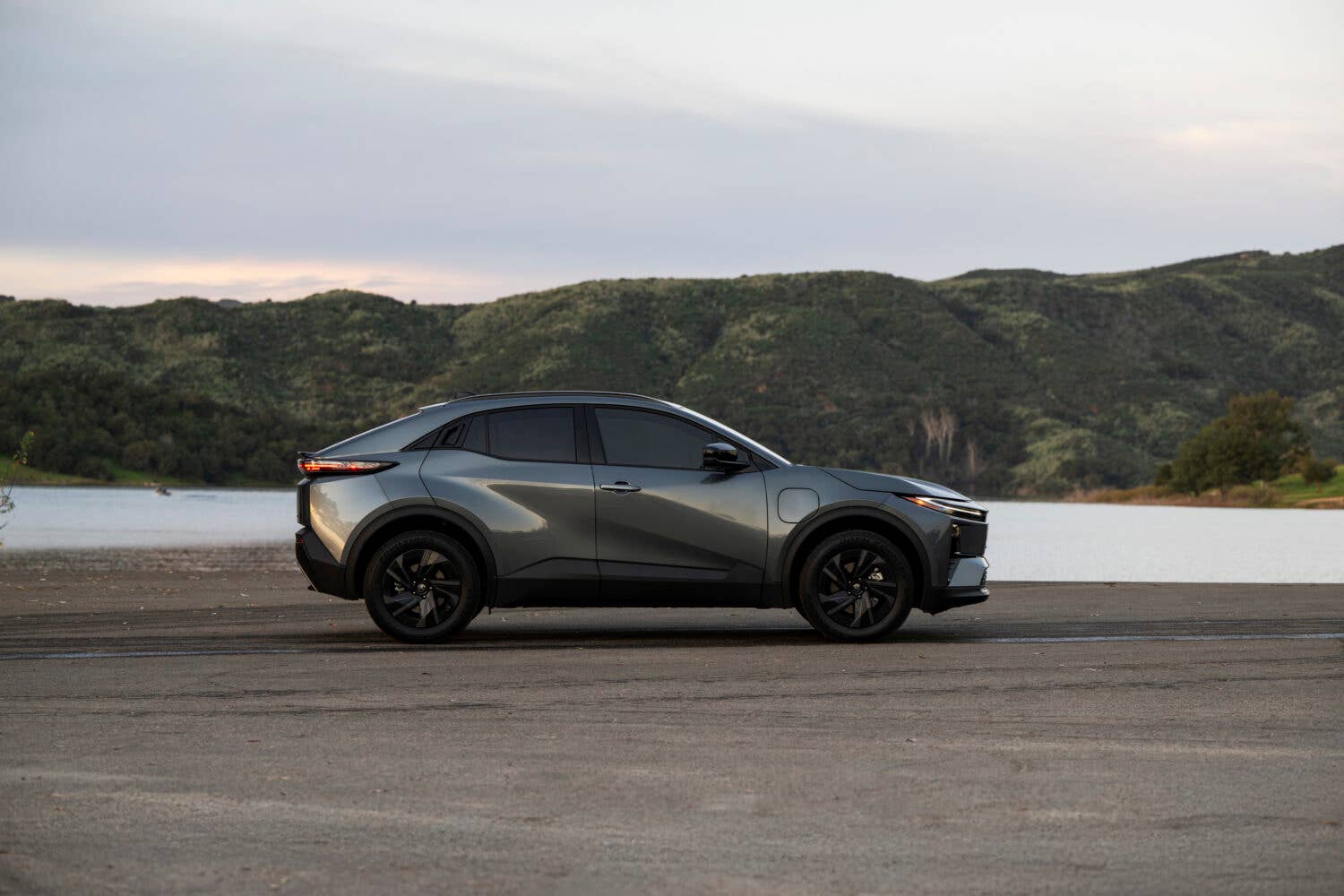
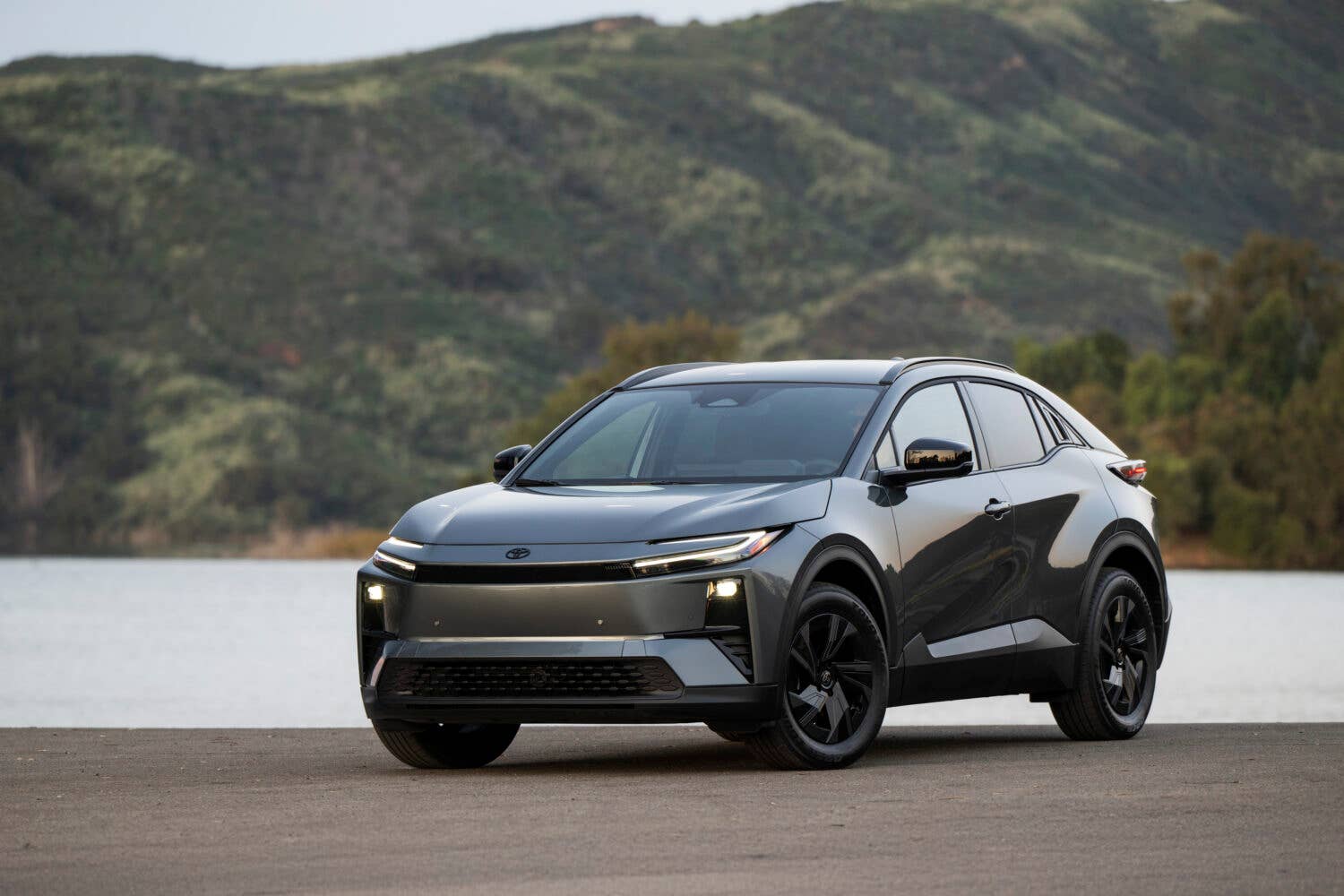
The first C-HR looked as though its designers had been told to make absolutely sure nobody mistook it for a Corolla. The new one is more restrained. There are enough angles and curves to give it an identity, but I find it less distinctive than the original. Perhaps that’s the price of growing up. Fortunately, the familiar Toyota face and coupe-like roofline give it some presence without making it look like it escaped from a science-fiction movie set.
Related: I Drove the 2027 Chevy Bolt RS and This is Everything I Hated About It
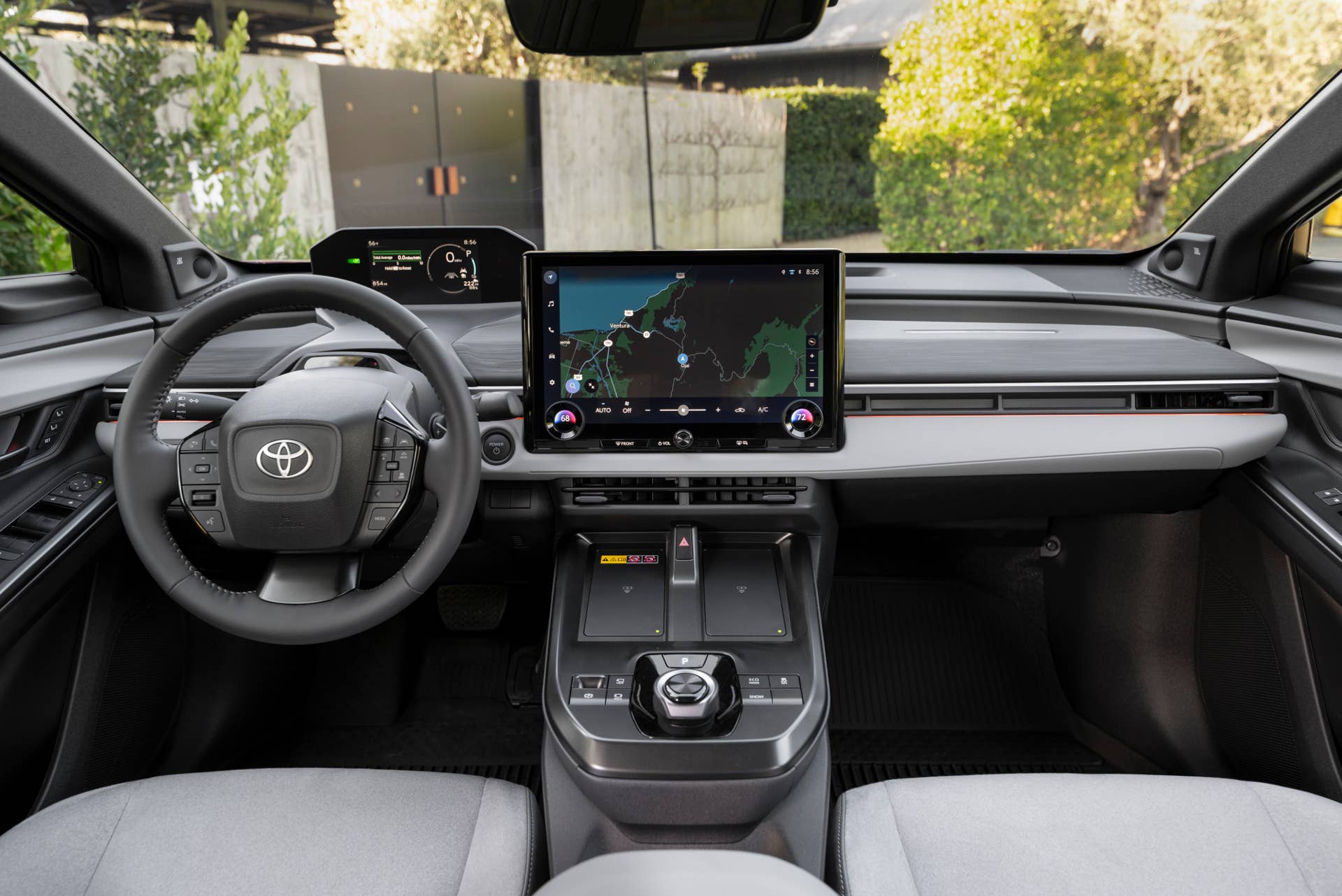
Inside, the C-HR is attractive and appears solidly put together, but I don’t find it especially playful. The 14-inch central touchscreen dominates the dashboard, joined by a slim driver display and two wireless phone chargers. Wireless Apple CarPlay and Android Auto are included. The XSE adds synthetic suede and SofTex-trimmed seating, a power passenger seat with driver-seat memory, and an available panoramic glass roof. It also gets a panoramic-view camera, Lane Change Assist and Traffic Jam Assist, although some connected features depend on a trial or subscription. Not cool, Toyota.
Toyota
View the 2 images of this gallery on the
original article
There’s a lot of equipment for the price, even if the cabin’s personality is closer to “very competent commuter” than “weekend troublemaker.” Seat comfort is quite good, and back seat space is vastly improved over the last model. That is to say, average-sized adults can fit back there.
My main complaint is Toyota’s reliance on the screen for controls I’d rather operate by feel. Climate functions are much easier to use when a button or slider is waiting exactly where you left it. Looking through a display to make a simple adjustment takes attention away from the road. At least there’s still a physical volume knob. I’m tempted to send it a thank-you card for being true to its anachronistic self.
Related: 2026 Dodge Charger SIXPACK vs. EV: Which Powertrain is Best?
The new C-HR is more useful than its predecessor. Toyota lists 25.3 cubic feet of cargo space behind the rear seats and 59.5 cubic feet when the 60/40-split rear seatbacks are folded. That gives this small crossover a legitimate argument when someone asks whether it can do more than look sharp and leave a traffic light quickly. Its overall length is 177.9 inches, so it remains manageable around town while offering considerably more everyday flexibility than I remember from the original.
View the 2 images of this gallery on the
original article
SE or XSE?
This is an unusually easy decision to frame. The SE has the same motors, 338 horsepower, all-wheel drive, battery and 14-inch touchscreen as the XSE. It also has heated front seats and a heated steering wheel, a power liftgate, rain-sensing wipers and Toyota Safety Sense 3.0. Most importantly, it starts $2,000 lower and carries the longer EPA range estimate. For someone shopping primarily on performance and value, the SE is the one I’d point to first.
The XSE makes sense if you want its 20-inch wheels, upgraded upholstery, extra seat adjustments and additional camera and assistance features. Those are real upgrades. Just be honest with yourself about whether they matter more than the SE’s lower price and 14 extra rated miles. There’s no secret performance bonus hiding behind the XSE badge. Toyota has already given the good stuff to both versions.
View the 3 images of this gallery on the
original article
Competitors
The C-HR enters a crowded part of the EV market. I’d look at the Chevrolet Equinox EV, Hyundai Kona Electric, Hyundai Ioniq 5, Kia EV6, and Nissan Leaf, depending on local pricing and how much space I need. While I like the Nissan Leaf quite a bit, it does not offer all-wheel drive.
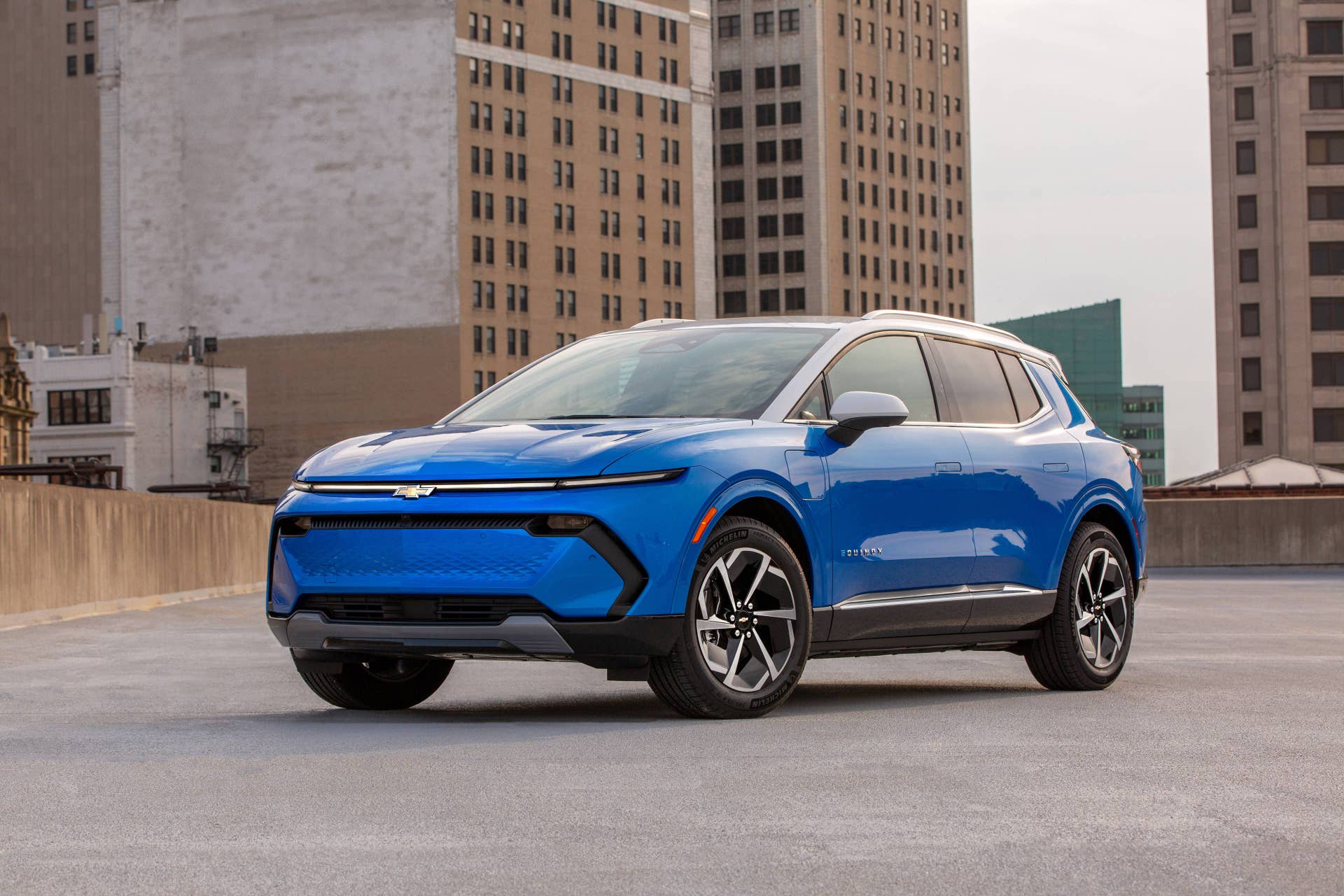
Toyota’s own bZ deserves a look as well. These vehicles differ in size and equipment, so I wouldn’t treat them as interchangeable simply because they all plug in. The Equinox EV presents a particularly clear value challenge: its 2026 front-wheel-drive version starts at $34,995 and has an EPA-estimated 319-mile range. Plus: I’m seeing some serious deals with the Equinox EV, it’s a worthy competitor. The C-HR counters with standard all-wheel drive and considerably more power.
Final Thoughts
The original C-HR was memorable, but I spent too much time explaining away what it lacked. This electric one gives me far fewer excuses to make. It has useful cargo space, credible range, practical charging equipment and enough acceleration to make the old car seem like it belonged to a different family. Its interior could use more character, and I would happily trade some screen controls for proper buttons. The XSE also gives up range for its larger wheels.
Still, the value is hard to dismiss. The XSE is an appealing quick EV for $39,000, but the SE is my pick: same power, more rated range and a lower starting price. The new C-HR may be less eccentric than the old one, but it finally delivers the all-wheel-drive performance that the original styling promised. That seems like a trade I can live with.
Related: 2026 Hyundai Kona Limited Review: Lots of Goodies, a Little Less Aloha
I Drove The 2026 Ford Mustang RTR: Here’s My Honest Review Of Ford’s Nearly $56,000 Factory Drift Car
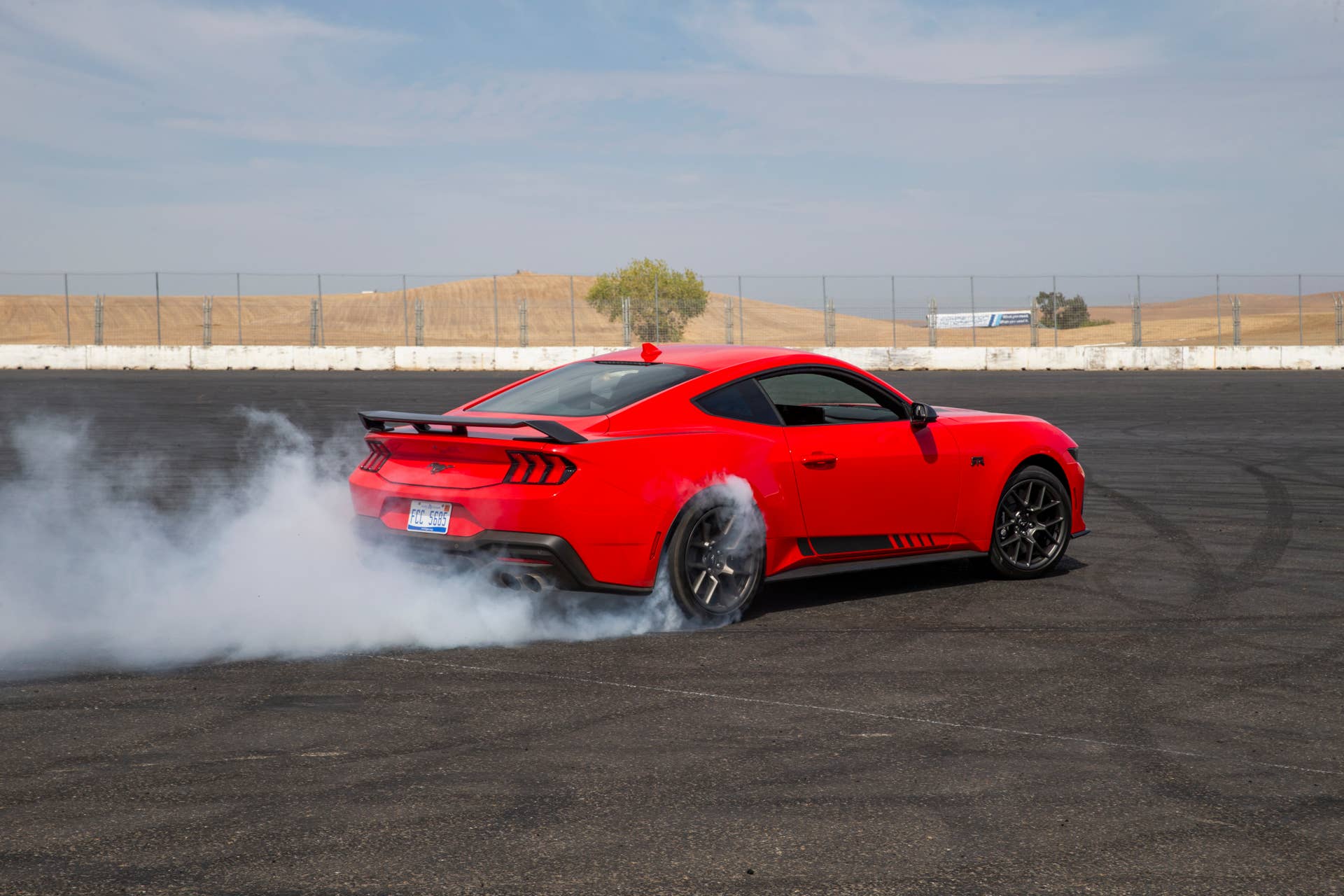
I knew I was making some progress when the instructors turned off all my electronic assists. At Thunderhill Raceway Park, Ford began my drift lesson with the 2026 Mustang RTR’s clever traction and stability systems still watching over me. I then completed two J-turns and two donuts cleanly, after which the instructors completely disabled the remaining safety nets and let me have a go at the full three-corner course. Eventually, I was able to link the first two turns before repeatedly spinning at the third, which at least made for a great smoke show. The RTR had flattered me almost immediately, and I’d like to think Vaughn Gittin Jr.—a professional drifter, racing driver, and founder of RTR, who observed from the sidelines—felt proud of me in ways even my own family never could. A guy can dream, can’t he?
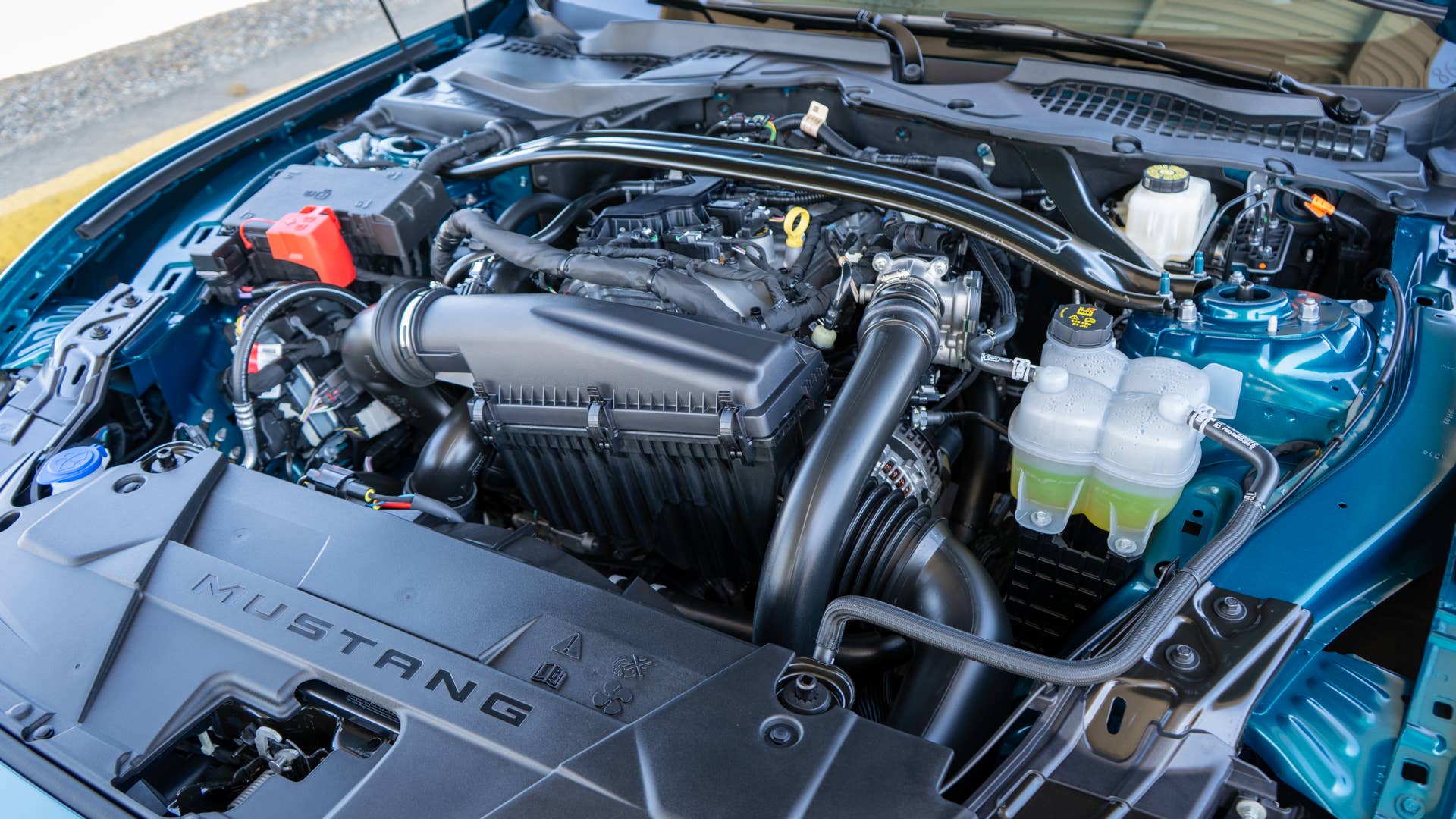
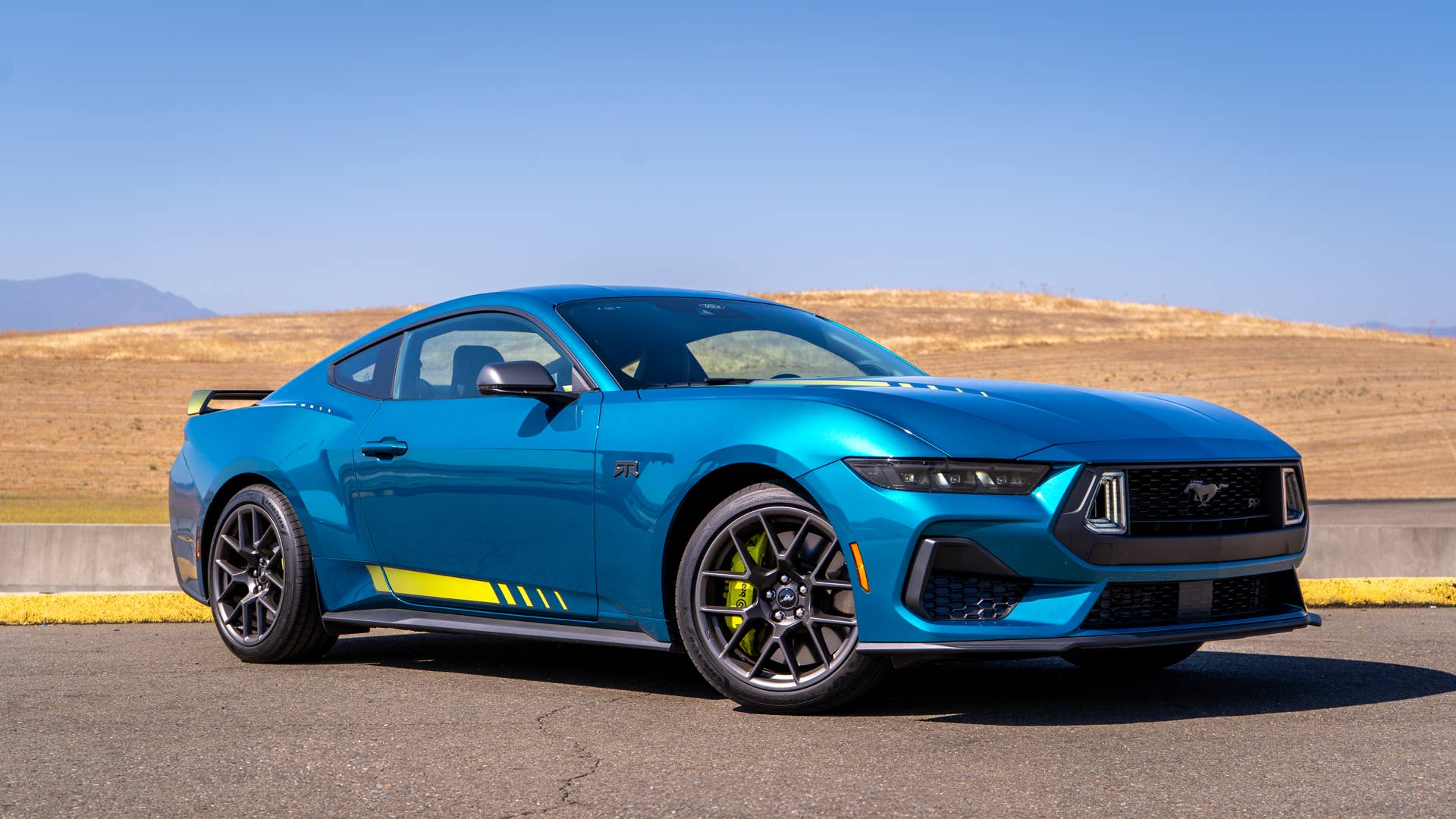
Dreaming seems to be the ultimate point of this truly unusual Mustang. Ford and Vaughn Gittin Jr.’s RTR Vehicles have turned the four-cylinder EcoBoost into one of the most overtly drift-focused production cars on the market—a “dream car” for young drifting enthusiasts by design. It has extra steering angle, a dedicated drift-brake lever, a Torsen limited-slip differential, anti-lag, and chassis hardware borrowed from the GT and Dark Horse. And somehow it’s still comfortable enough to drive to work. The biggest contradiction, however, was discovered on the window sticker. Two representative configurations supplied for the program totaled $53,440 and $55,850 delivered, respectively. For that money, the RTR still has just 315 horsepower, a 10-speed automatic, and a four-cylinder engine, whereas a base Mustang GT costs less and includes a 480-hp V8 and six-speed manual. So while Ford has created an excellent toy for younger drivers to thrash about in, I’m less convinced those younger drivers can—or will want to—pay for it.
Cole Attisha
2026 Ford Mustang RTR Specifications And Pricing
Specification | 2026 Ford Mustang RTR |
|---|---|
Engine | 2.3-liter turbocharged four-cylinder |
Output | 315 hp and 350 lb-ft of torque |
Transmission | 10-speed automatic |
Drivetrain | Rear-wheel drive; 3.55:1 Torsen limited-slip differential |
Curb weight | 3,783 pounds |
EPA fuel economy | 21 mpg city, 30 highway, and 25 combined |
RTR package | $6,520 |
Mustang RTR starting price | $42,205 before destination; $44,200 including destination |
Representative as-tested totals | $53,440 and $55,850, including destination |
2026 Mustang GT starting price | $47,795 before destination; $49,790 including destination |
Thinking about selling your car? Get an instant cash offer online now. Click here to get started.
Cole Attisha
Cole Attisha
What Makes The Mustang RTR Different?
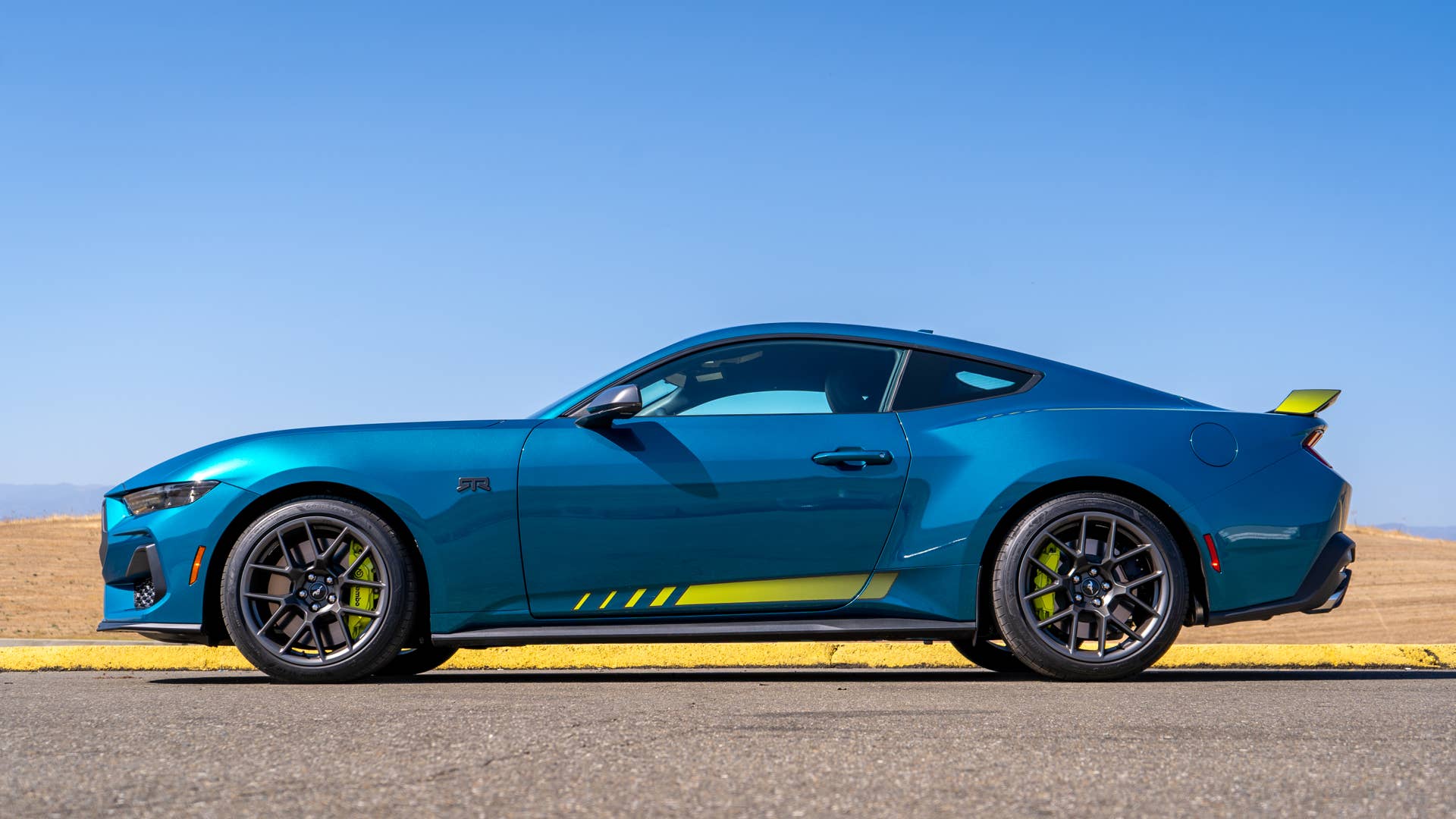
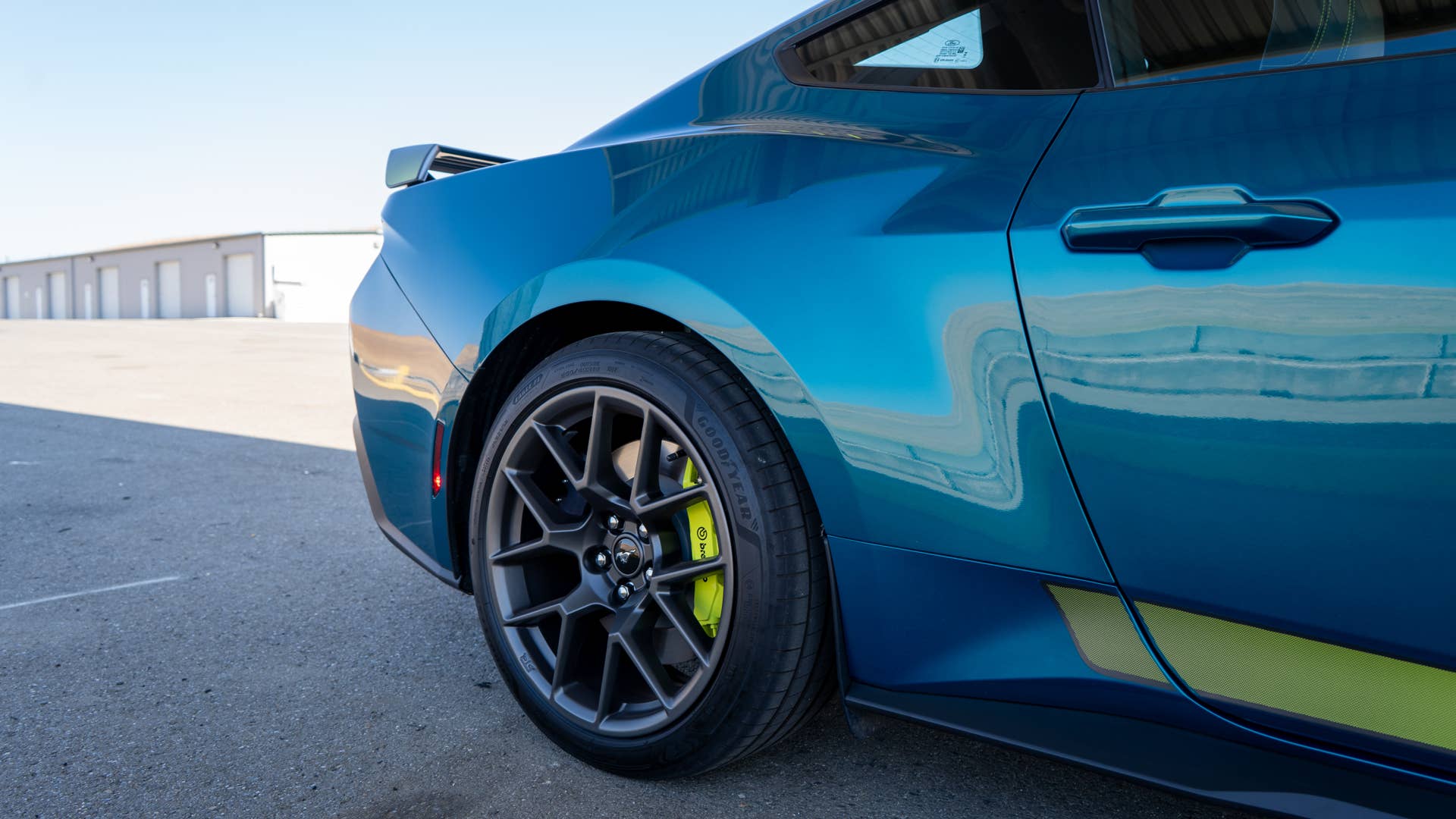
The RTR is much more than an EcoBoost wearing luminous accents. Its $6,520 core package adds the electronic drift brake, active-valve exhaust, a 3.55:1 Torsen rear differential, 19-inch wheels with 255/40 summer tires, and the GT Performance Package’s six-piston front and four-piston rear Brembo brakes. Ford also installs the Dark Horse’s rear subframe and stabilizer bars, adjustable strut mounts, a GT steering rack with 72.5 millimeters of additional travel, an RTR-specific Track-mode stability-control calibration, and a larger cooling fan. The optional MagneRide dampers receive their own RTR tune.
The engine retains the standard EcoBoost’s 315 hp and 350 lb-ft of torque, but adds Ford-patented anti-lag technology derived from the Le Mans-winning Ford GT race car. It doesn’t spit flames, but it does keep the turbocharger ready for when the driver lifts and quickly returns to the throttle, which I noticed most during drift transitions, because I am, of course, a drifting God with a signed certificate to prove it. The result isn’t so much a power package as it is a control package for a specific use case—that is, sliding its bright green dumper around corners in excessively dramatic fashion. Ford has engineered the car around specific moments inherent to drifting, like when initiating a slide, catching it, changing direction, and repeating the process without destroying the car.
Cole Attisha
Cole Attisha
Surprisingly Civilized On The Road
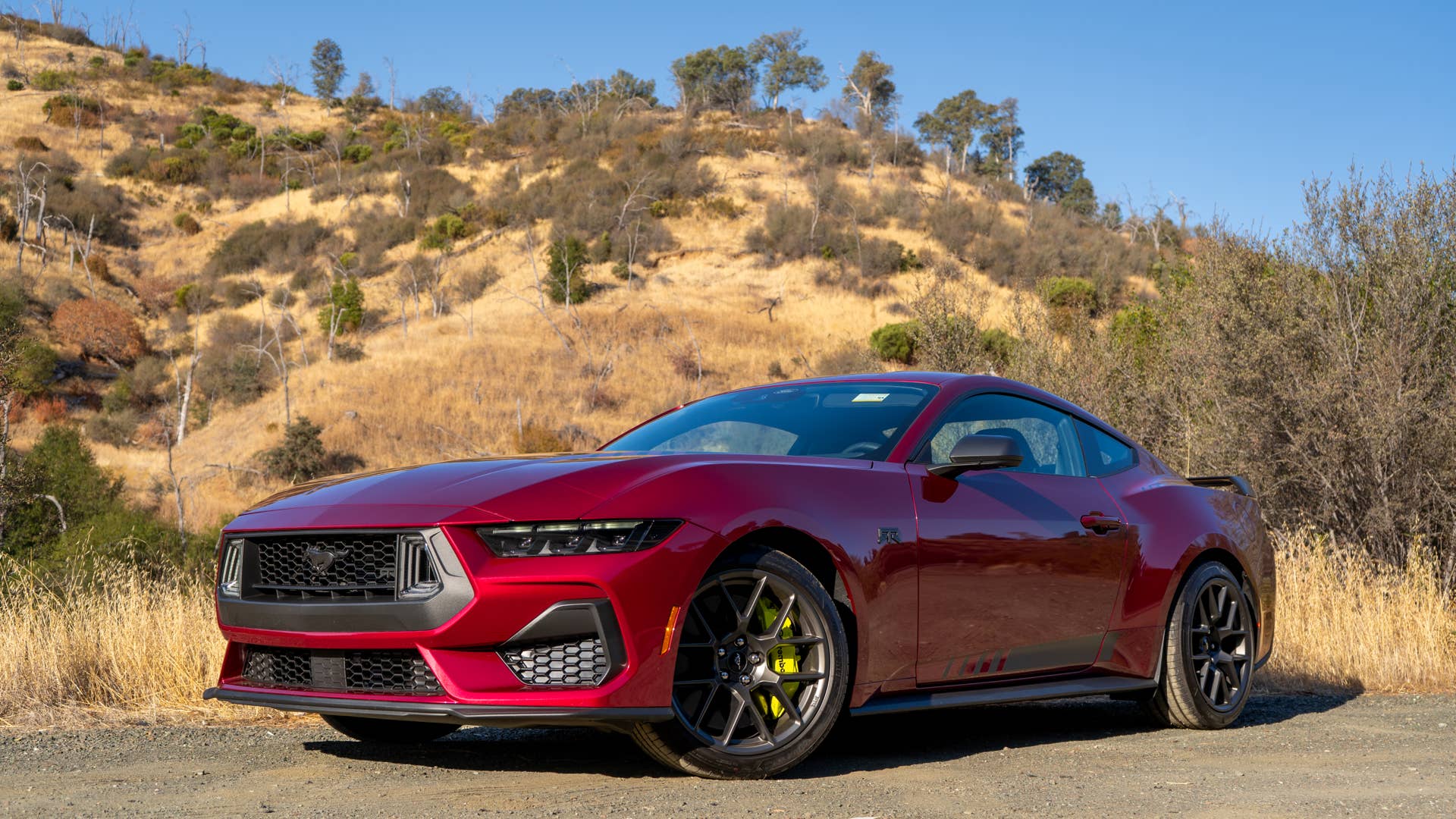
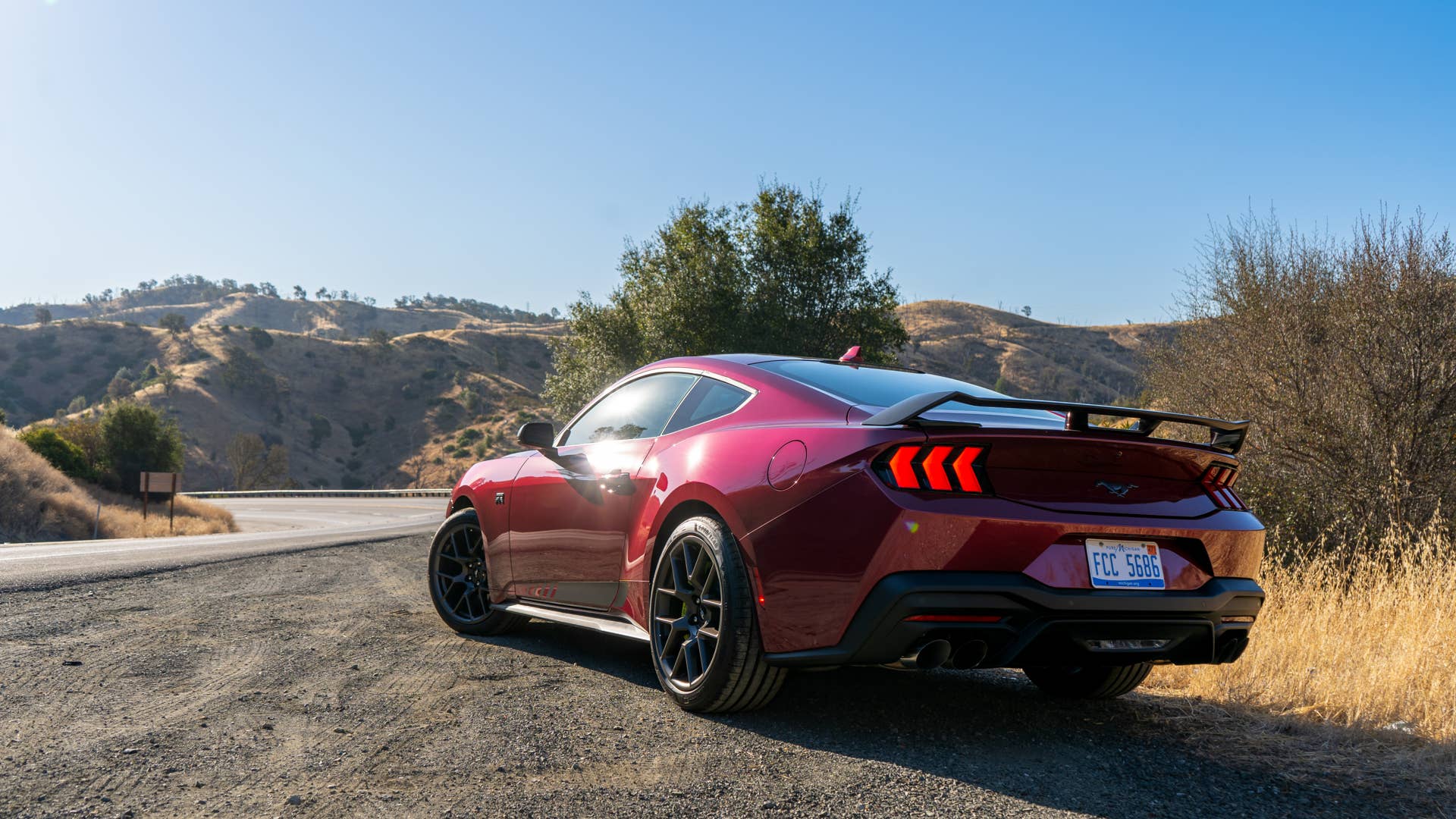
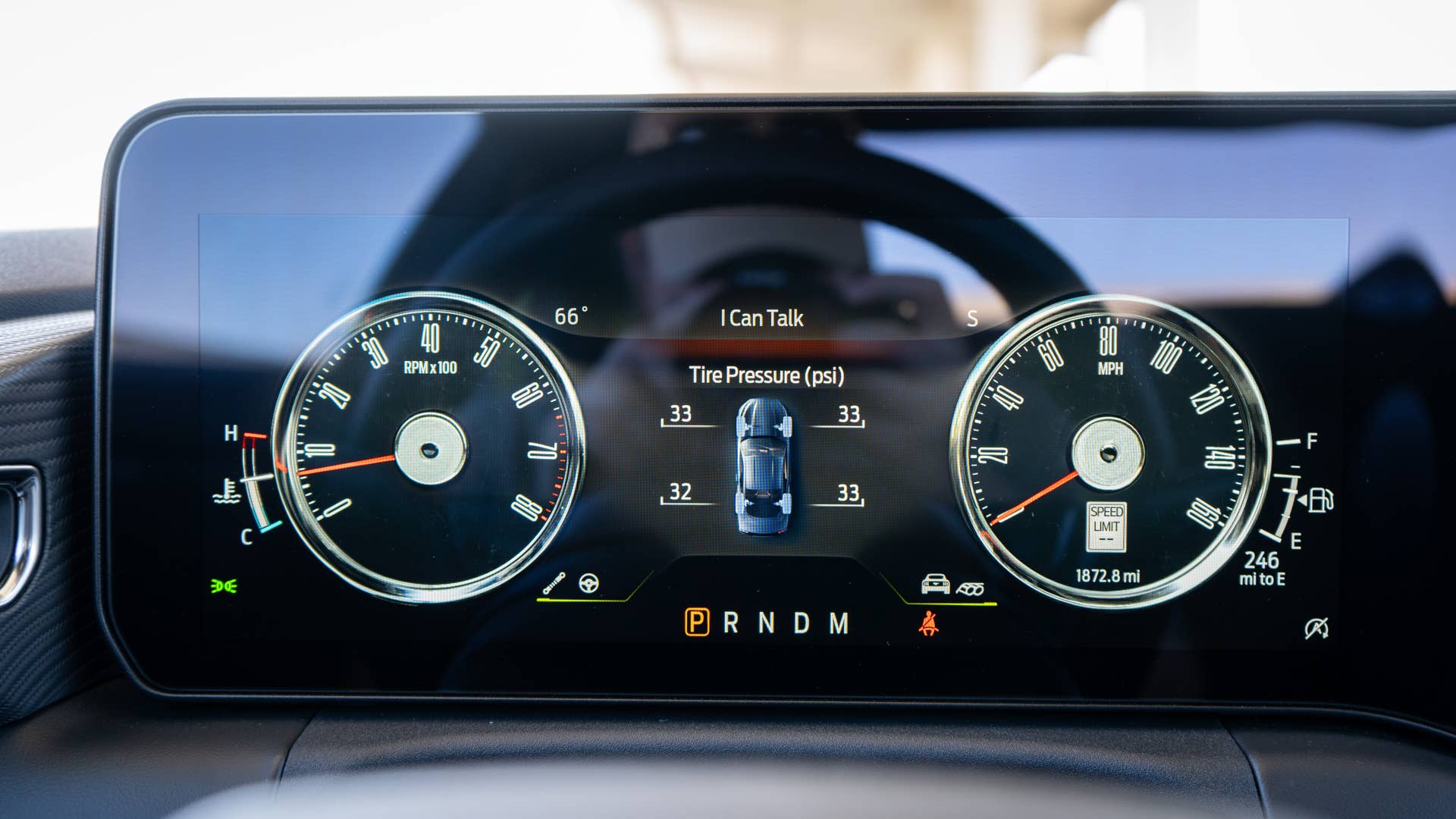
Before I got to produce any tire smoke, my drive partner and I spent roughly two hours taking a dark-red RTR from our Napa Valley hotel to Thunderhill. We split the driving over highways and windy canyon roads, then repeated the trip back to the hotel after the track sessions. The RTR was far friendlier than its graphics suggested; its optional MagneRide suspension controlled the body without making broken pavement feel like a personal failure, road noise remained reasonable, and the 10-speed behaved unobtrusively in ordinary traffic. Critically, its additional steering travel didn’t make it feel awkward on the road. This is fundamentally a daily driver that can drift, and not the other way around.
Shopping for a new car? Click here to get a great deal on your next vehicle. Powered by Carvana: no-haggle pricing, 100% online.
Cole Attisha
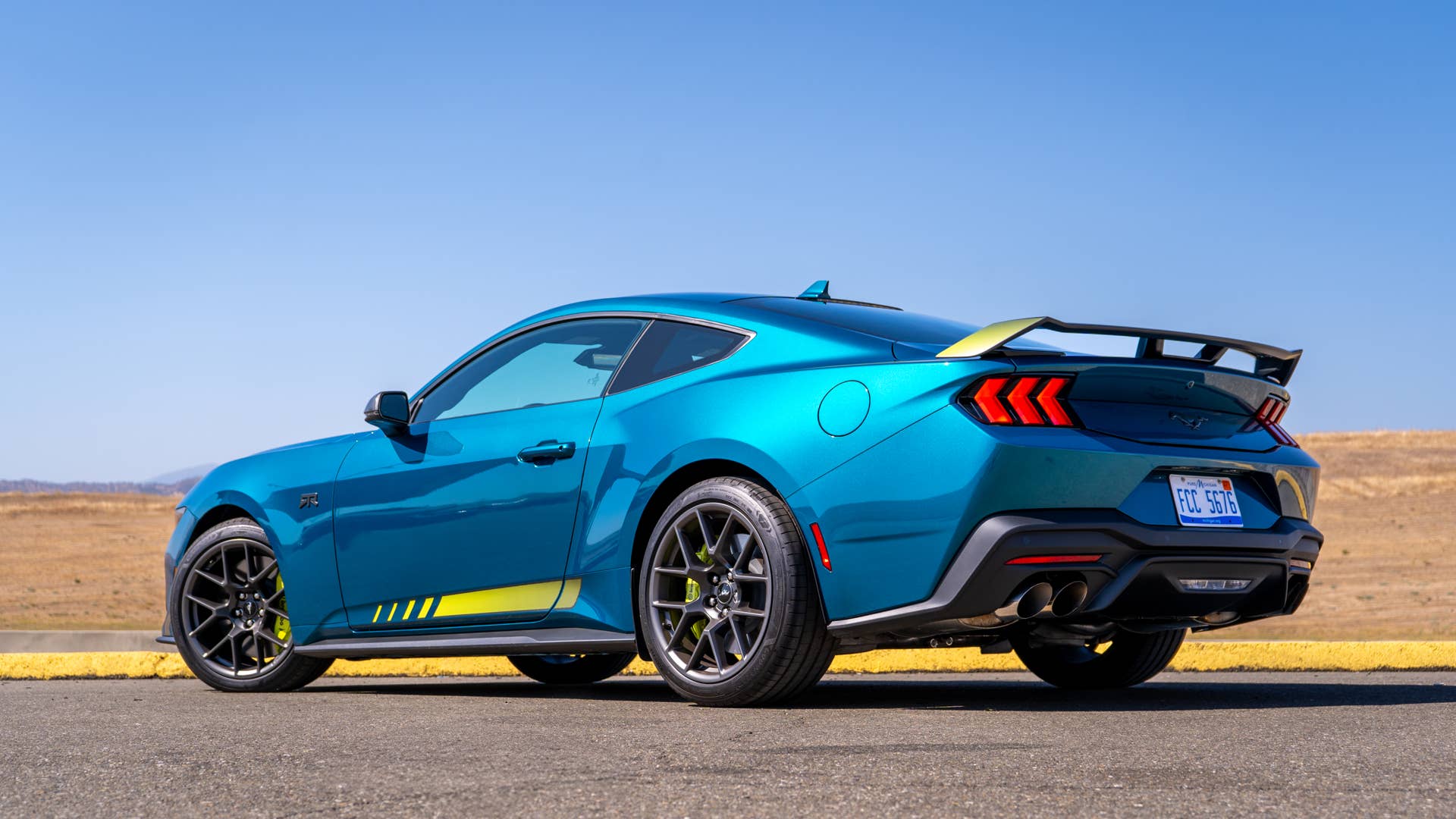
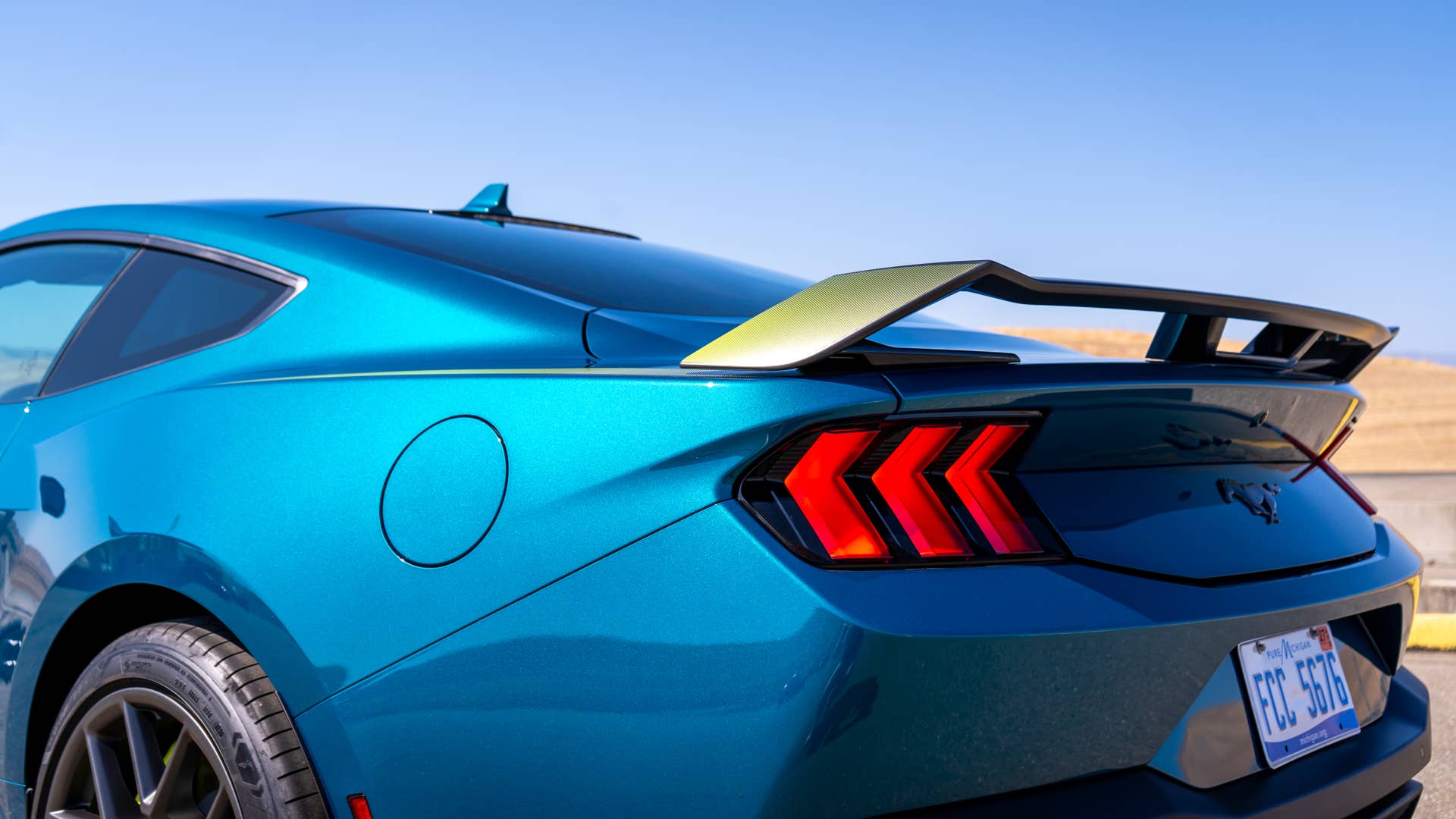
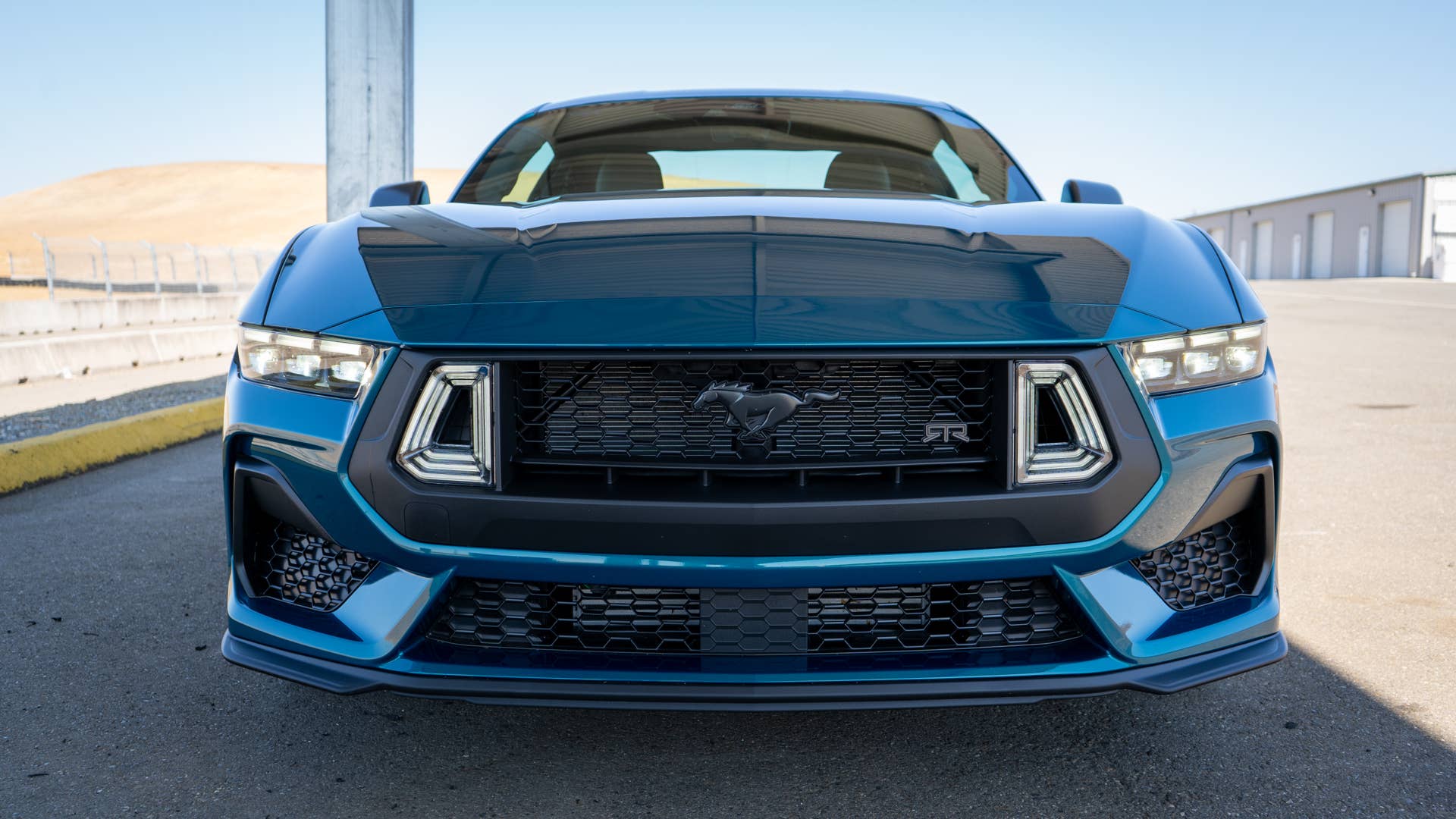
It really looks the business, too. It steals its front fascia from the GT, gets those signature illuminated RTR grille nostrils that look so good it’s as if every Mustang should have them, as well as dark-finished wheels, a raised rear spoiler, and available Hyper Lime graphics and brake calipers, which make it appear more provocative than a regular EcoBoost. Parked beside the Dark Horse SCs we would drive the following day, however, it was clearly the less beastly Mustang. So it’s proud of what it is, but it still knows its place within the family hierarchy.
Cole Attisha
Cole Attisha
Cole Attisha
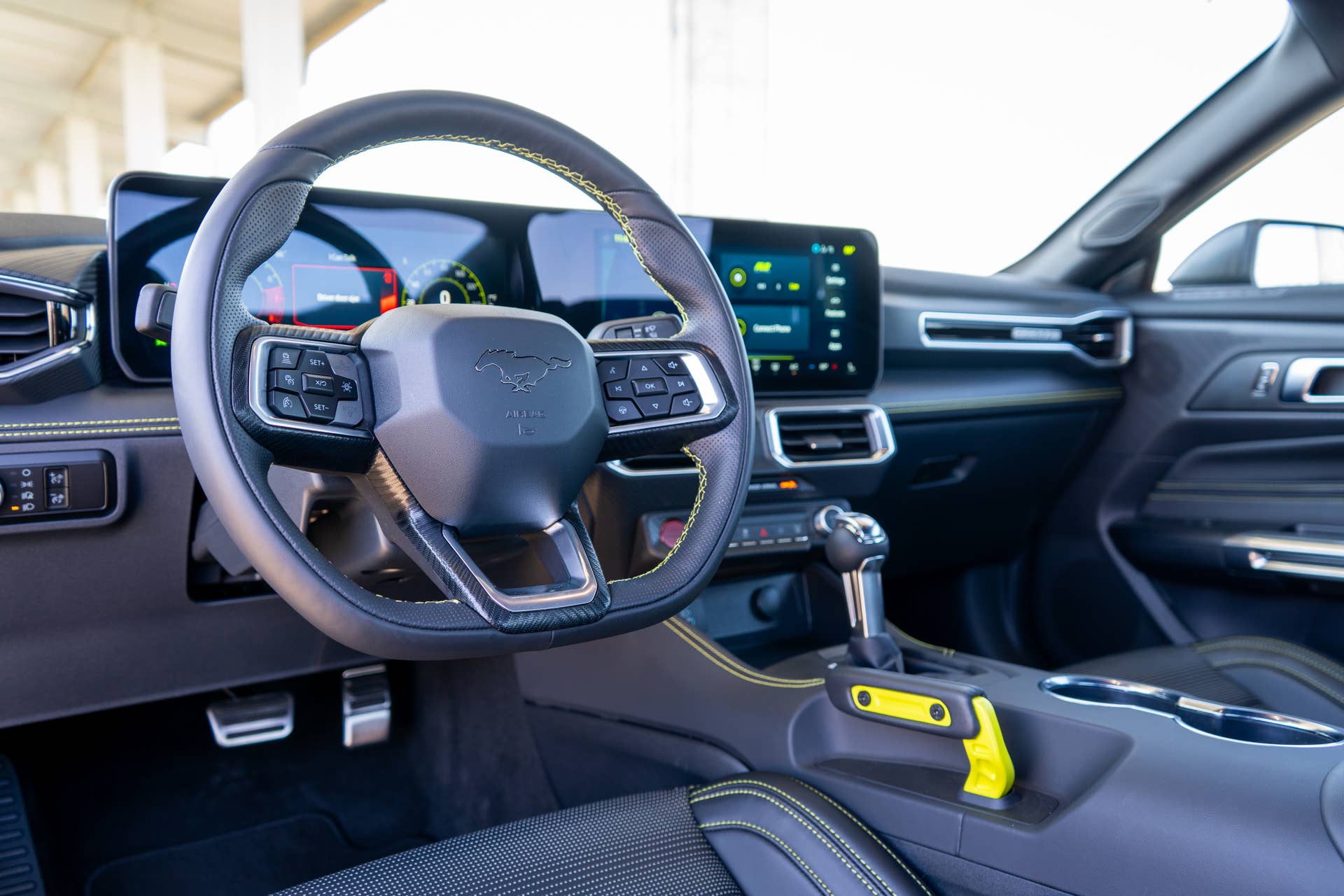
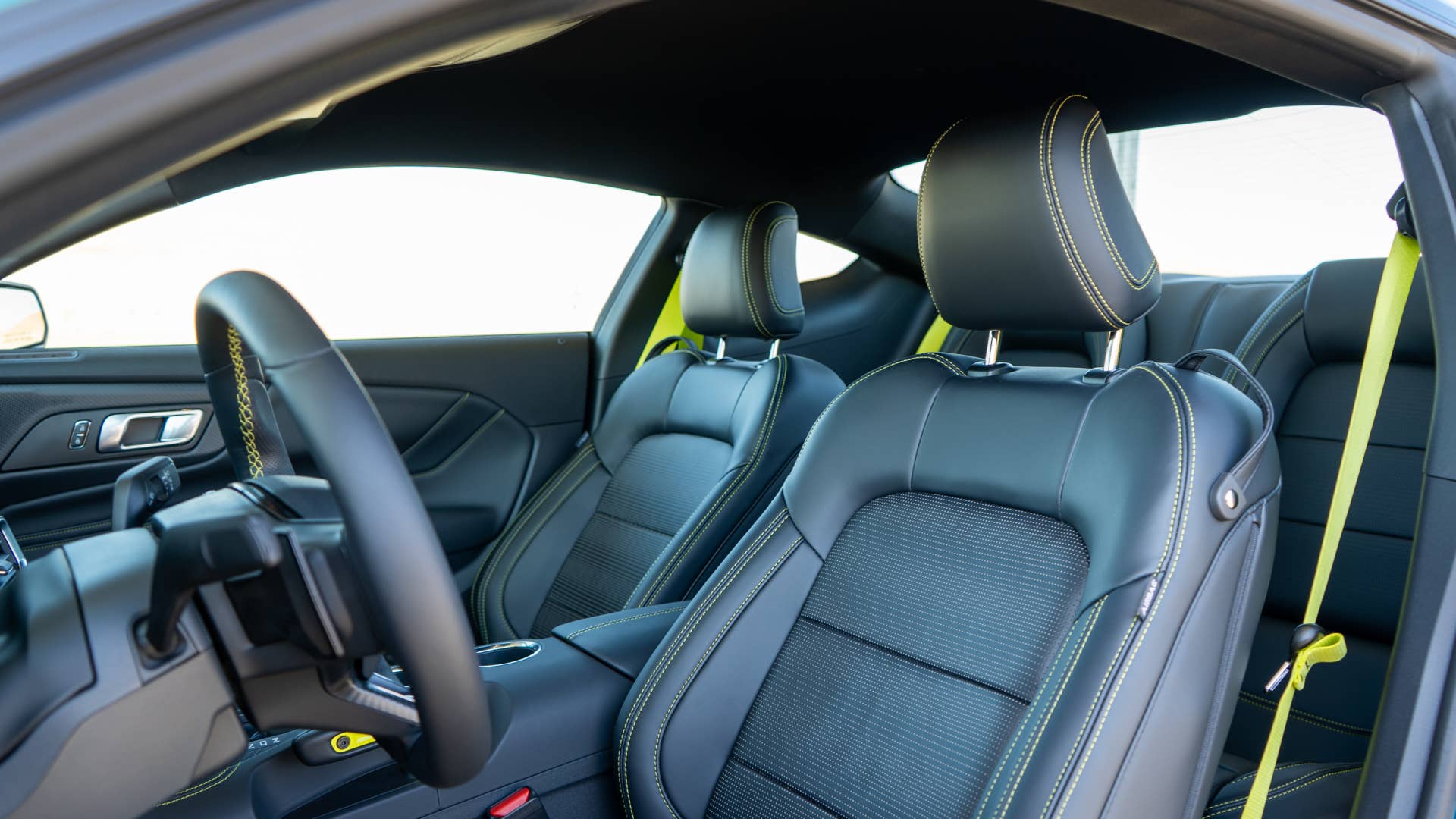
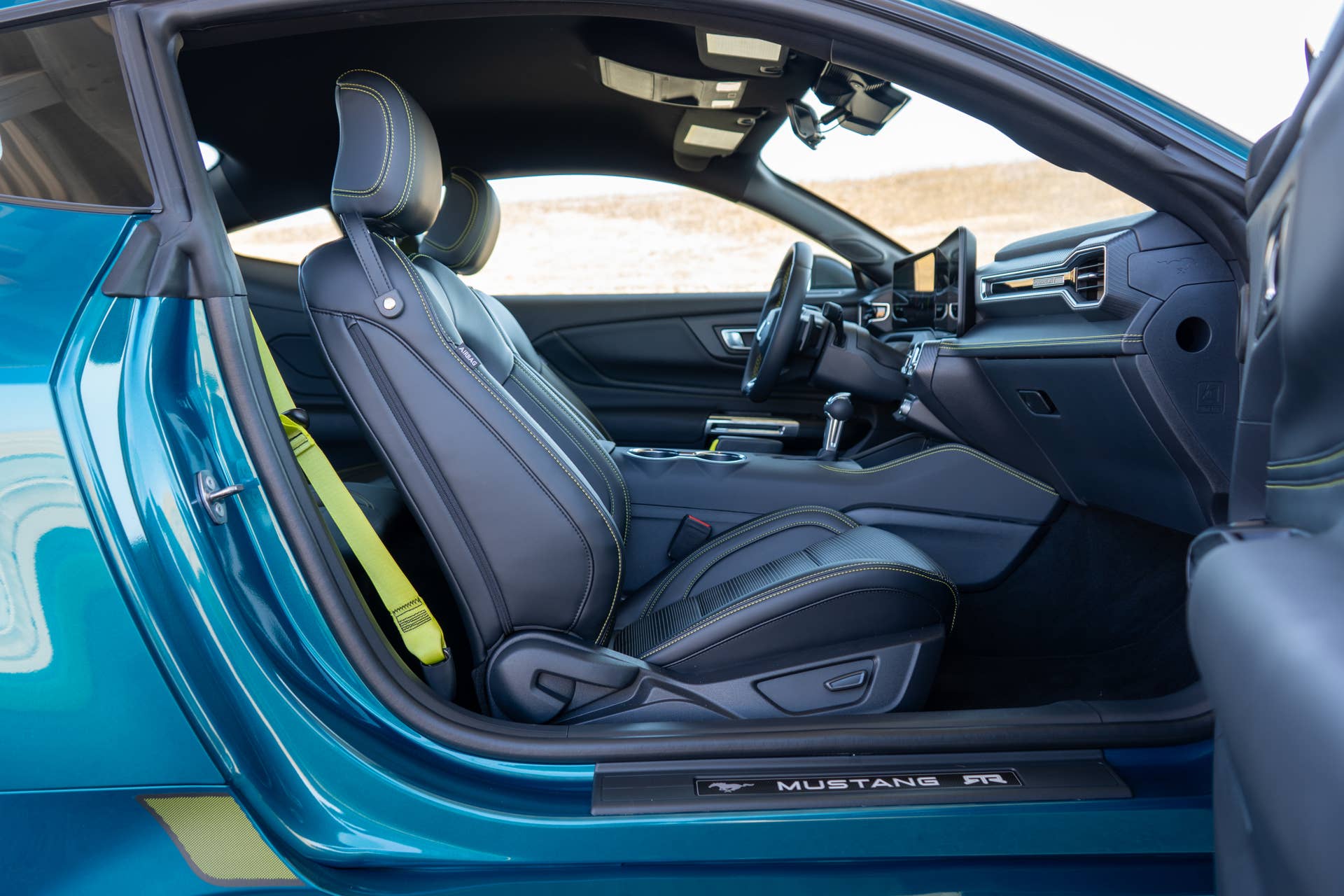
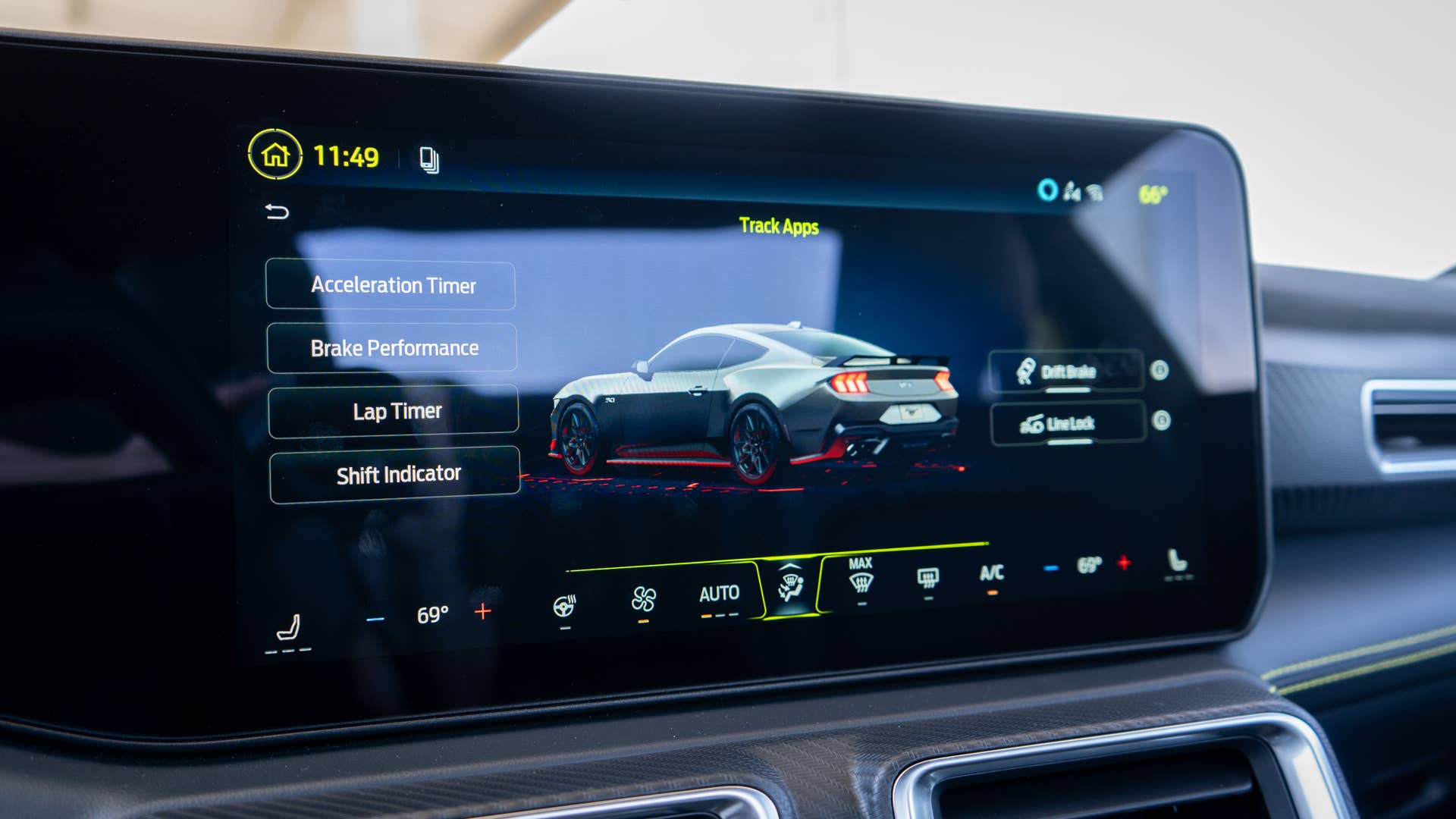
The cabin tries just as hard to establish an identity distinct from other Mustangs. Hyper Lime stitching, seatbelts, screen graphics, and a matching drift-brake lever separate it from lesser EcoBoost models. At times, the effort resembles an older corporation’s interpretation of what younger enthusiasts find cool. At one point, my drive partner and I changed the ambient lighting from green to red, only to discover that someone from Ford had changed it back while we were on track—a gesture we found quite cheeky and therefore loved. Also, the virtual Mustang displayed while selecting drive modes wore a GT badge. Material quality also remains a bit of a question mark. Some panels creaked, and the sun visor would swing away from the side window during turns, striking me in the head, though it thankfully wasn’t very heavy. This kind of stuff is easier to tolerate in a Mustang with a legitimate value proposition than in one approaching $56,000.
Cole Attisha
Cole Attisha
Cole Attisha
A Lighter Nose Makes A Better Mustang
Thunderhill’s tight road-course configuration gave the EcoBoost enough room to demonstrate its abilities without exposing its power deficit. Across three independently paced laps, 315 hp felt adequate, the Brembos stayed consistent, and the chassis encouraged me to use more of the car. The real highlight was balance. Without a Coyote V8 over the front axle, the RTR changes direction with far less effort than a GT. Ford cites a 54/46 weight distribution, and that lighter nose might ultimately be the strongest reason to choose the EcoBoost foundation. The steering was direct, the MagneRide suspension kept the car disciplined, and the throttle encouraged the rear axle to rotate. It even overrotated unexpectedly once on my first hot lap—I was clearly bred for drifting—but the correction came quite naturally.
Ford
Ford Built A Drift Lesson Into The Car
After our circuit laps, one of Ford’s professional drivers took us through the upcoming drift course as passengers. Her demonstration revealed how much capability the RTR had when moving sideways, and my next exercise was a drift class led by Gittin and his team, which meant I would have to see just how much of that capability I could squeeze out of the car myself. The electronic drift brake works less like a conventional handbrake and more like a digital command that triggers hydraulic action. In Drift mode, initiation depends more on how quickly the lever is pulled than how long it is held. Pull it sharply, the rear wheels lock, and releasing the lever disengages it—no secondary button or switch required. Outside Drift mode, the same lever functions as an on/off parking brake control.
The simplicity of it all allowed me to just focus on weight transfer and steering—I could jump straight into working on my technique, rather than spending so much time feeling out the car. The car didn’t hold my hand through the process, as my repeated spins at the third corner proved, but it removed enough friction to make learning approachable. A novice could use the assists to explore the first stages, while an experienced driver can turn everything off and receive absolute freedom to shed rubber. So this is much more than just a gimmicky drive mode that produces one canned slide at a time. The extra steering angle becomes tangible as the car rotates; the lighter front end gives the driver time to work, and the automatic transmission means you don’t have to think about what to do with your left foot. The RTR makes drifting easier without making the accomplishment feel unearned.
Cole Attisha
How Does A Four-Cylinder Mustang Reach $55,850?
Although the most basic Mustang RTR can be had for $42,205 before destination, a representative Orange Fury example present at the event program carried, in addition to the RTR package, the $1,330 RTR Appearance Package, the $1,750 MagneRide suspension, the $3,000 Equipment Group 201A, a $1,160 B&O audio system, $1,995 for Recaros, $750 for Hyper-Lume calipers, and $995 for paint, bringing the total to $55,850. Meanwhile, Ford currently lists the base 2026 Mustang GT at $47,795 before the same $1,995 destination charge, and the GT Premium starts at $52,075 before destination. So the comparison practically writes itself: Do you want the most extreme version of the EcoBoost Mustang, or the most basic version of the V8 Mustang?
Personally, I would probably opt for the GT and add the drift brake, additional steering angle, and other hardware later if I really, desperately wanted that stuff. That route would surrender the RTR’s integrated calibration, full factory execution, lighter front end, Dark Horse chassis hardware, and serialized identity. It would also provide the manual gearbox and V8 that remain central to the Mustang experience for many buyers, including me. The intended audience that Ford claims it’s after here makes the price feel even more awkward. Ford acknowledged that RTR’s large following among 18- to 35-year-olds was part of the partnership’s appeal, yet the finished product can, at times, feel like older executives assuming young enthusiasts will gladly accept a long-term finance contract for a heavily optioned, automatic four-cylinder Mustang. The actual buyer for the RTR may care less about the Mustang mythology than the mechanical proposition: a turbocharged, rear-wheel-drive coupe that can commute all week and destroy its rear tires on the weekend. Alternatively, it may be an EcoBoost buyer who is unusually easy to upsell.
Cole Attisha
Verdict: An Excellent Toy With A Difficult Audience
The 2026 Ford Mustang RTR succeeds at the difficult part. It feels distinct from the regular EcoBoost I previously reviewed, behaves naturally on the road, remains balanced on a circuit, and makes genuine drift technique easier to access. It’s fun, useful, and engineered far beyond its graphics. My experience with it actually made me appreciate the regular EcoBoost more—mainly because of its price. The RTR’s engineering is most persuasive while the car is sideways, but its window sticker follows it everywhere. Once the total passes a base GT and approaches a GT Premium, the absence of both a V8 and a manual can no longer be treated as a mere footnote. The Mustang RTR is ultimately an expensive toy designed for kids to thrash about in, and while it is very good at being that toy, the difficult question is how many of those kids can responsibly justify buying it.
Autoblog aims to feature only the best products and services. If you buy something via one of our links, we may earn a commission.
2026 Chevrolet Suburban High Country Diesel: Is $86K a Good Value for Families?
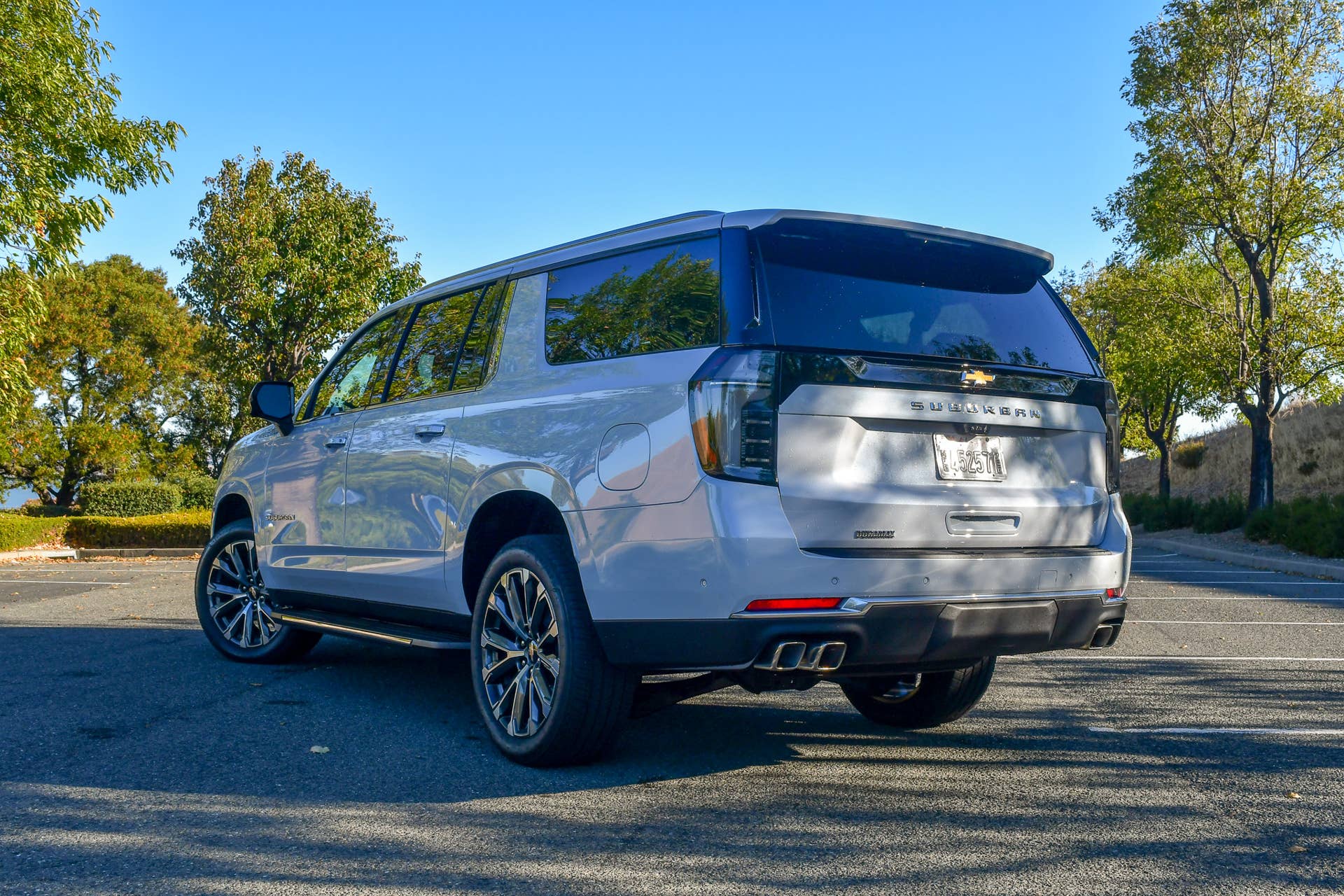
Few nameplates let you trace a direct line back nearly a century, but the Chevy Suburban is one of them. In 1935, the Suburban Carryall solved a simple problem: take a half-ton truck frame, drop an enclosed steel body on top, and build a workhorse that could haul people, produce, or whatever else life demanded. Ninety-one years later, that core mission hasn’t changed. To test whether the 2026 Suburban High Country still lives up to its heritage, we loaded six people across three generations—two car seats, grandparents, and a few necessities—for a 2.5-hour road trip from the East Bay up to Apple Hill. The verdict before we even cleared the highway was an easy one: the Suburban is still the undisputed Queen of usable space.
Kristen Brown
At an as-tested $85,990 (including destination, Polar White Tricoat paint, and a Duramax diesel that actually knocks $1,500 off the sticker), it isn’t cheap. Yet in a market crowded with fragile luxury three-rows, the Suburban makes a compelling case as one of the few full-size SUVs that effortlessly blends workhorse utility, road-trip luxury, and surprising value. Let me explain.
Related: Road Ethos Launches: The New Automotive Lifestyle Site You Should Read
The Chevy Suburban was—and still is—a land yacht
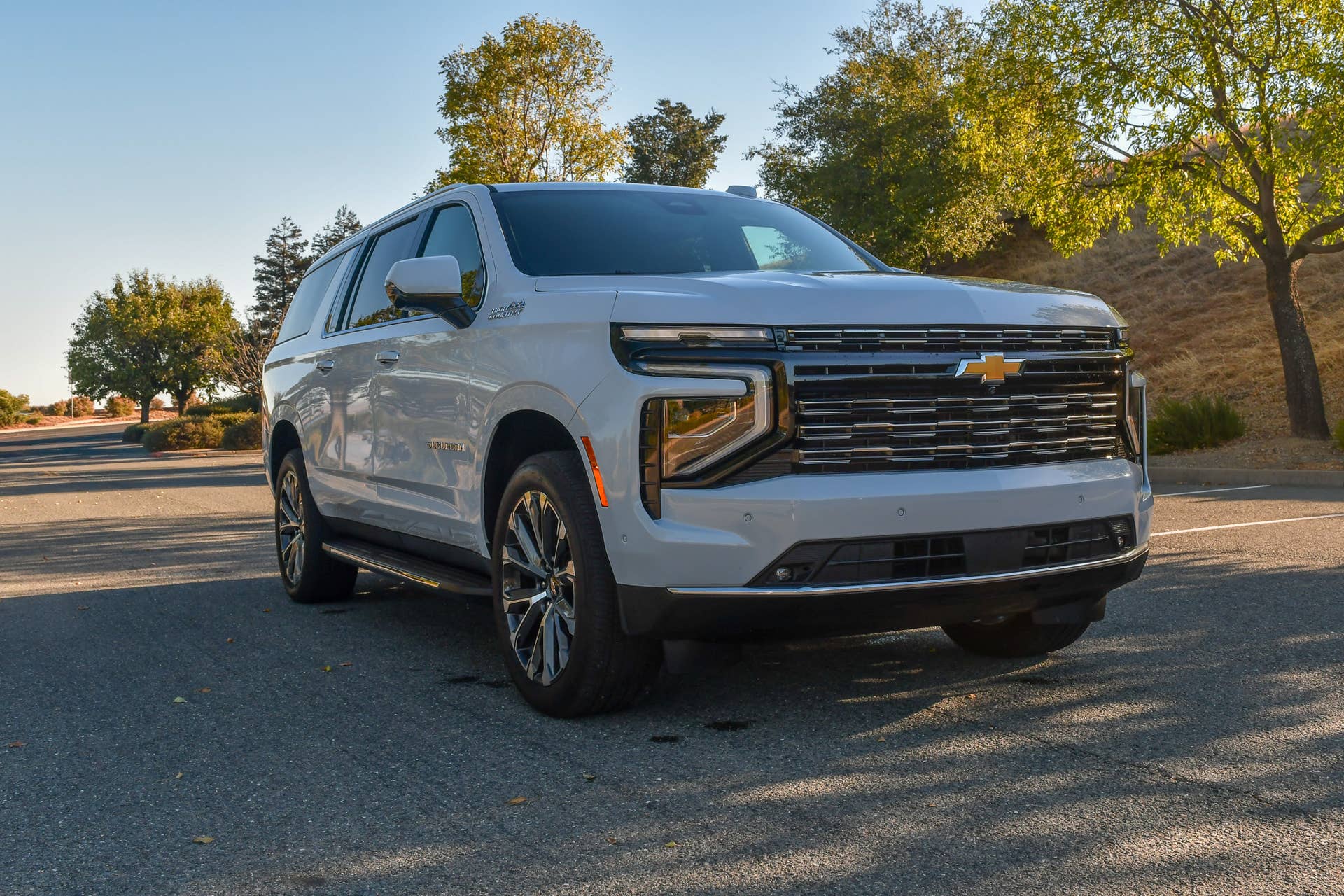
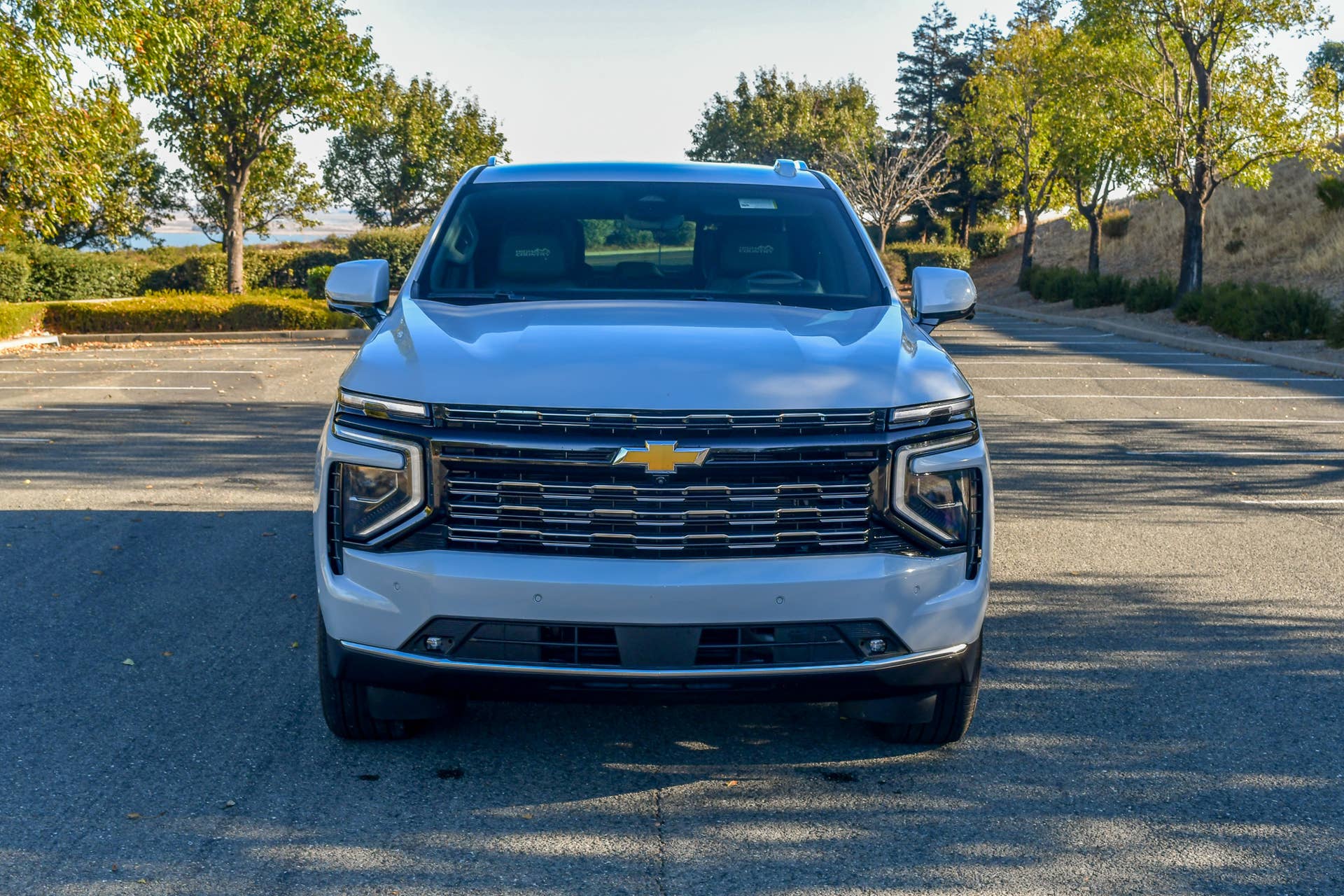
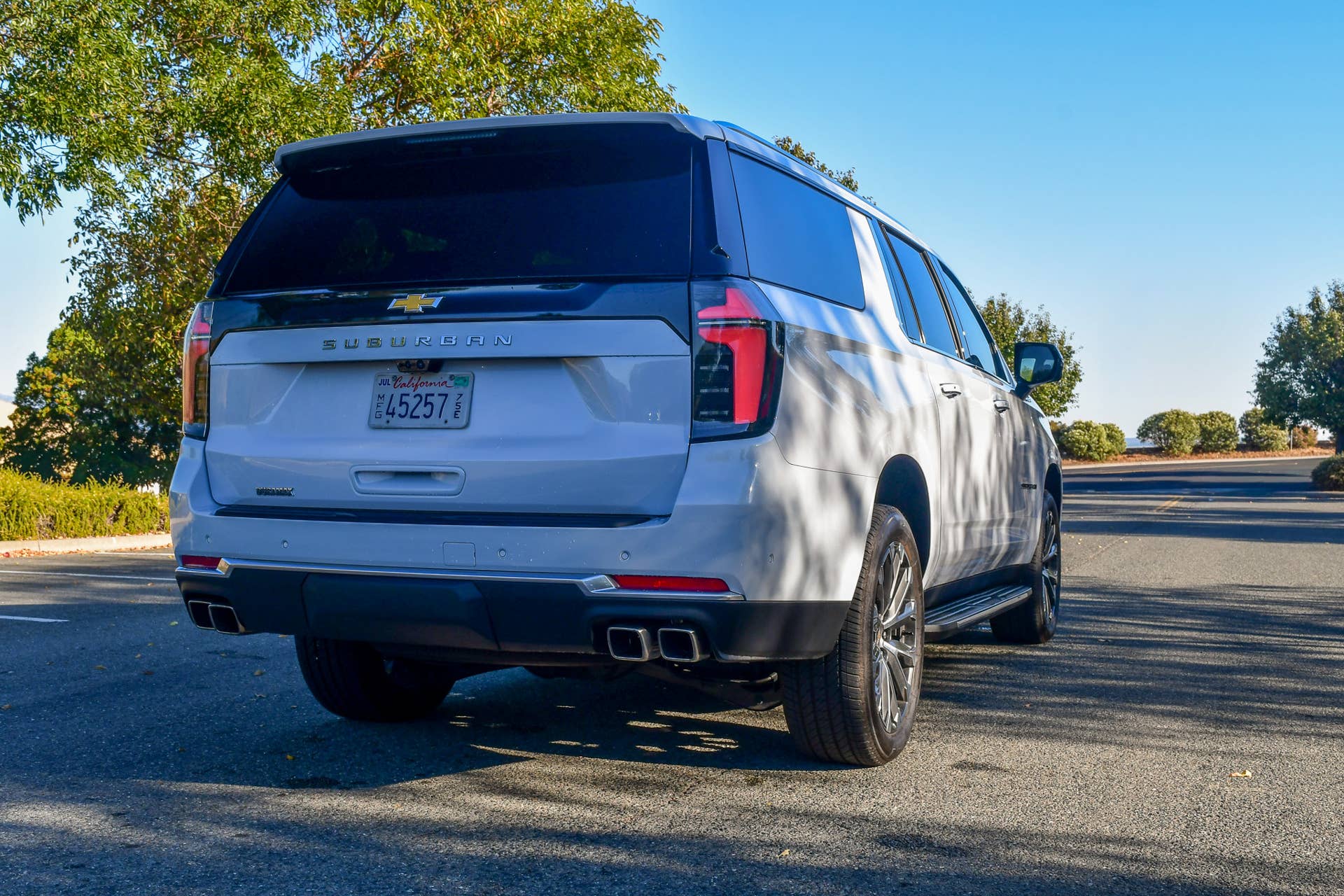
Chevy will happily remind anyone who asks that the Suburban is the longest-running nameplate in automotive history, and it has never once tried to fly under the radar. Measuring 226.3 inches stem-to-stern, 81.1 inches wide, and over six feet tall, this isn’t an SUV that slips into a parking structure unnoticed. But with massive exterior proportions comes uncompromising cabin volume—a currency any growing family will gladly trade curb appeal for. Though you do get both with the High Country.
Kristen Brown
What set my tester apart from the sea of Disneyland sticker-clad Suburbans crawling the Bay Area was what lived under the hood: the 3.0-liter Duramax turbo-diesel. Sure, seeing diesel prices tick north of $8 per gallon, local unleaded can give California drivers pause, but on the road, the powertrain just makes sense. Capable of towing well over 8,000 pounds without breaking a sweat, the Suburban succeeds because it never suffers an identity crisis. It’s an unpretentious, heavy-duty road trip weapon, and it knows it.
Let’s talk about interior space and amenities
The High Country proves luxury and family practicality don’t have to fight for dominance. Rather than treating top-tier trim as a badge with softer leather, Chevy bundles the exact conveniences that keep multi-generational road trips quite civilized.
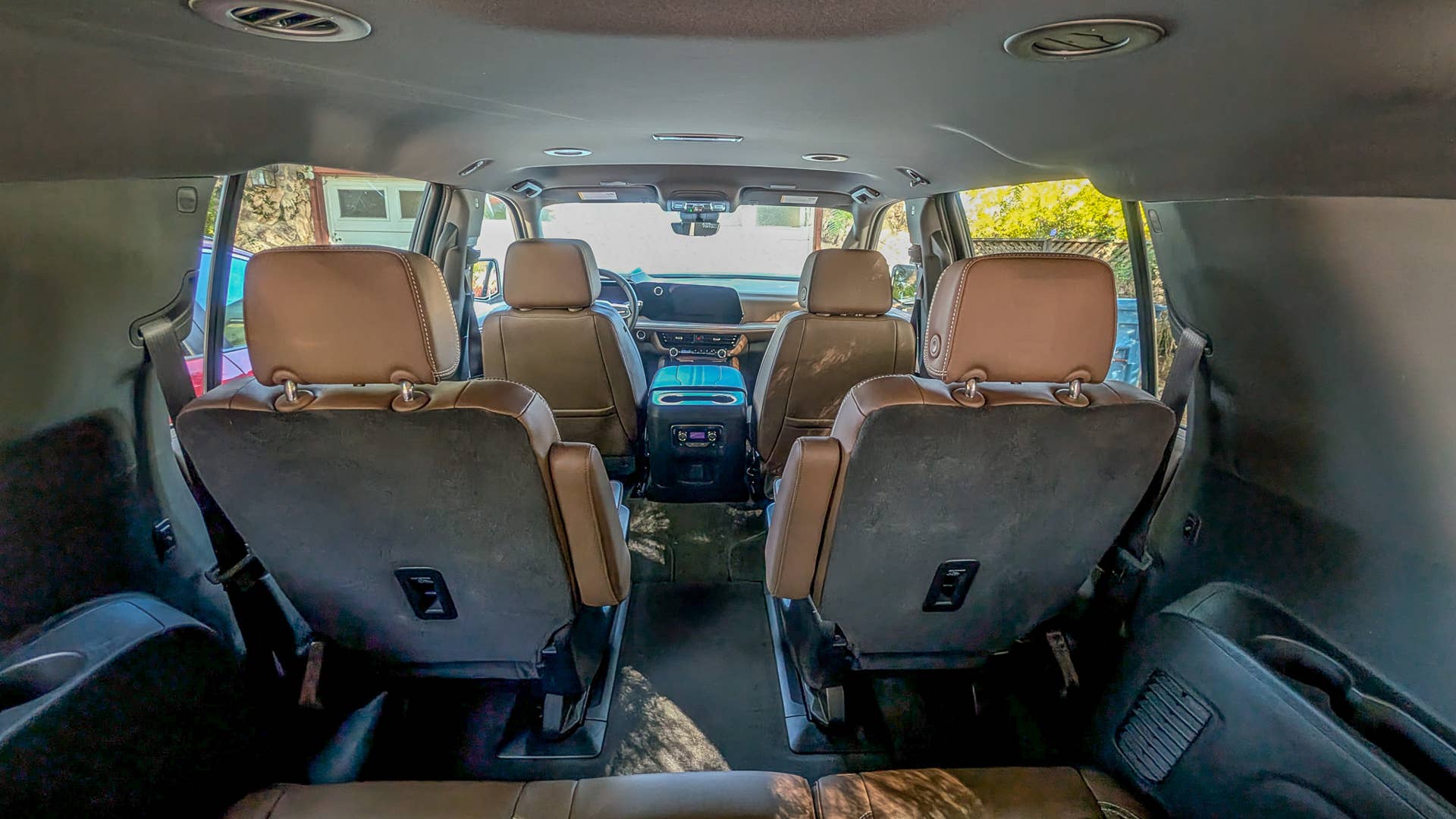
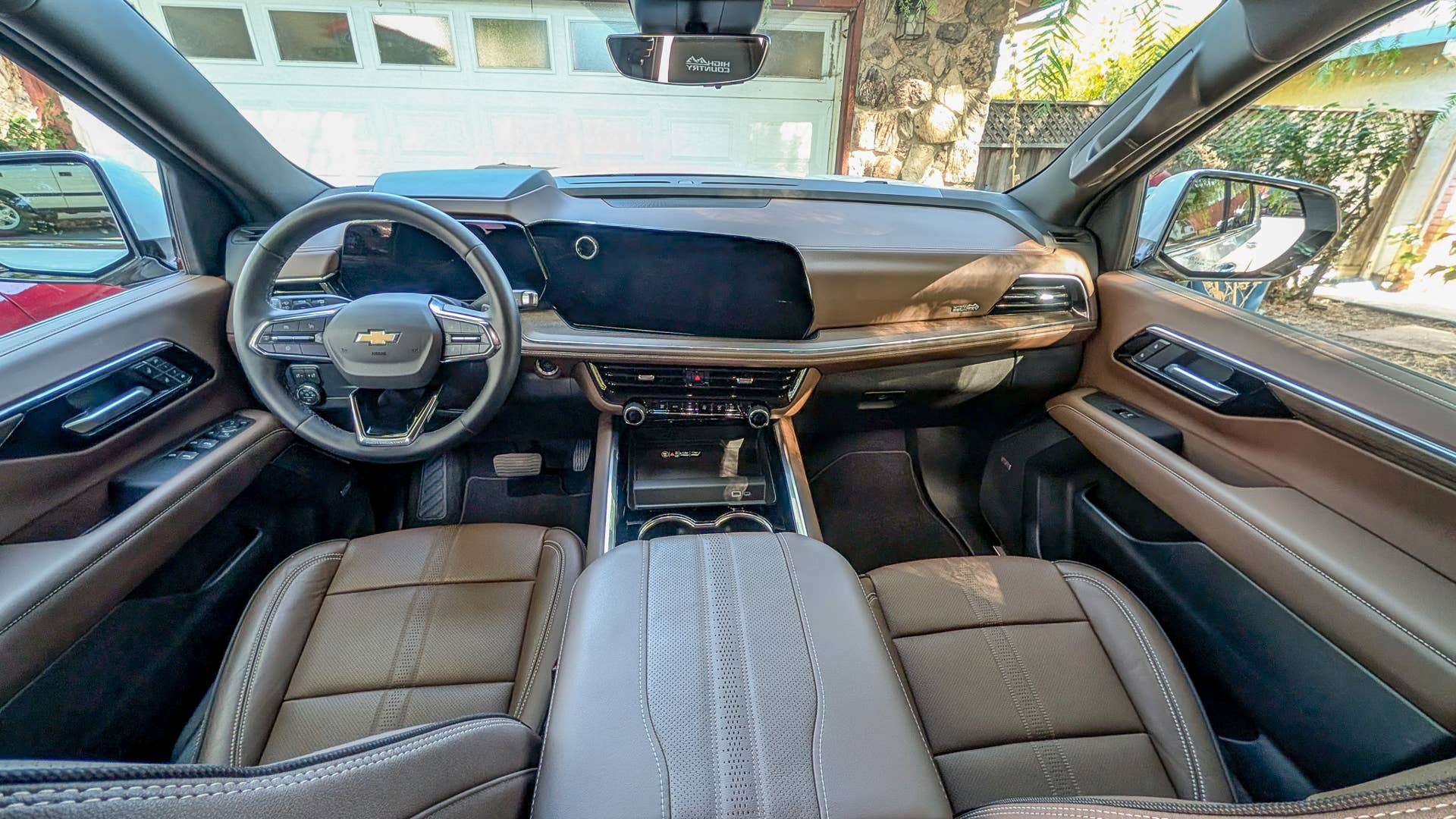
Up front, heated and ventilated perforated leather seats set a premium tone, but the real parent-friendly wins are in back. Tri-zone climate control ends backseat thermostat diplomacy before it starts, and heated second-row captain’s chairs keep tiny passengers with big opinions from complaining about the cold. Better yet, access is effortless: power-release second-row seats make loading car seats, kids, and backpacks past the middle row painless, while power-folding third-row seats eliminate wrestling with heavy bench hardware when cargo needs suddenly expand.
Kristen Brown
Up on the dash, the centerpiece is an intuitive 17.7-inch infotainment touchscreen with Google built-in and wireless smartphone projection, paired with a massive 15-inch head-up display and a crystal-clear rear camera mirror. Standard safety is equally comprehensive, wrapping active lane-keeping, blind-zone steering assist, surround-view parking cameras, and cross-traffic braking straight into the base MSRP.
Kristen Brown
At this price point, that all-inclusive packaging matters. You aren’t starting with an empty shell and nickel-and-diming your way to usability through five-figure option packages—the High Country delivers a fully realized, luxury family hauler right out of the box.
Related: Chevrolet Suburban Vs. Ford Expedition: Which One Has More Cargo Space?
The numbers are definitely in the Suburban’s favor (dimension-wise, I mean)
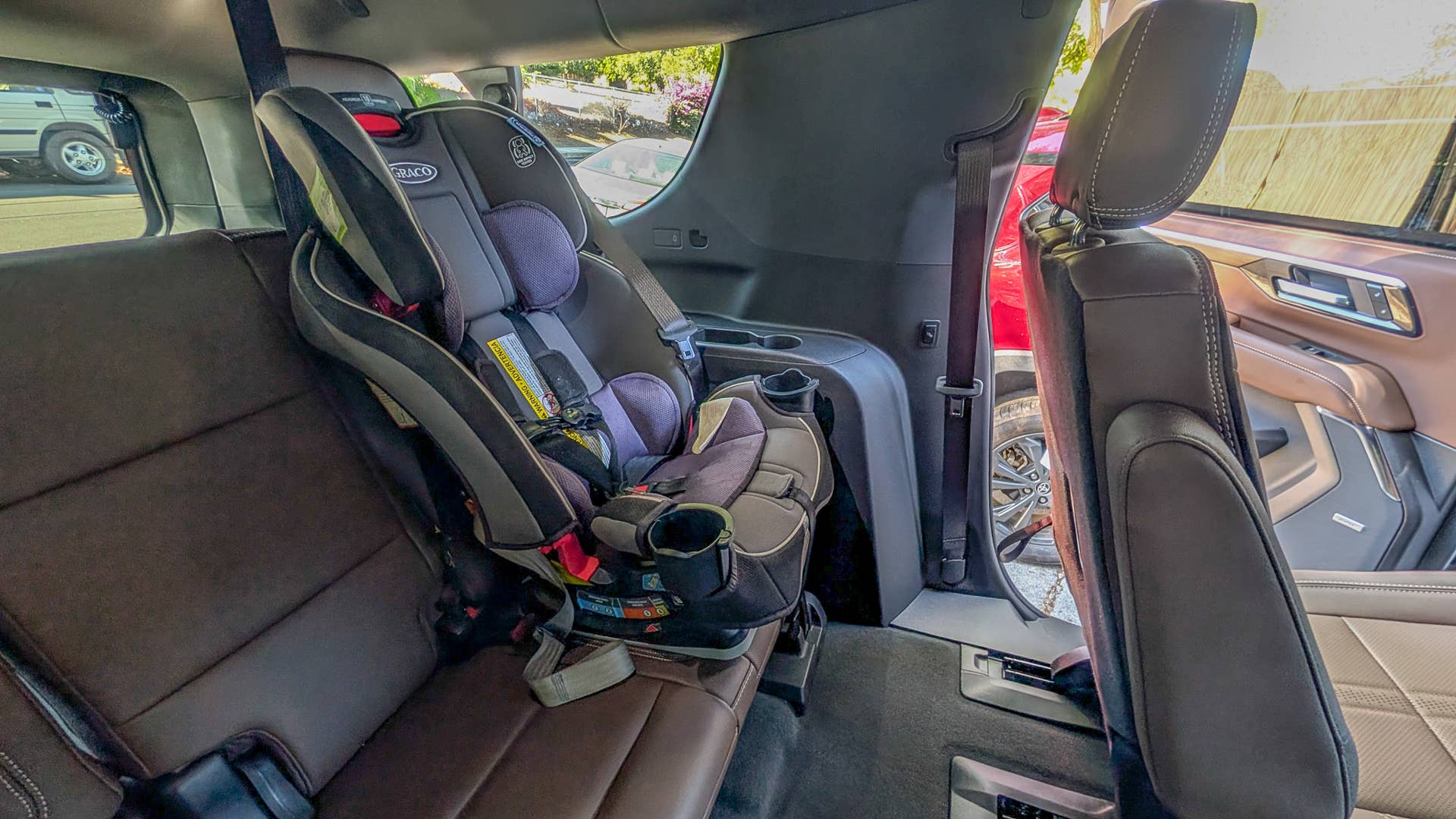
Second-row passengers enjoy a limo-like 42.0 inches of legroom, leaving plenty of breathing room even behind bulky rear-facing infant seats. But the third row is the real triumph: with 36.7 inches of legroom, a flat floor, and a properly elevated seat cushion, adults and growing teenagers can ride back there for hours without their knees crammed into their chins.
Kristen Brown
The biggest game-changer for traveling families, however, is what happens behind that third row. Most 3-row SUVs force an impossible choice between carrying people or carrying luggage, but the Suburban provides a cavernous 41.5 cubic feet of dedicated cargo space with every single seat in use—beating out the extended Ford Expedition MAX’s 37.4 cubic feet and utterly embarrassing standard three-row crossovers that hover around 16 to 20 cubes. That means double strollers, hard-sided suitcases, coolers, and backpacks swallow into the back without blocking the rear-view mirror or requiring an overhead roof box.
And when you drop the power-folding second and third rows, you unleash a respectable 144.5 cubic feet of maximum volume, essentially turning this luxury cruiser into a weather-tight cargo van ready for furniture runs, camping gear, or whole sheets of plywood.
Now for the loud elephant in the room: the diesel engine
On paper, the 3.0-liter Duramax turbo-diesel might look like an underdog with 305 horsepower next to the 6.2-liter V8’s 420 hp, but those in the know understand horsepower isn’t what matters. The Duramax cranks out an impressive 495 lb-ft of torque at just 1,500 RPM, out-pulling the big 6.2L V8 (460 lb-ft at 4,100 RPM) and thoroughly dusting the base 5.3L V8 (383 lb-ft at 4,100 RPM). While max tow ratings are virtually neck-and-neck across the board, topping out around 7,800 to 8,100 pounds depending on drivetrain, the experience of towing with the diesel is in a league of its own.
Kristen Brown
For families who regularly hitch up a horse trailer, a 26-foot camper, or a car hauler, that instant off-idle torque provides silky-smooth acceleration that won’t jostle livestock or wake sleeping kids when something’s on the hitch. On the highway, the diesel holds taller gears up steep grades without the transmission hunting and screaming revs typical of gas V8s, while an integrated exhaust brake effortlessly manages downhill speeds to prevent brake fade.
Add in significantly better fuel range that spares you from maneuvering a long trailer through cramped gas stations, plus the shocking fact that selecting the Duramax actually knocks $1,500 off the High Country’s sticker price compared to the standard 6.2L V8, and it becomes a no-brainer powertrain for anyone serious about towing for the long haul (see what I did there?).
Compared to its competitors, it’s an all-inclusive unicorn
When sizing up full-size, three-row heavyweights, the Suburban High Country Diesel stands alone as a unicorn: it is one of the only full-sized SUVs left on the market that you can buy with a diesel engine.
The Ford Expedition MAX is its closest rival, but matching the Suburban’s standard equipment and capabilities means climbing into King Ranch or Platinum territory that easily blows past $88,000 to over $100,000. Even on lower trims, Ford traps you in an expensive option-package maze—forcing you to pay extra for a Heavy-Duty Trailer Tow Package just to unlock full towing capacity. The Jeep Grand Wagoneer L quickly catapults into six-figure pricing with a gas-hungry twin-turbo six, while the Toyota Sequoia lacks an extended wheelbase altogether, offering a cramped third row and minimal cargo space. Neither Ford, Jeep, nor Toyota offers a high-torque, long-range diesel at any price.
Kristen Brown
That is where the Suburban’s real value shines. You don’t have to pay a luxury tax or check five different option boxes just to get integrated towing hardware, 360-degree cameras, and power-folding third-row seats. You get a fully loaded family hauler with 495 lb-ft of diesel pulling power, exceptional range, and sprawling space—all bundled straight out of the box for less money than the competition.
Related: Chevrolet Tahoe And Suburban Diesel Owners Get A 150,000-Mile Repair Lifeline
I ended up feeling convinced I needed one
Watching Jingle All the Way as a kid, every time Schwarzenegger’s Suburban appeared, my mom would nudge my dad: “Can you buy me one of those? I want one so bad.” I was hooked, too—the massive stance, the sightlines, the sheer road presence. Decades later, the Suburban is still the It Girl. It delivers on every promise. When my husband recently started shopping for a truck to haul our Wrangler to the trail, I didn’t suggest a pickup. I asked, “What about a Suburban?”
Very few vehicles on the road today have stayed this true to their original blueprint for nearly a century. With the Duramax diesel giving it heavy-duty towing muscle and an interior that comfortably sat three generations and all their gear, the 2026 Suburban proves that Chevy didn’t just fill a historic gap, it built an institution that rivals still struggle to match.
2026 Hyundai Kona Limited Review: Lots of Goodies, a Little Less Aloha
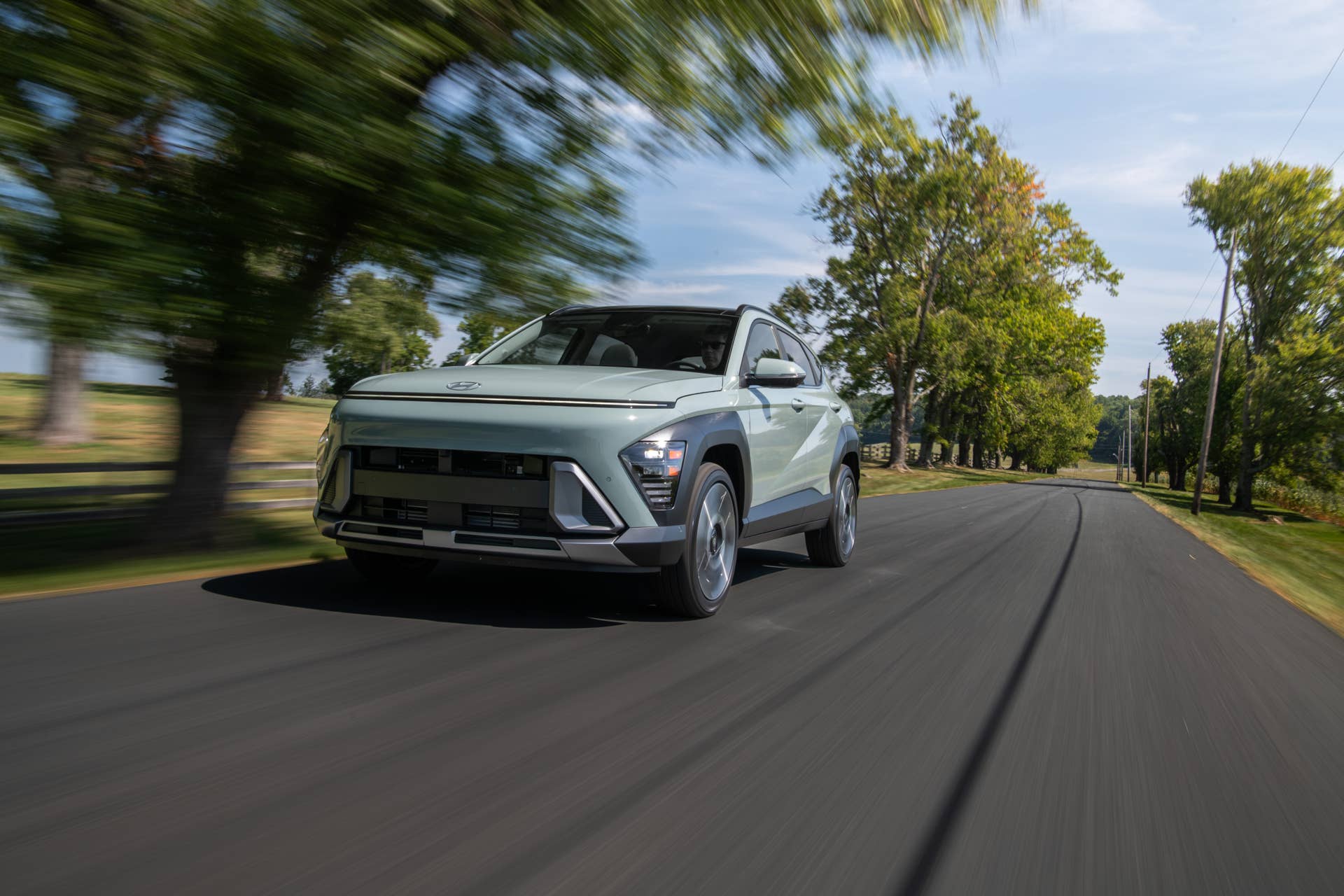
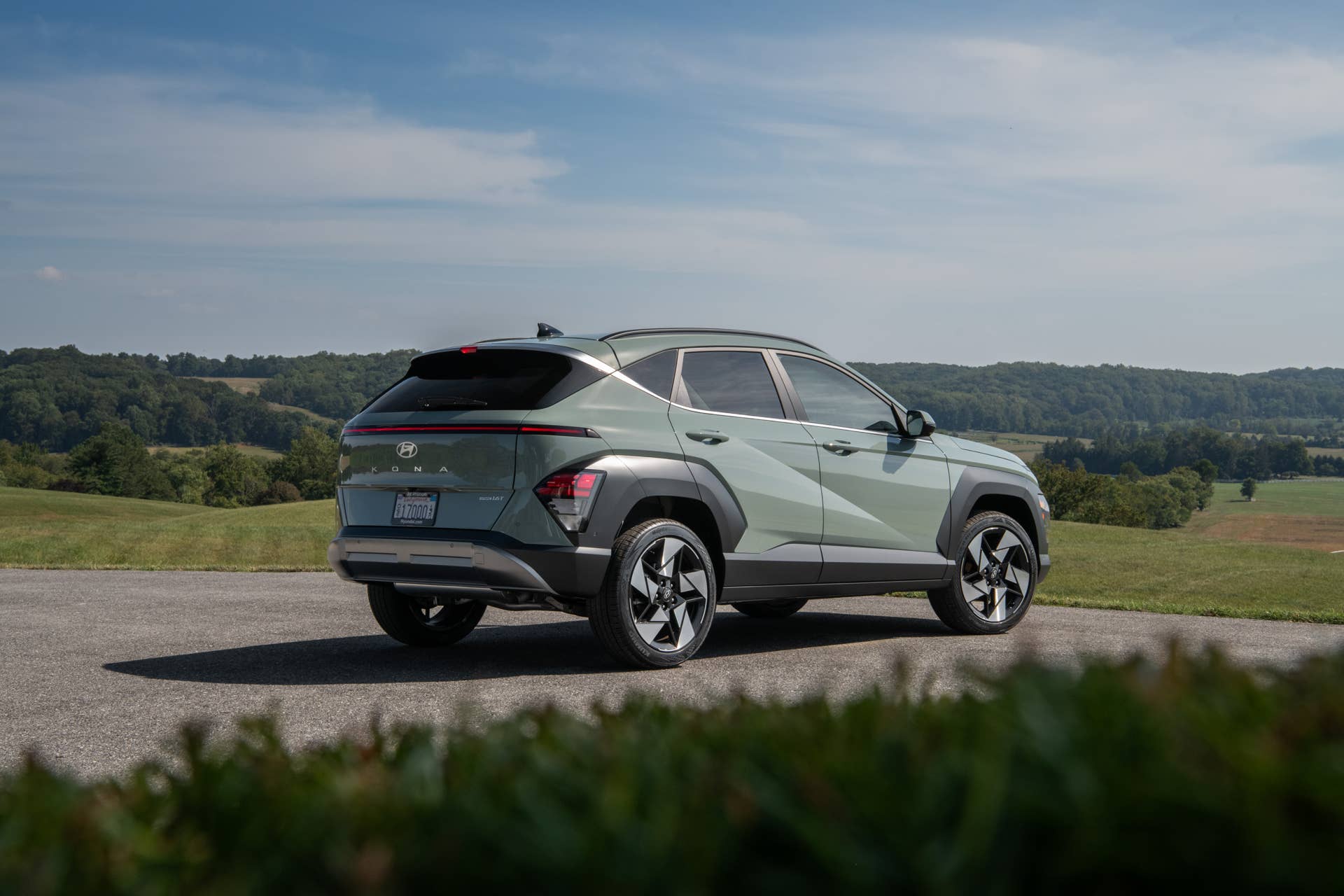
The Hyundai Kona arrived for the 2018 model year as the smaller sibling to the Tucson. It has since grown into a more substantial little SUV, which puts it in the same conversation as the Kia Seltos, Subaru Crosstrek, and Mazda CX-30. I’m especially fond of the Mazda because it reminds me that an affordable crossover can still be fun to drive. The Kona takes a different approach. It offers generous space, a long list of features, and, in Limited trim, enough power to keep the driving experience from feeling like homework.
Hyundai
There’s a sizable gap between the least and most expensive gas-powered Konas. The SE starts at $25,500, while the Limited starts at $32,535, both before freight and other charges. That’s still a reasonable entry point, but a Limited with all-wheel drive can move into the mid-$30,000 range quickly. At that price, I expect more than a handsome face and a large screen. Fortunately, the Kona has more than one trick up its sleeve.
Hyundai
Powertrain and performance
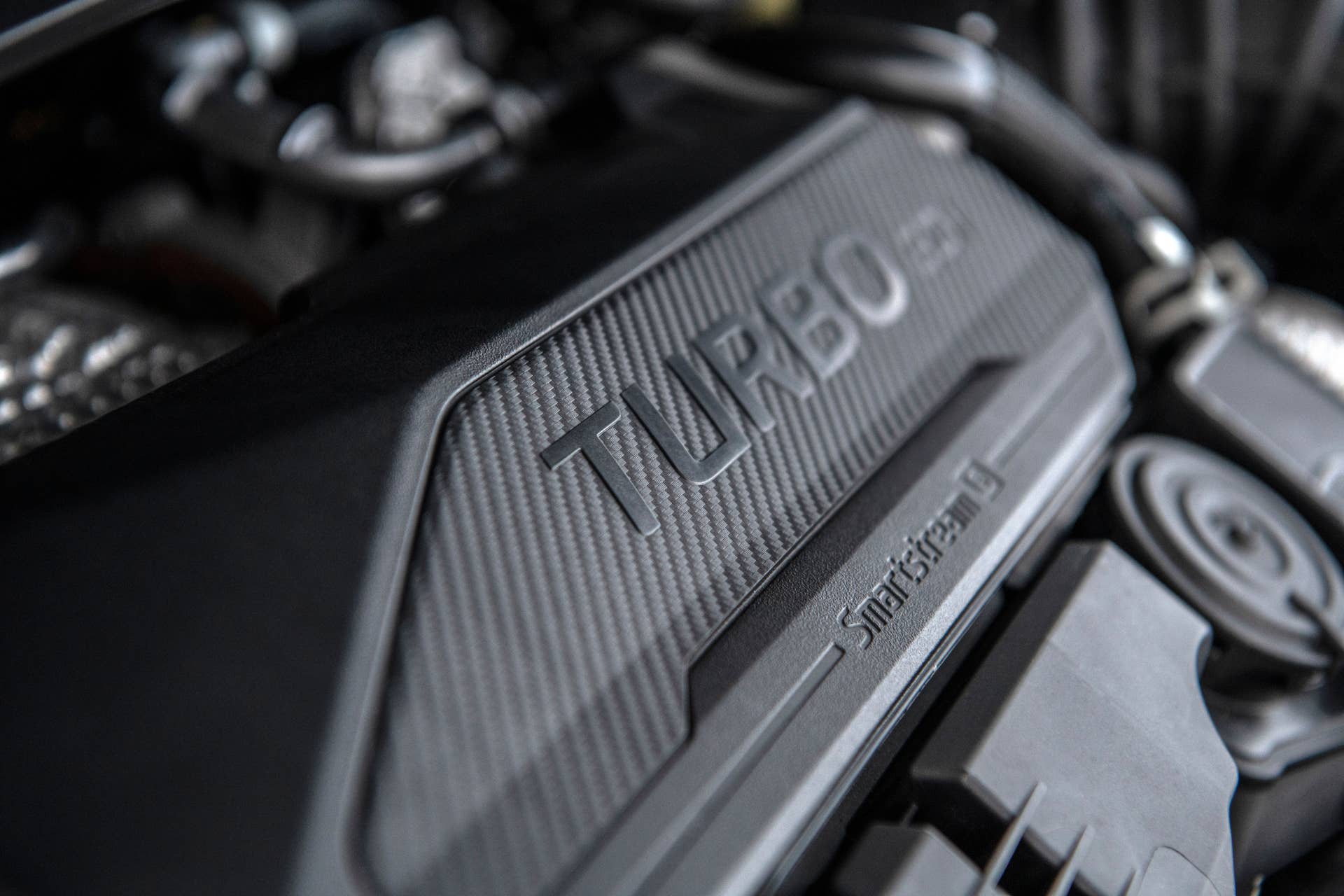
The standard 2.0-liter four-cylinder makes 147 horsepower and 132 pound-feet of torque and is paired with Hyundai’s Intelligent Variable Transmission. It’s the sensible choice if the purchase price matters most. The Limited gets a 1.6-liter turbocharged four-cylinder producing 190 hp and 195 lb-ft, along with an eight-speed automatic transmission. That is the combination I’d choose. The additional torque gives this small SUV a welcome dose of enthusiasm, and I’d rather have the conventional automatic than the variable transmission when I’m asking the engine to get moving. Front-wheel drive is standard, and Hyundai’s HTRAC all-wheel drive is available.
There is a fuel-economy trade-off for the turbo. Hyundai lists the Limited at an EPA-estimated 26 mpg city, 31 highway and 28 combined with front-wheel drive. The all-wheel-drive version returns 25 city, 28 highway and 26 combined. Those are respectable numbers, even if nobody is going to mistake this for a fuel-sipping hybrid. The reward is a Kona that feels better suited to highway merging and passing than the base model’s output suggests.
Would I call it the most engaging vehicle in the class? No. For that, I’d still point you toward the Mazda CX-30. But there’s a difference between wanting a little more driving enjoyment and demanding that every grocery run feel like a qualifying lap. The turbo Kona has enough punch to make ordinary driving more pleasant, which is exactly what I want from an everyday vehicle.
Hyundai
View the 3 images of this gallery on the
original article
Interior, technology and utility
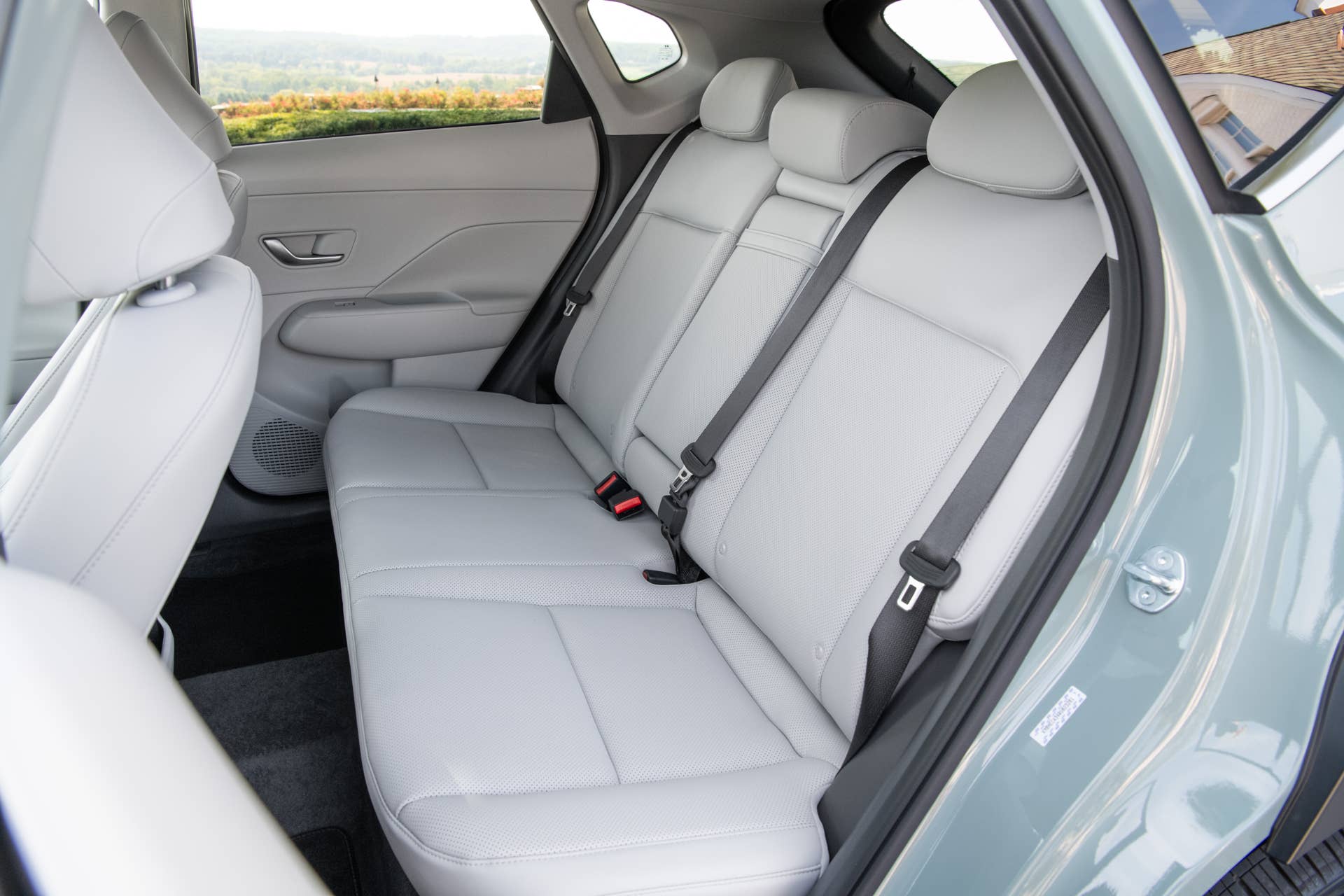
The Kona makes excellent use of its size. There are 25.5 cubic feet of cargo space behind the second row and 63.7 cubic feet with the rear seats folded. That’s useful room for luggage, shopping and the miscellaneous cargo that somehow accumulates the moment you own a vehicle with a hatch. Compared with Hyundai’s smaller Venue, the Kona feels like the more practical choice for someone who regularly carries passengers and their belongings. The rear seats also recline and split 60/40, giving you a little more flexibility than the exterior dimensions might suggest.
The Limited piles on the creature comforts. It has heated and ventilated front seats, H-Tex upholstery, a power driver’s seat with lumbar adjustment, dual-zone climate control and rear air vents. The hands-free power liftgate is another feature you’ll appreciate most when both of your hands are occupied. Up front, the broad digital display arrangement gives the cabin a more expensive appearance, while wireless Apple CarPlay and Android Auto keep everyday phone use simple. Bose audio, wireless device charging and a digital key add to the impression that Hyundai was determined to fit as much equipment as possible into this trim.
Related: Before the Cars, Kia Mobilized South Korea on Bicycles
I’m also glad Hyundai kept physical climate controls. I don’t need to conduct a touchscreen treasure hunt just to turn down the fan. The Limited’s surround-view camera and blind-spot view monitor add practical value, especially in tight parking lots. Technology is wonderful when it saves time or prevents a mistake. It is less wonderful when it makes me stare at a menu while the windshield fogs up.
Final thoughts
The 2026 Kona Limited makes a strong case for itself as a well-equipped, useful small SUV. Its turbo engine and eight-speed automatic are the powertrain to get, its cargo space is genuinely helpful, and the cabin includes features I once expected to find in considerably more expensive vehicles. Hyundai’s 10-year/100,000-mile limited powertrain warranty is another persuasive point, provided you pay attention to its terms.
Still, I wouldn’t buy one without driving the Mazda CX-30. That car offers a more connected feel, while the Kona makes its pitch through room, equipment and everyday ease. Which one wins depends on what you value once you’re behind the wheel. For me, fun still counts for an awful lot, but I can’t ignore how much the Kona gives you for the money.
It’s a smart, capable little SUV. I only wish something called Kona brought a bit more aloha to the drive.
Related: 2026 Mazda CX-30 2.5 S Aire Edition Review: A Little Crossover With a Lot of Personality
2026 Dodge Charger SIXPACK vs. EV: Which Powertrain is Best?
When the V8-powered Dodge Charger was discontinued in 2023, there was an expected uproar among muscle car enthusiasts. Though that wasn’t the first time the famed muscle car had been on the guillotine. The first time was in 1978; then it was brought back in 1983, only to be discontinued again in 1987; then it was brought back in 1988; then shafted again in 2005, where it stayed a staple until 2023 (at least the V8-powered one; Stellantis made sure to mention an EV was coming). I started to think the Charger name was cursed.
Kristen Brown
View the 2 images of this gallery on the
original article
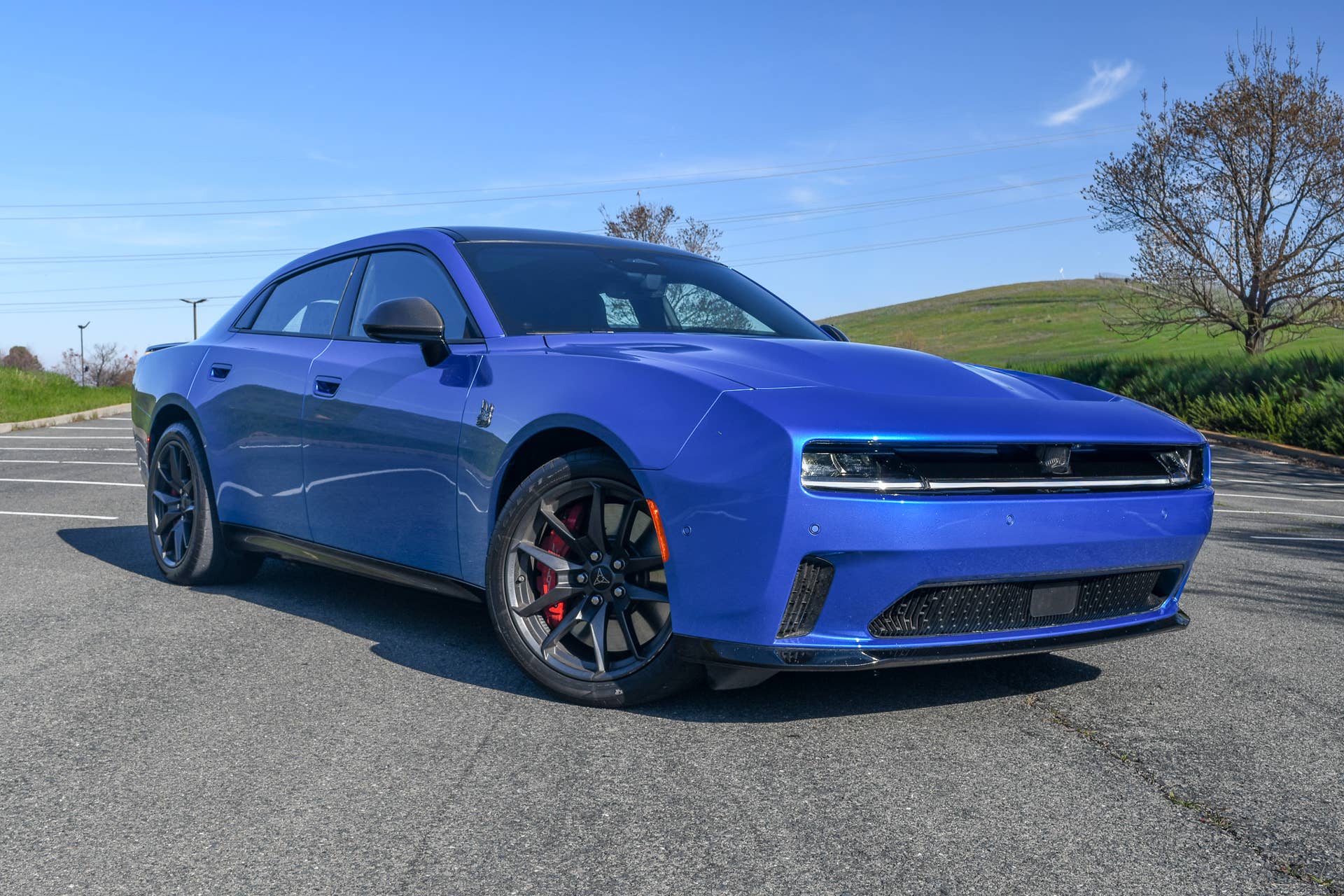
The silk curtain was drawn back from the first all-electric Dodge Charger just one year later, and naturally, it came with mixed reactions. Mostly bad ones, even though it came with all-wheel drive, up to 630 horsepower as the Scat Pack variant (469 as the R/T), and four- or two-door configurations. Dodge was careful to maintain the classic Charger looks; it’s bigger than previous generations, and it came with some seriously impressive track-ready software. The gas-only Hurricane-powered version came shortly after, thanks to some heated demands from Mopar lovers. Now that I’ve driven both, I can say one is most certainly better than the other. But it’s not the one you’re probably thinking of.
Related: Road Ethos Launches: The New Automotive Lifestyle Site You Should Read
First, let’s break down the EV details
The all-electric Dodge Charger gets so much more hate than I think is deserved. If anything, it suffers from the same criticism the Mustang Mach-E did. While the Dodge Charger EV isn’t an EV SUV that borrows the name of an iconic pony car, it does disconnect incredibly far from the moniker’s legacy in terms of propulsion. The Charger saw a few V6s throughout the years, but the Charger was well-known for its ridiculously high-output HEMI V8s. So, taking out the guzzling, loud and proud V8 and replacing it with two electric motors felt sacrilegious to many.
Kristen Brown/Autoblog
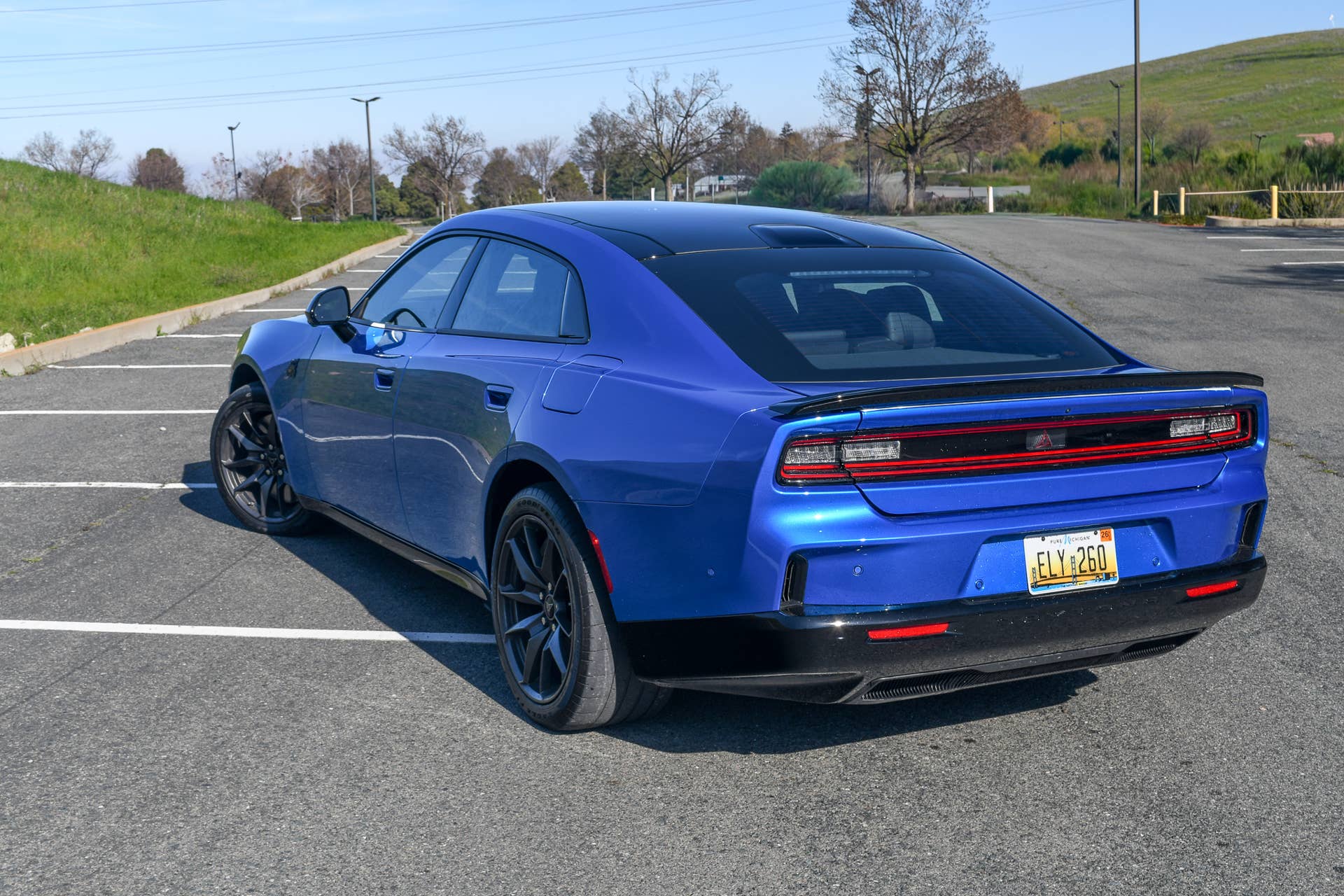
With that in mind, I do feel like, once you look past the heritage of the Charger name, the EV version has a hell of a lot to offer. I reviewed the Daytona Scat Pack model, which is the highest tier you can go. For $70,345, here’s what you get over the gas-only model:
- Horsepower Aplenty: The standard EV charger, the R/T, makes 496 horsepower and 404 lb-ft of torque, while the Daytona Scat Pack makes 630 horsepower and 627 lb-ft of torque. If you use the PowerShot button, you get a temporary boost of 40 horsepower, bringing the total to 670. But only for a short period.
- Track-Ready Drive Modes: The all-electric Daytona Scat Pack comes with two noteworthy modes: Donut and Drift Mode. They do exactly what you think they do. Either mode moves the motors’ torque where it needs to be in order to achieve either driving stunt. I didn’t test these modes, but I’ve seen videos, and it looks amazing. The gas-only version doesn’t have these modes, but you can essentially disable the front axle to make it RWD if you wanted to.
- Usable Driving Range: The Daytona Scat Pack I reviewed had a maximum range of 241 miles. Notably less if you fit it with the factory summer tires.
- Fast Charging: It’s optimized for DC fast charging up to 183 kW, going from 20% to 80% in about 27 minutes. It comes with a CCS port, but you can get an NACS adapter from Dodge if needed.
- Frunk Space (For a Price): The Charger is already built with impressive cargo figures, but the EV comes with a frunk instead of an engine. It adds 1.5 cubic feet of space, but you need the Plus Group package to get it, which costs $4,995.
- Smoother Driving: The gas-only model has an automatic 8-speed transmission, which I found to be incredibly harsh when shifting, and it felt very clumsy. The EV’s one-speed “transmission” was smooth and effortless, no matter how you drive it.
- It’s Cheaper to Refuel: Only if you can charge from home, but it’s still worth mentioning. Study after study shows that charging at home only costs about $0.04 to $0.06 per mile (or $35 to $61 per month), while gas cars cost between $0.10 to $0.15 per mile (or $120 to $180 per month). If you have to rely on public charging, that cost per mile for EVs jumps significantly, making it just as expensive or more than gas, depending on the EV, which charging company you’re using, how often you’re charging, and even when you’re charging.
What’s so different about the gas-only model?
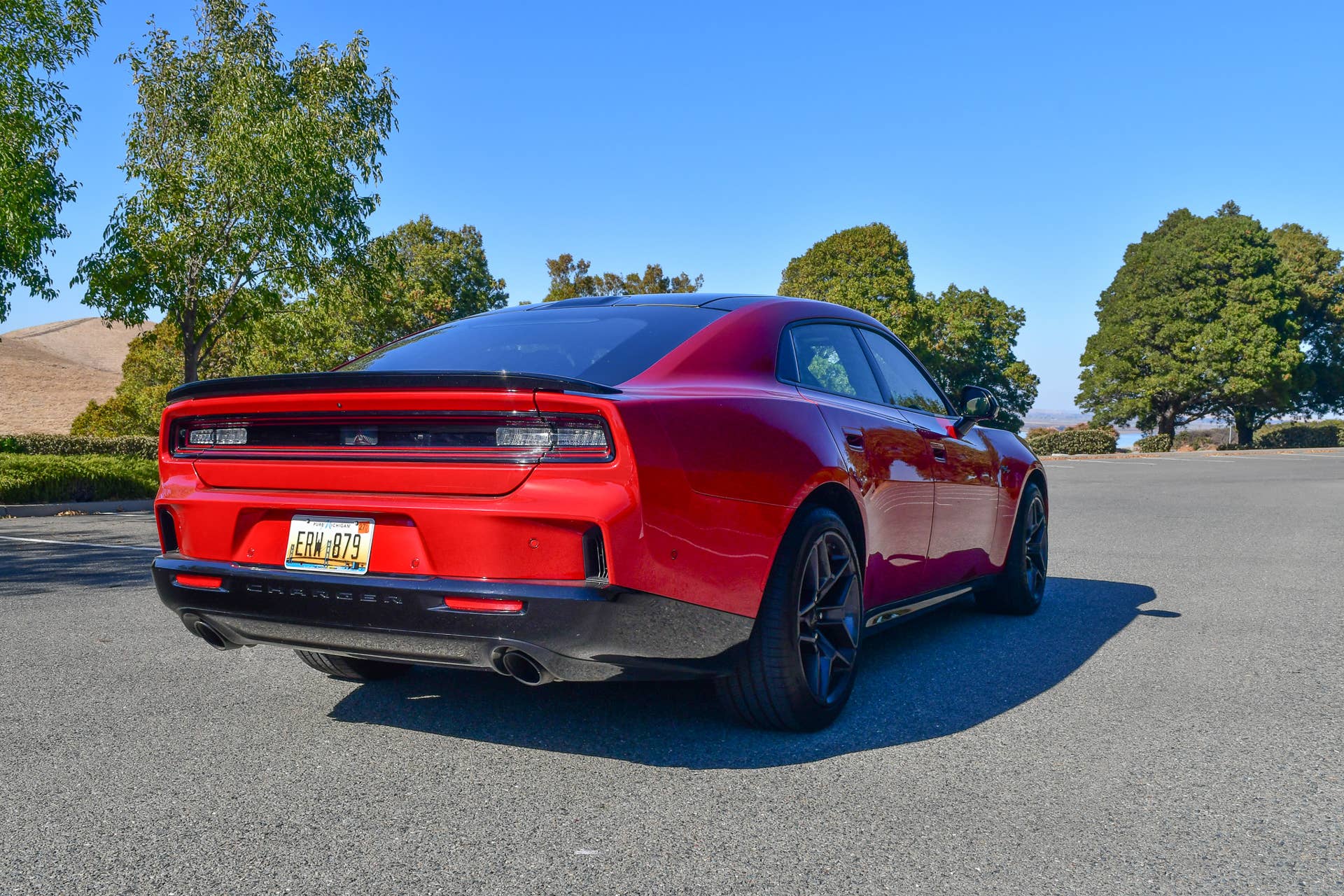
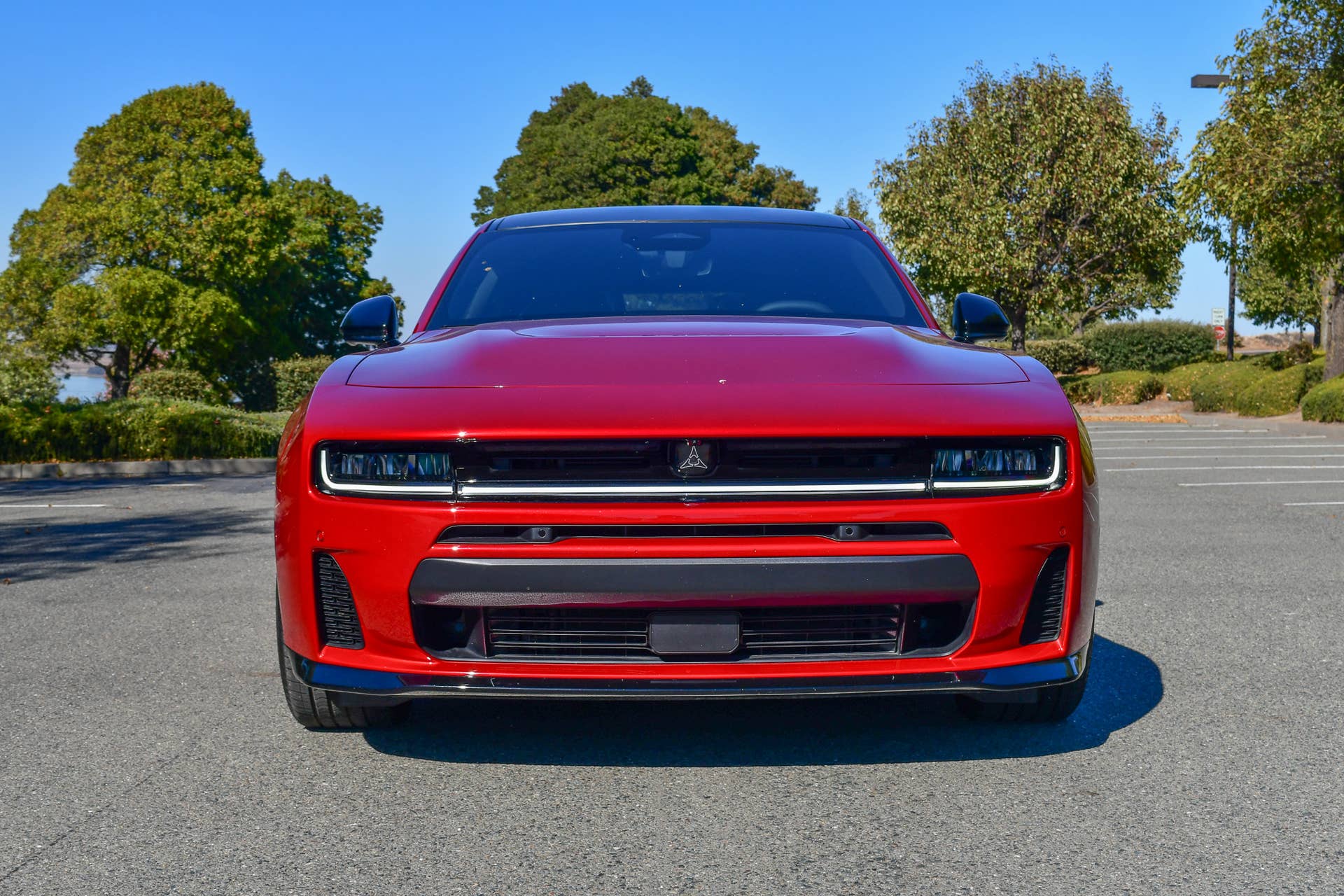
The Dodge Charger, regardless of what it’s powered by, shares the same looks, the same touchscreen, the same software, the same rear legroom dimensions, and the same interior amenities. They’re even similarly priced. But there are a few notable differences between the SIXPACK and the Daytona Scat Pack EV.
Kristen Brown
For $67,160 (just $3,185 less than the top-tier EV), this is what you can expect over the electrified version:
- Pony Variation: Like the EV version, there are two ways to slice the Hurricane twin-turbo inline 6: The SO, which stands for “Standard Output,” offers 420 horsepower and 468 lb-ft of torque. The HO, or “High Output” option, boosts the horsepower to 550 horsepower and 531 lb-ft of torque.
- You Can Go Farther: Dodge’s website claims that the gas-only maximum range on a full tank is close to 500 miles if you’re doing mostly highway driving, as the average MPGs in that case are around 26. I’m not sure I believe that, as most of my driving was on the highway, and the range I saw was 322 miles. Which is still further than the EV.
- Natural Sound: The Daytona Scat Pack EV has a fake exhaust that you can hear looping if you listen close enough. It’s a fun feature that adds personality, and you can adjust the loudness (or even turn it off completely) if you want to, but you can’t beat the natural roar from a thirsty, roarin’ gas-only engine.
- Better Track Behavior: I’ve seen a few reviewers drive both on the track, and while the EV has a faster, smoother transition from zero to sixty, the added weight of the battery certainly changes the dynamics. The gas-only version is lighter, so it’s more maneuverable and easier to control.
- The Gas-Only Version is Cheaper: There are a lot of trims to choose from, because you can opt for either two- or four-door configurations. The two-door R/T version starts at $49,995 and tops out at $59,990 for the Scat Pack. That’s a lot less than the EV, which starts at $59,995 and maxes out at $64,990. Though, as we’ve seen, the price can be over $70,000 depending on packages and add-ons.
Related: 2026 Dodge Charger EV: Is it More Than Just a Gimmick?
What do they have in common?
I’ve said it a few times by now, but they share literally everything save for the propulsion method and price. Both are roomy, large, and surprisingly practical. The trunk of the EV version surprised me and my mother-in-law, when both of us were able to fit our Costco hauls in the trunk. Because the wheelbase is long and it has a rear hatch door, there’s tons of space at your disposal. The rear seats are comfortable; it was easy to get my daughters’ car seats into either model, and there was plenty of legroom for adults with rear-facing A/C vents, USB-C charging ports, and cupholders for everyone. Both my husband and I were shocked by how much practicality was packed into a muscle car’s body.
Kristen Brown
And they’re both so much fun. My daughters enjoyed both, though I’d say the gas-only version was their favorite because it came in the Redeye color instead of the Bludicrous color. They also liked how loud the gas-only version was compared to the EV. Both have very easy-to-use software and interior controls. They’re essentially dummy-proof. I enjoyed both thoroughly.
With that, I’d pick the EV—because it’s more reliable
Listen—I was just as shocked to learn that I’d pick the EV over the gas-only version, but I have a few reasons. First being the fact that EVs are more reliable. Their systems are relatively simple compared to today’s gas engines, and I have a personal beef with whoever decided to not put an engine oil dipstick in the new Charger. Here’s why:
The day after it was delivered to me, I decided to drive it to the gym. As it rumbled to a start, I got an alert on the dashboard that read, “ENGINE OIL LOW. ADD 1 QT SOON.” I had to dismiss the message, and then a light was permanently illuminated on the dash. I decided not to drive it to the gym, for fear I’d do harm to the engine. I asked my husband, who’s an ASE Certified Advanced Level Specialist and a Subaru Certified Master Technician, and asked him about it. His first words were, “It probably doesn’t have a dipstick. I’d call the fleet company.” So, I did. They sent someone out, who verified there wasn’t a dipstick to check and had to go through the computer. The computer said it was indeed a quart low—at only 3,000 miles—and left a quart with me. While I was driving to the gym later, the car alerted me that it was “CRITICALLY LOW” and showed one bar below empty. It didn’t update to its previous reading of 1 quart low until I parked it at the gym, which told me that it freaked out from being parked on an inclined driveway. You wouldn’t have to worry about that with the EV.
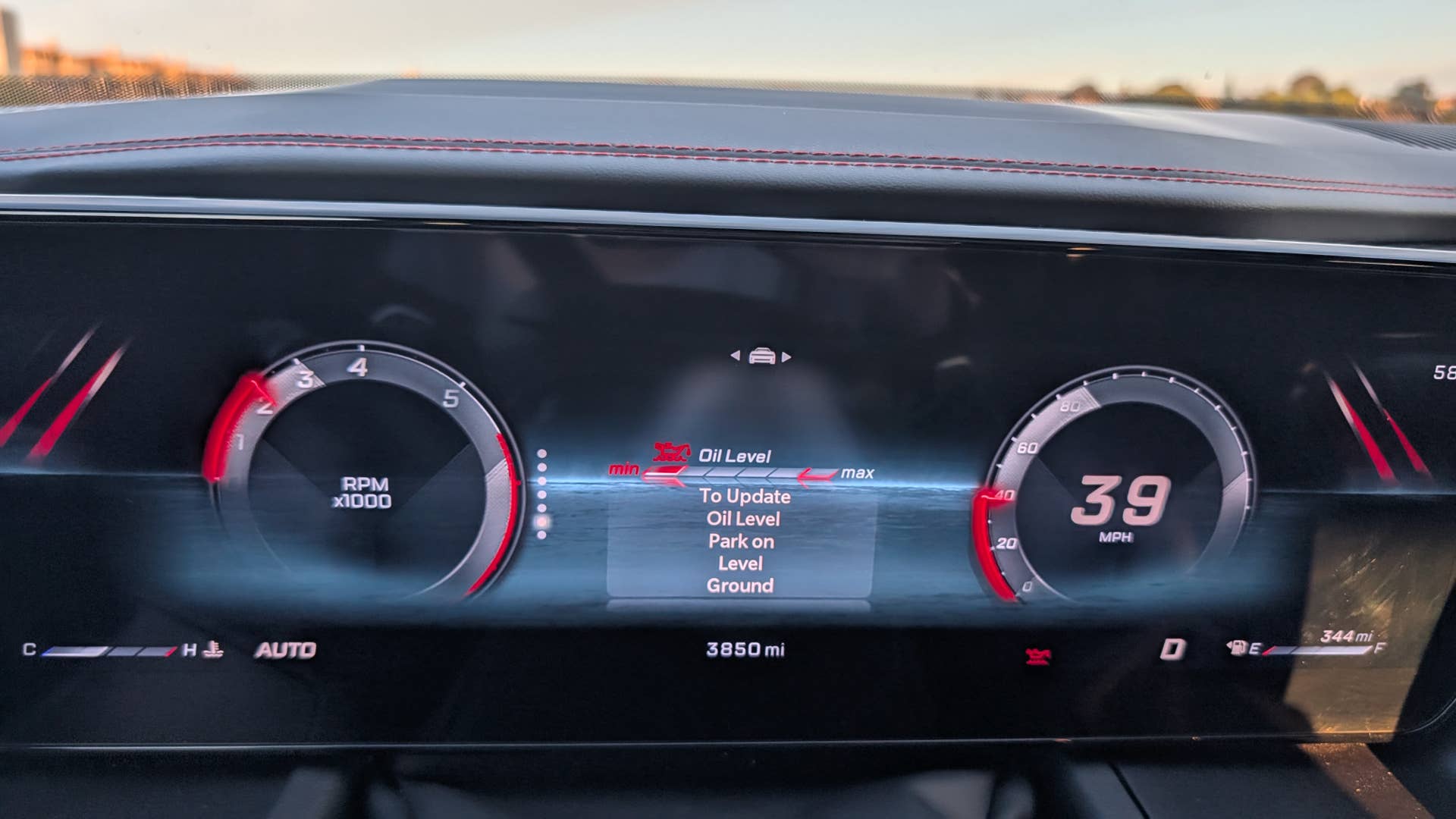
Kristen Brown
At the end of my week with it, it’s still reading low. And because there’s no dipstick, I have to rely on the computer (which has already proven to not be reliable, since it can’t tell the difference between being parked on an incline or not) to check on the level.
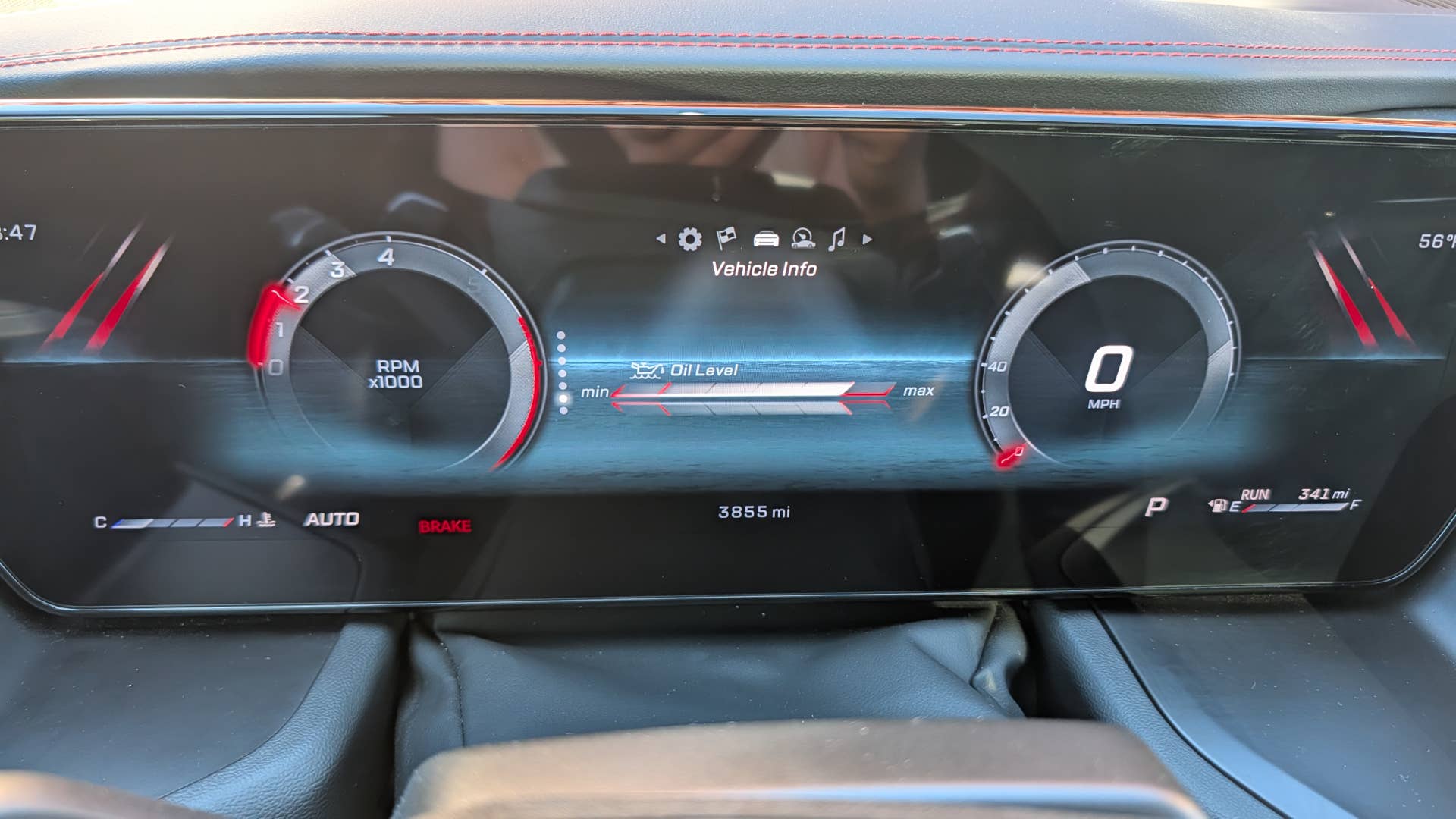
Kristen Brown
Also, the transmission in the gas-only version felt… Funky. At slow speeds, even in Eco mode, it would rev high and then shift into the lower gears, but it would do it very aggressively. If you wanted to, say, put the pedal to the metal before you get onto the freeway, the engine would make a ton of noise before the transmission seemed to engage. And when it did, it did very aggressively. It didn’t feel right at all. And, to be fair, given its name and category, drivers before me likely drove it harder than Dodge would probably want people to, but… Still. If I bought it brand new and it drove like that, I’d be very concerned about the Charger’s longevity as a gas-only version. I wouldn’t have those fears with an EV.
2026 Acura Integra A-Spec vs. Type S: I Drove Both To See If the Type S Is Worth the Upgrade
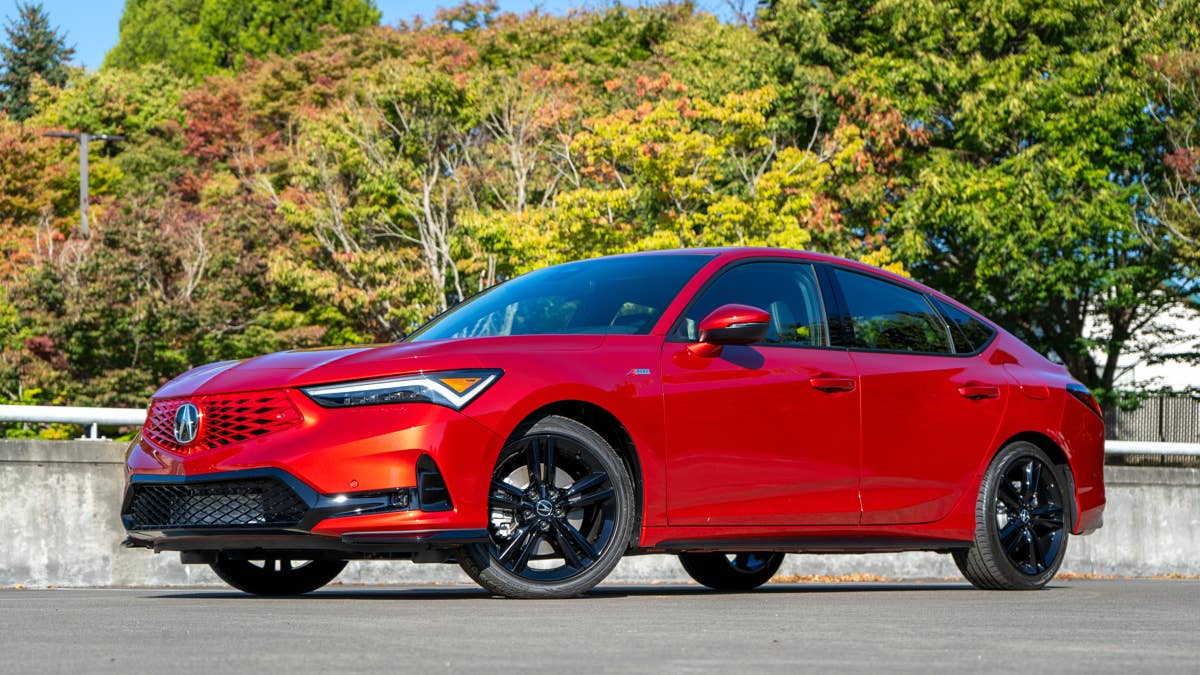
Halfway around a highway cloverleaf at the Northwest Automotive Press Association’s 2026 Drive Revolution program, where 17 journalists voted on 20 vehicles across a handful of categories, the Acura Integra A-Spec earned near-unanimous adoration. Its steering was precise, its body took a clean set, and its six-speed manual slipped into the next gear with familiar Honda tactility. It was a $41,195 compact liftback doing exactly what an everyday enthusiast car should. I liked it enough to vote for the Integra A-Spec as my top internal-combustion vehicle at the event; the category that it ultimately won. I also ranked it second for overall value, behind only the Hyundai Venue.
And yet, as the highway opened up, the A-Spec mostly made me miss the Integra Type S—a feeling I found rather curious, since driving the Dodge Charger Scat Pack at the very same event made me feel as though its less expensive and less potent sibling, the R/T, was a perfectly adequate, money-saving substitute. The A-Spec with Technology Package is a friendlier, more economical, and arguably more complete daily driver than the Type S, which is substantially more expensive, thirstier, and less accommodating. But the Type S is still the one I would buy in a heartbeat.
Cole Attisha
Same Family, Different Priorities
I drove the A-Spec for roughly 30 minutes during the same speed-dating-style event rotation as the other cars at Drive Revolution. By then, however, I had recently spent a full week and about 500 kilometers with the Type S around Vancouver, British Columbia, on the Sea-to-Sky Highway, and along Squamish Valley Road—a particular local favorite of mine. The Type S was still fresh in my memory—which might have made the contrast unusually apparent, but the same can also be said of the Dodge Charger duo. Both cars preserve the fundamentals that make the Integra special. They are front-wheel-drive liftbacks with six-speed manual transmissions, limited-slip differentials, adaptive dampers, and plenty of space for daily transportation. Both feel light on their feet, communicate clearly, and remind you that an engaging car doesn’t require rear-wheel drive or absurd power to be excellent.
Thinking about selling your car? Get an instant cash offer online now. Click here to get started.

Cole Attisha
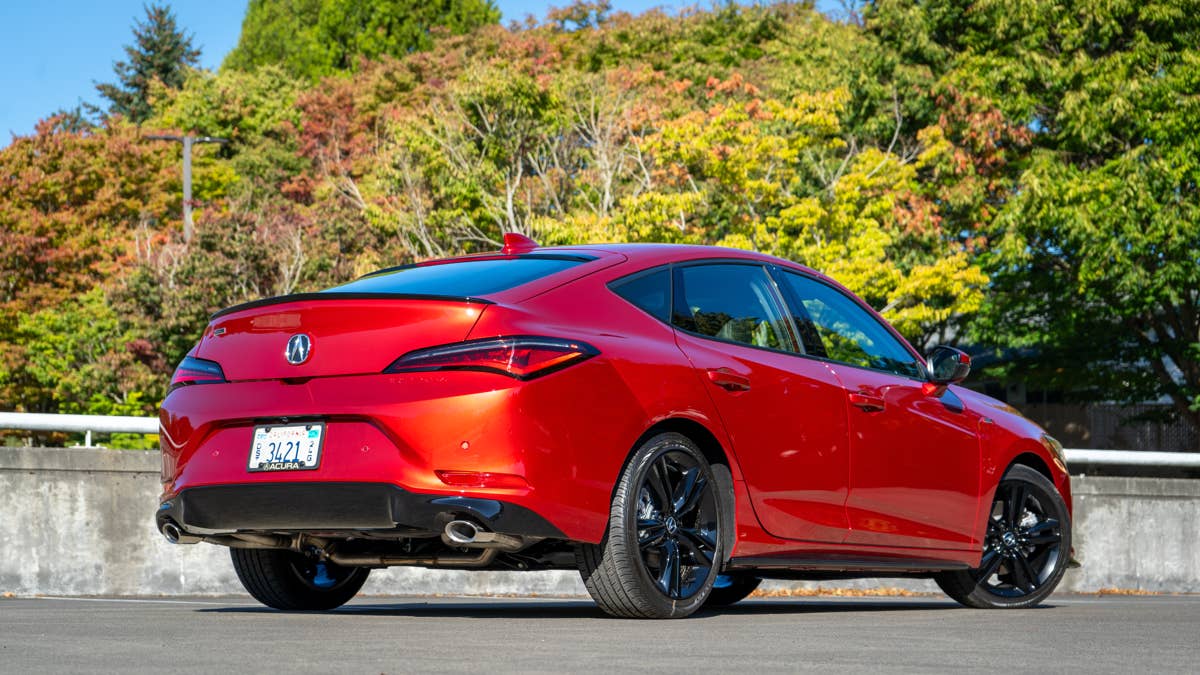
The scale of the mechanical difference is quite substantial, though, especially given the car’s relatively low weight. The A-Spec’s turbocharged 1.5-liter four-cylinder produces 200 horsepower and 192 pound-feet of torque. The Type S gets a 2.0-liter turbo four with 320 hp and 310 lb-ft, plus a dual-axis front suspension, larger brakes, a wider track, much more tire, and a louder active exhaust. The A-Spec with Technology Package starts at $39,200. My Performance Red Pearl test car carried an $800 paint charge and a $1,195 destination fee for a $41,195 total. The Type S starts at $53,900 before destination. However you normalize the additional charges, this is a five-figure decision—no small upgrade.
Cole Attisha
The A-Spec Earned Its Award
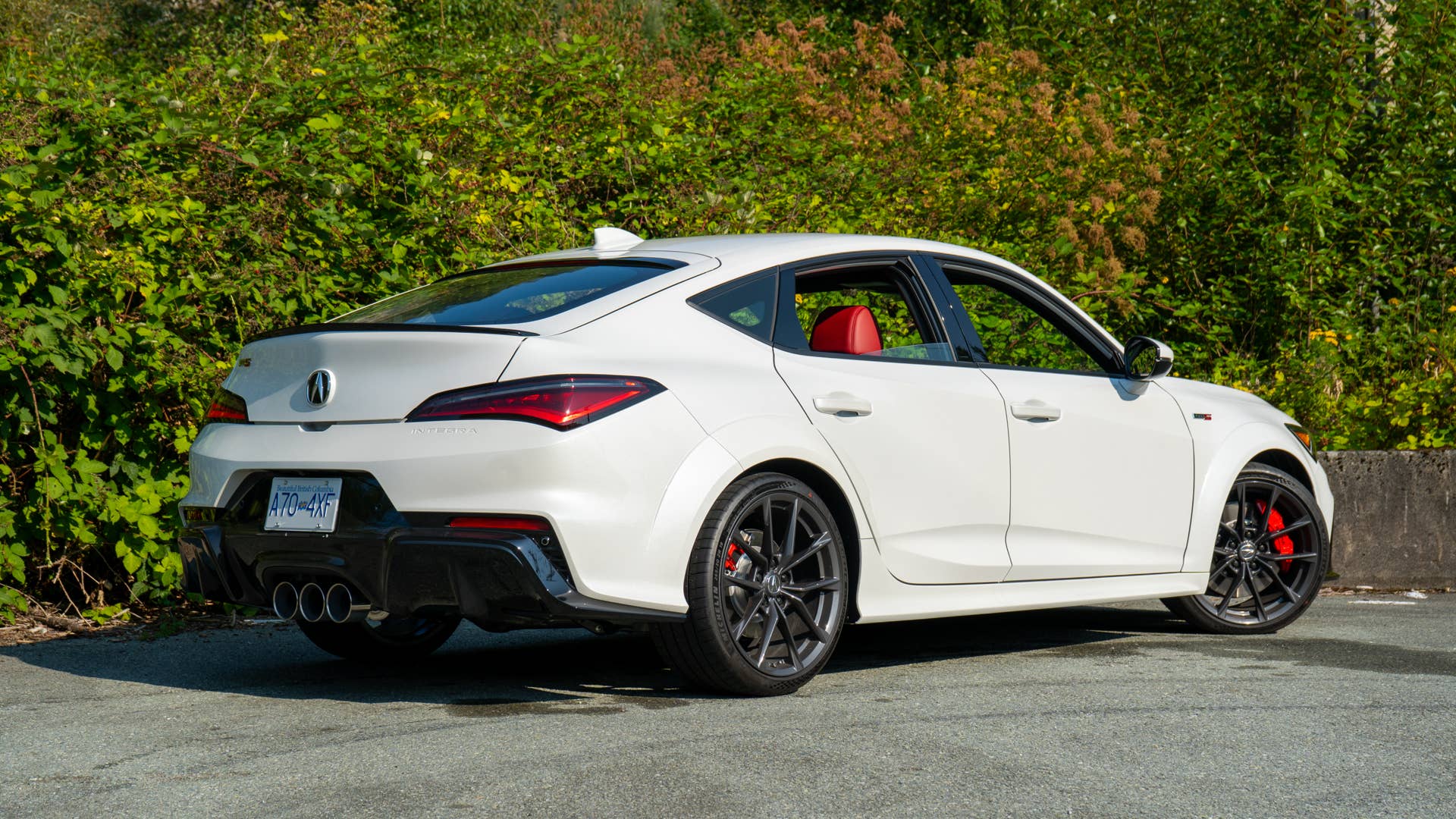
Two hundred horsepower sounds modest in 2026, but the A-Spec is still plenty quick. Its 1.5-liter engine is responsive enough to make on-ramps enjoyable and yet flexible enough to suit commuting, errands, and long highway drives. More importantly, it feels multidimensional—more so than the Type S. You can work the engine and gearbox in Sport mode when the road gets interesting, and Comfort mode quiets things down immensely for calmer daily cruising. The six-speed also retains the fundamental precision I loved in the Type S. Its throws are clean, its gates well defined, and its clutch easy to use. Still, the gearbox feels more naturally matched to the Type S’s powertrain. In that car, every shift becomes part of a symbiotic rhythm shared among the engine, exhaust, front axle, and driver. In the A-Spec, shifting is an enjoyable way to operate a very good daily powertrain. Its chassis follows a similar pattern—the steering carries the same underlying accuracy, but the A-Spec is not as tight or immediate. There is more body roll, and its responses are less intense, but that extra movement is a large part of what makes it ride so well.
Shopping for a new car? Click here to get a great deal on your next vehicle. Powered by Carvana: no-haggle pricing, 100% online.
Cole Attisha
The Type S rides superbly for something so sporty, but the A-Spec simply rides superbly. It blends body control and compliance without requiring that added qualifier, absorbing imperfect pavement while still retaining enough composure to make more spirited drives worthwhile. Its narrower body is easier to place, the cabin is quieter, and it keeps the moonroof that Acura deletes from the Type S in the name of rigidity and weight savings. Fuel economy strengthens the A-Spec’s more sensible appeal: the manual A-Spec is rated at 26 mpg in the city, 36 on the highway, and 30 combined, whereas the Type S manages just 21/28/24 mpg. Add the A-Spec’s lower tire, brake, and likely insurance costs, and the fiscal separation extends well beyond the showroom floor.

Cole Attisha

Cole Attisha
The Type S Creates A Sense Of Occasion
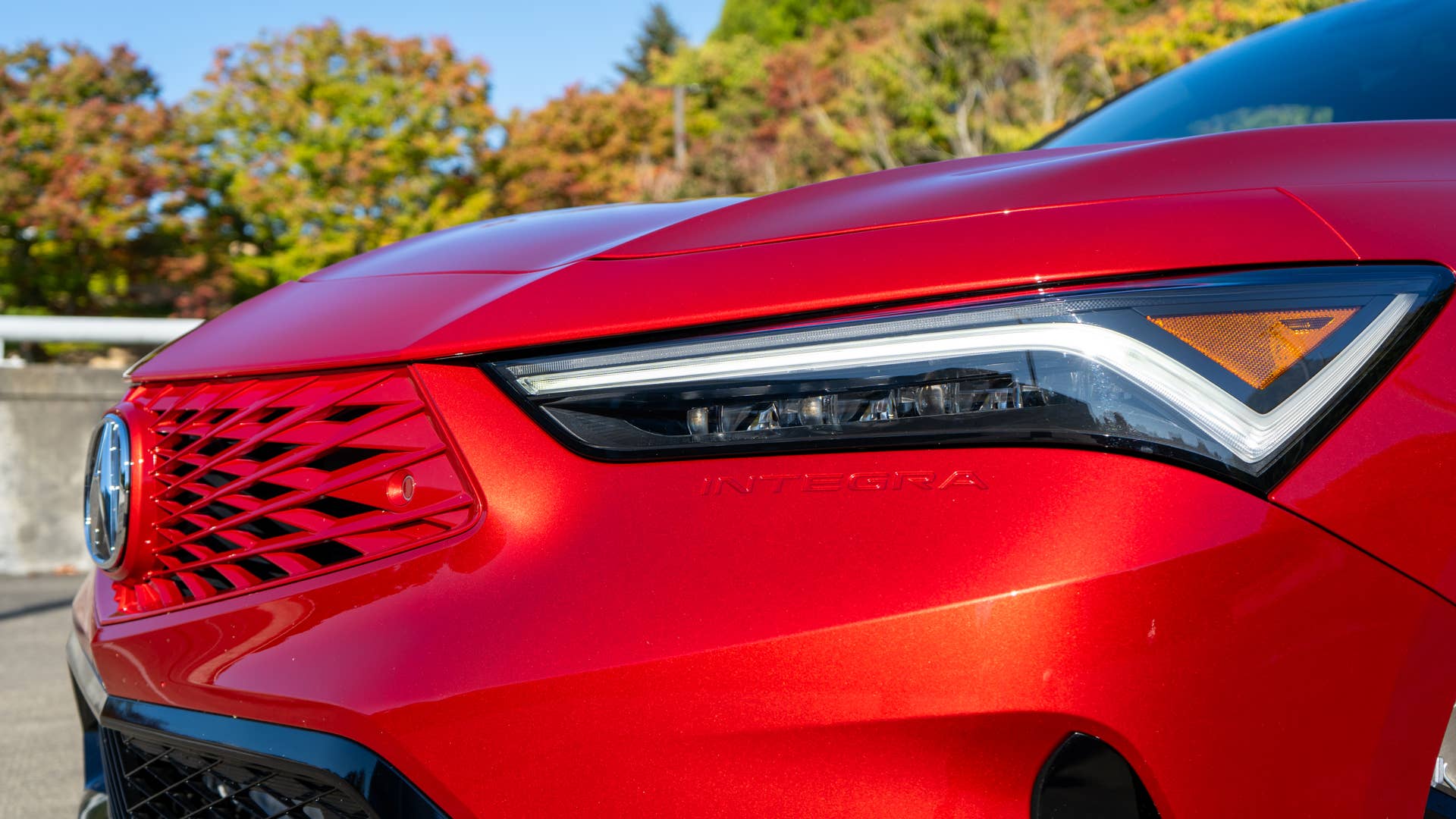
None of that changes what happened when I accelerated away from the cloverleaf. The A-Spec was doing everything well, but I remembered how the Type S pulled itself toward an apex under power, how its 2.0-liter engine charged toward 7,000 rpm and how the triple exhaust erupted in pops and crackles when I lifted in Sport+. The A-Spec is one of the most engaging new cars you can buy, but the Type S may be the single most engaging one of all. Its upgrades don’t feel like a collection of impressive numbers and parts merely pasted onto the same car. The extra power suits the chassis, the tighter body control suits the steering, and the wider front end, large Brembo brakes, and serious tires give the six-speed a powertrain worthy of its exceptional shift action. The entire package feels naturally calibrated around one purpose, while remaining comfortable and useful enough to drive every day.
Cole Attisha
Cole Attisha
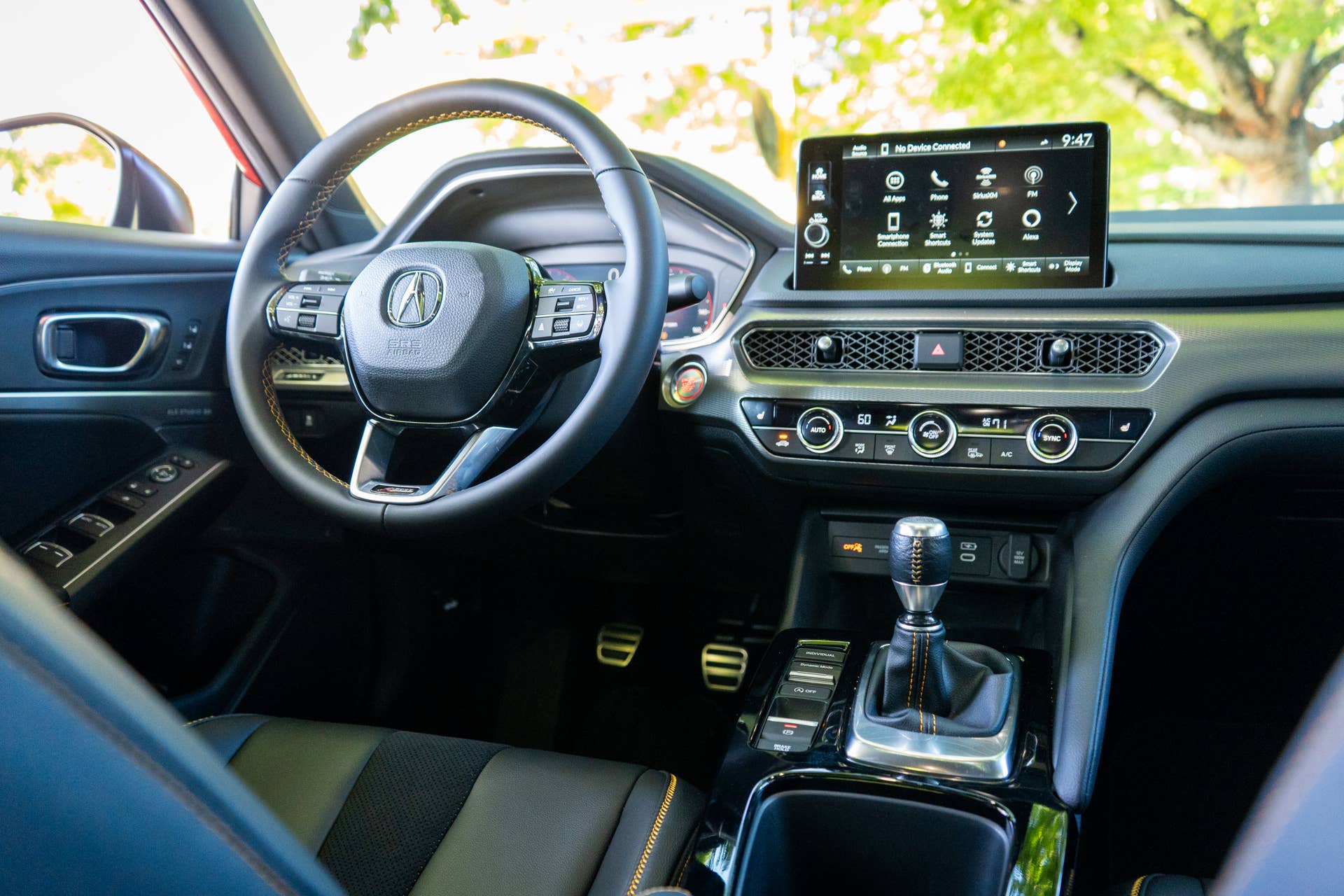
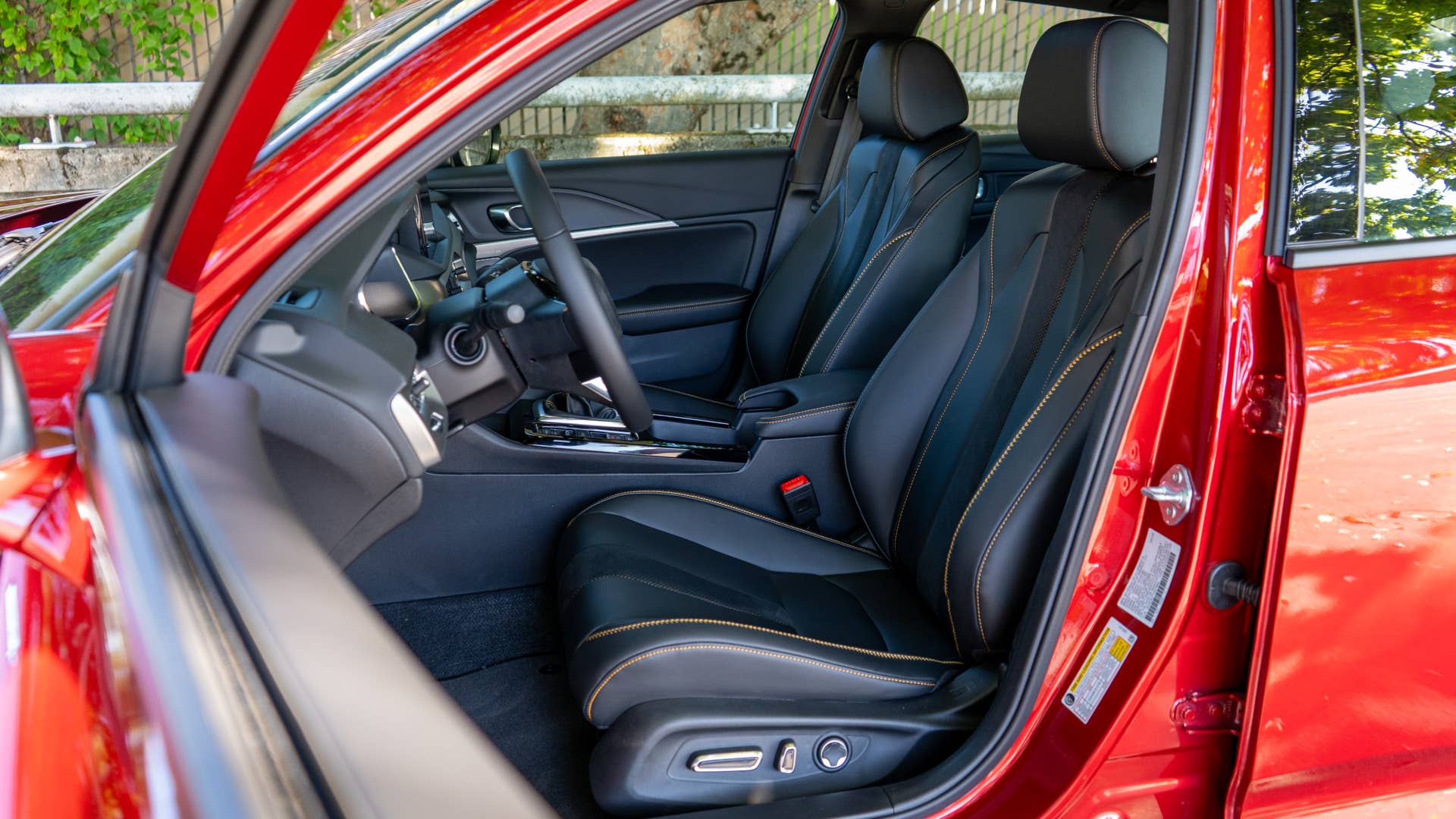
The distinction continues inside. The A-Spec with Technology Package is hardly sparse: it includes heated microsuede-trimmed seats, a head-up display, wireless phone integration, and that excellent 16-speaker ELS Studio 3D audio system. As a consumer product, it gives up remarkably little. As a driving tool and, admittedly, something of a toy, it gives up more, and the red upholstery in my Type S and its more focused environment made it feel special before I even pressed the start button. The Type S doesn’t merely perform better; its cabin, widened bodywork, and triple exhaust continually remind you why you paid more for it.
Cole Attisha
Is The Integra Type S Worth The Upgrade?
For most buyers, the A-Spec with Technology Package is the smarter Integra. It preserves the manual transmission, precise controls, practical liftback, and fundamental playfulness while riding better, consuming less fuel, and costing substantially less. It was an entirely deserving award winner, and I stand by both of my votes. But “smarter” and “more desirable” aren’t synonyms.
The A-Spec feels like a purposeful, appropriate compromise. Ordinarily, that would be the end of the story, but after living with the Type S, I knew exactly what had been compromised: the engine’s urgency, the front axle’s astonishing focus, the exhaust’s character, and the sense that you’re driving something truly special. So, yes, the Type S is worth the upgrade—if those qualities are what made you want an Integra in the first place. It’s not five figures better as fun, premium transportation, but it is a markedly better experience for those who are addicted to the act of driving, and that’s often what matters most to an enthusiast. The A-Spec may have won the logical argument and earned my vote, but the Type S captured my heart.
Autoblog aims to feature only the best products and services. If you buy something via one of our links, we may earn a commission.
Wiseco John Penton Women’s Race Report
The Progressive Grand National Cross Country (GNCC Racing) Series, an AMA National Championship, returned from its summer break this past weekend, September 18–20, with the Wiseco John Penton GNCC in Millfield, Ohio.
2026 Land Rover Defender Dog Review: What More Do You Want?
The Land Rover Defender, and especially the Defender OCTA, is the peak of off-road capability within the Land Rover lineup. The large SUV is designed to get anywhere, and the 626 horsepower OCTA is designed to do all that, but way faster. Its V8 bellow, upgraded drivetrain, and svelte interior make it the perfect luxury off-roader, even in the face of competitors like the Mercedes-Benz G-Class. To see if it still holds up when you throw a bit of regular life at it, I took the dog along during my week with the car.
As ever, our tester is my 85-pound dog, Beorn. He’s happy to do it and he works for cheap.
Ease Of Access: Too Tall For Some
Chase Bierenkoven
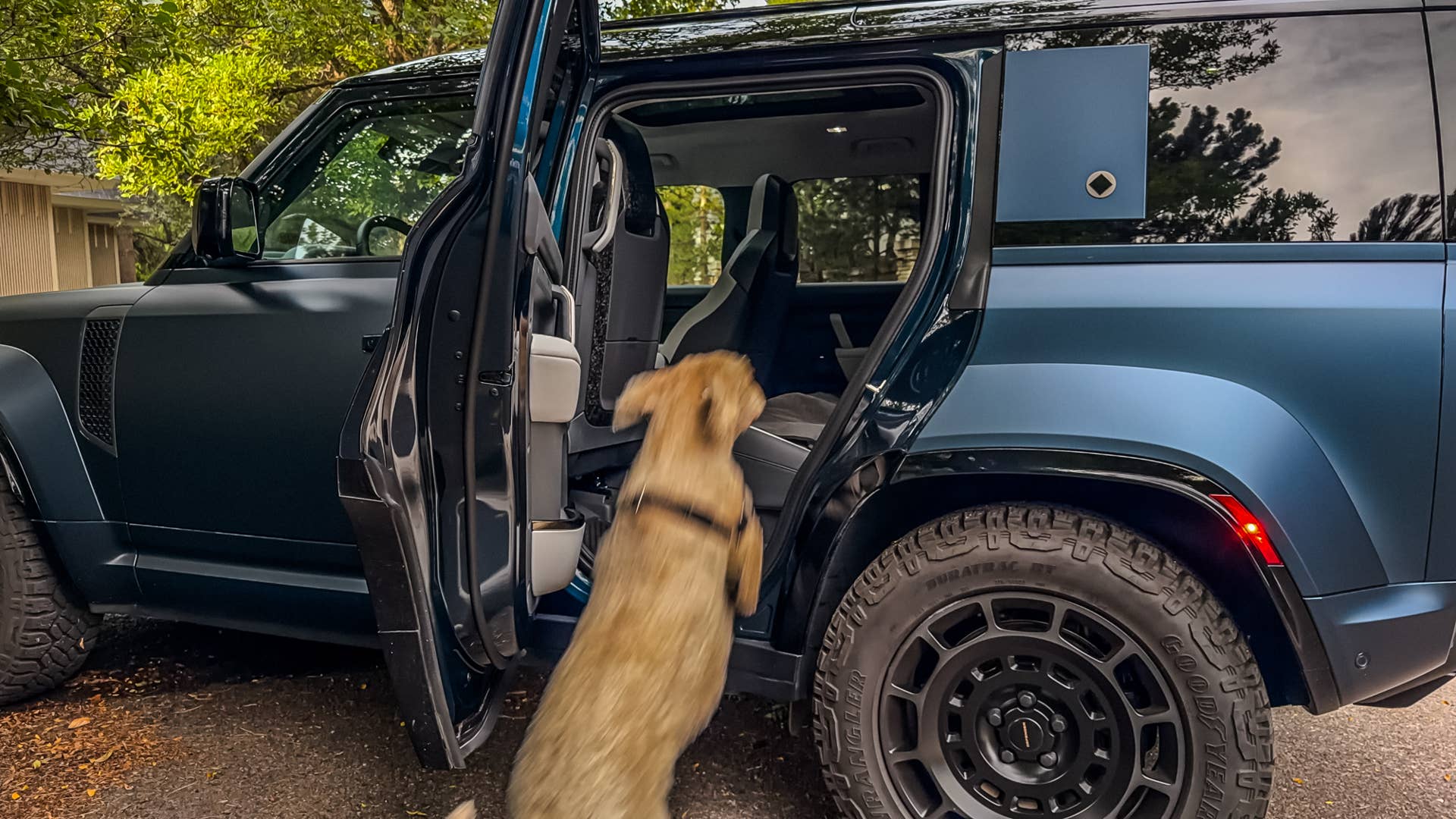
Accessing the Defender, and how easy your pet finds it, all comes down to vertical. If they’re spry and they’ve got some hops, this is a non-issue. The Defender’s rear doors are very wide, and so is the path to entry. Beorn had no trouble getting inside, but he’s also pretty tall, very young, and would rather die than be left somewhere alone for 10 seconds. If your dog is smaller or more independent, the Defender might be a tough sell.
If you prefer to put your pet in the trunk, though, I have good news. All Defenders equipped with air suspension can be lowered at the trunk, providing better access not only to the rear of the vehicle, but to the second row, too. After all, the whole rear of the SUV lowers a few inches when you press the button, which is located on the left side of the trunk.
Interior Space: Plush And Spacious

Chase Bierenkoven
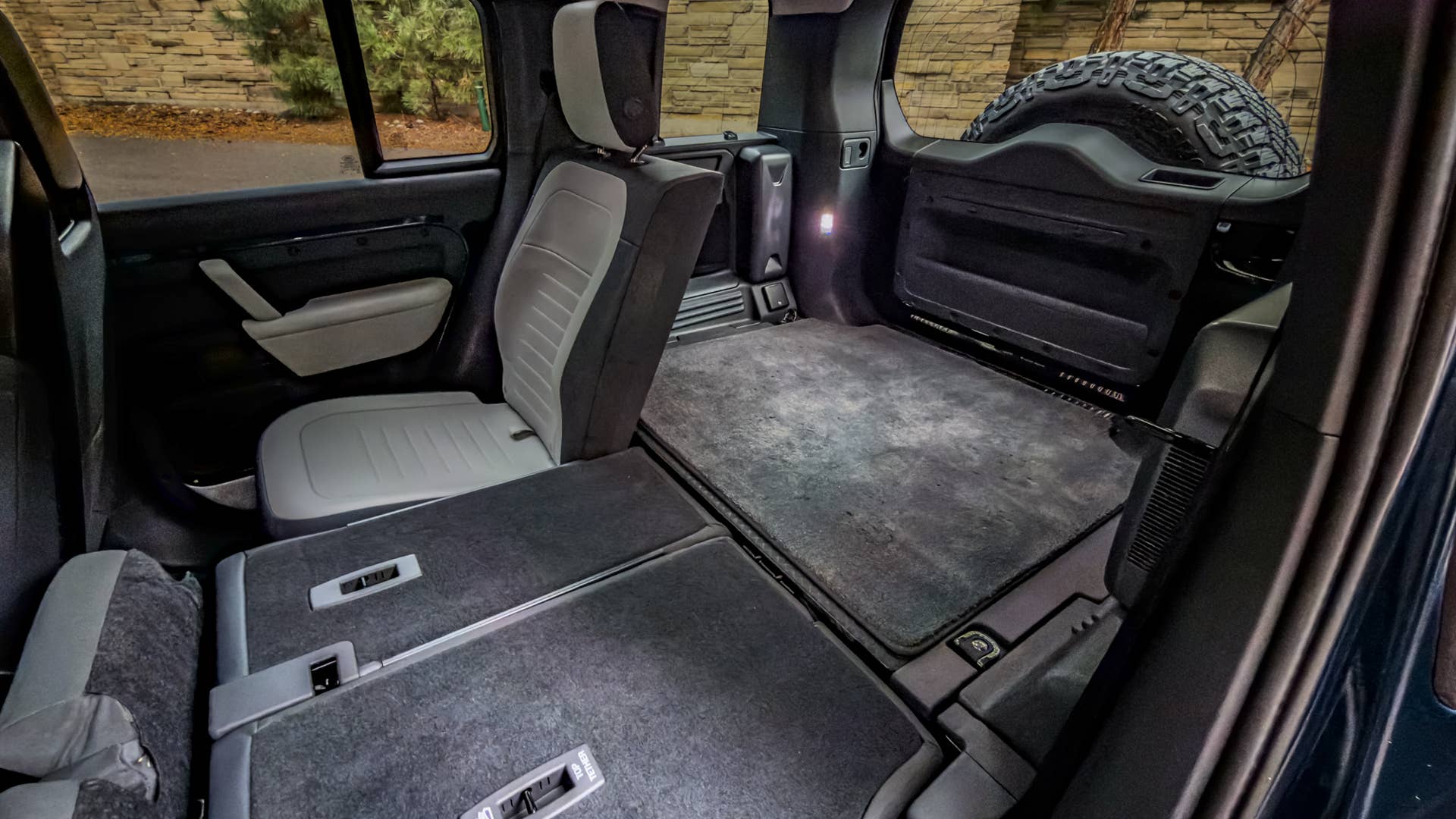
It’s good to be a dog, but it’s probably better to be one in a Defender. The OCTA’s ride is noticably more firm than the more pedestrian versions, but even so, it’s a comfortable place to spend some time. The rear seats are plenty wide enough for even big dogs like Beorn to sit like a sapien, and with headroom to spare. I caught him staring out the safari windows and the passenger windows, which also provide some excellent ventilation in the back. Speaking of which, there’s an independently controlled fan in the back that can help provide some added airflow to pets in the trunk space.
Chase Bierenkoven
The seats also fold totally flat independently, which makes the simulatneous carrying of pets and cargo much easier. You could, for example, have a pet occupy two rear seats, while leaving the third folded to accomodate larger items like skis inside the car. It’s a pretty sweet setup, and I don’t have much to complain about.
Materials: Tough-Feeling, But Too Nice For Pets
Chase Bierenkoven
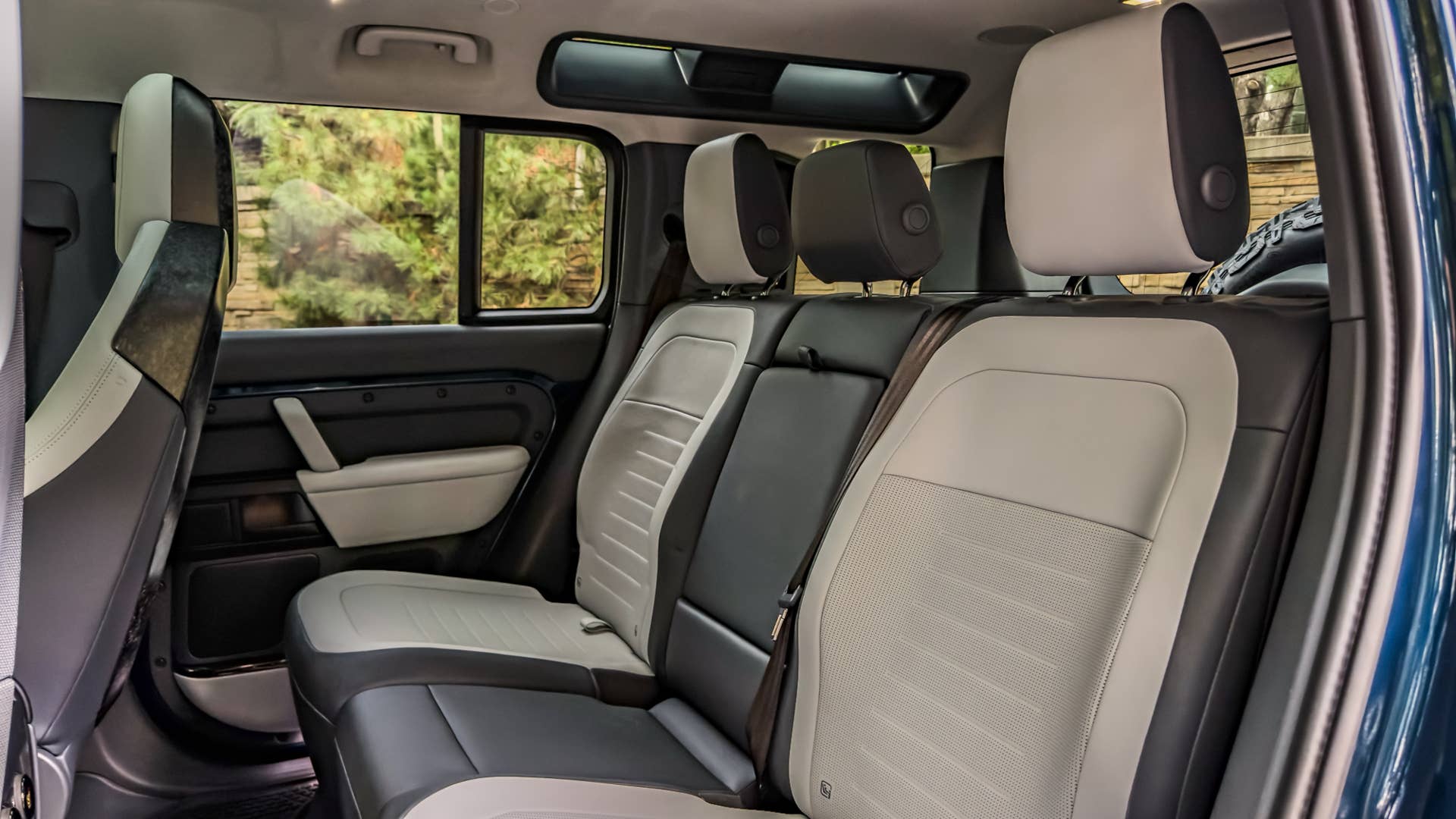
Still, this is billed as a high-dollar luxury SUV. While the materials no doubt feel luxurious and of high quality, they’re also way too nice for dogs. Maybe skip the white interior. The Defender OCTA in particular makes use of some high-quality leathers, which you’ll find on the seats, armrests, and even the seat backs. While these materials are great for people, I’d certainly want to avoid letting pets on them.
Verdict: A Nearly Perfect SUV For Dog Owners
Chase Bierenkoven
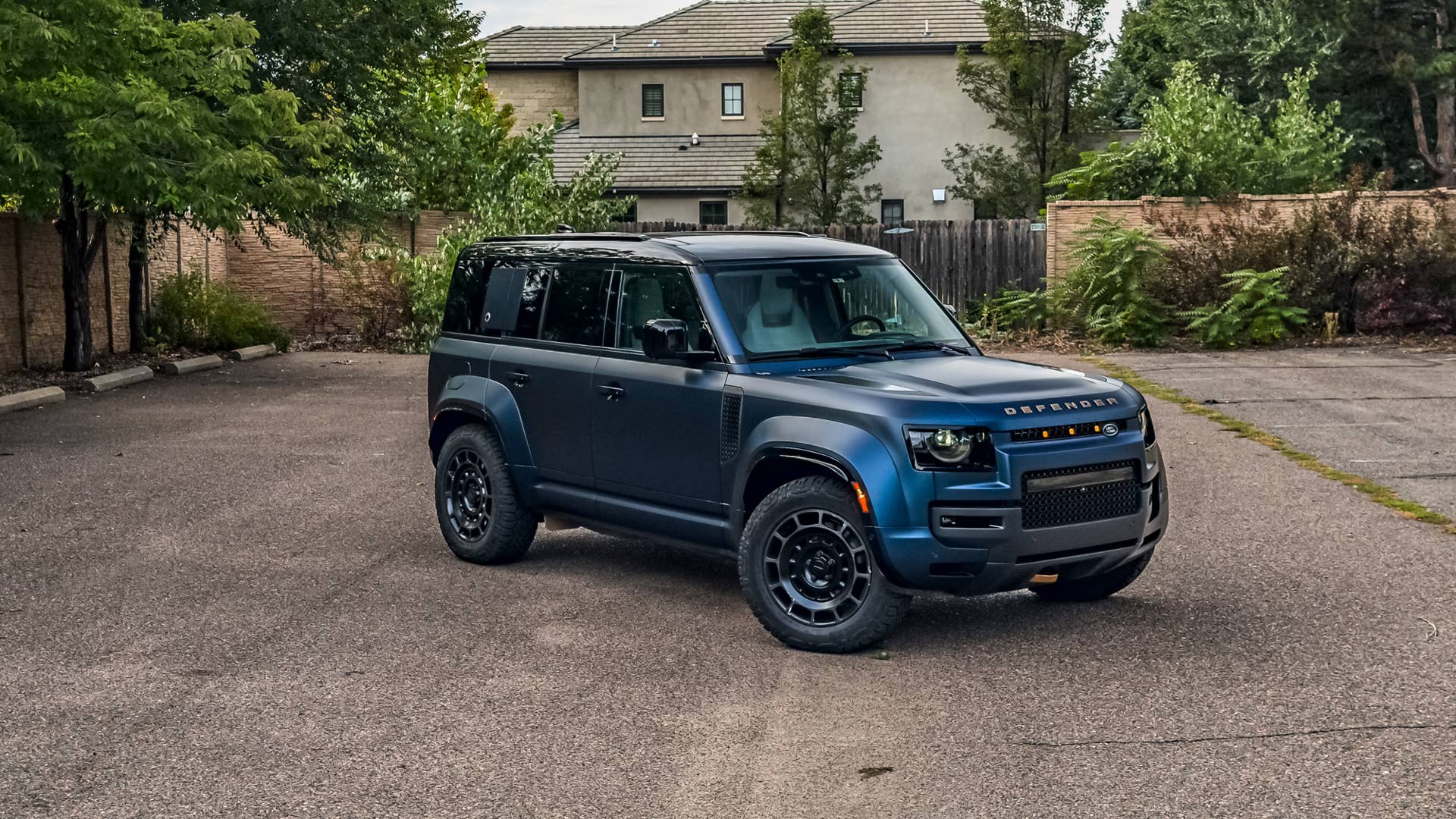
In summary, the Defender’s biggest weaknesses for pets are the things people love about it: the off-road ride height and premium materials. These two things can present some obstacles for dog owners, but they’re also easily mitigated. What you’re left with is an excellent SUV for hauling pets and conquering trails.
I Drove The 2027 Genesis GV70 2.5T Prestige: Here’s My Honest Review Of Its Subtle New Upgrades
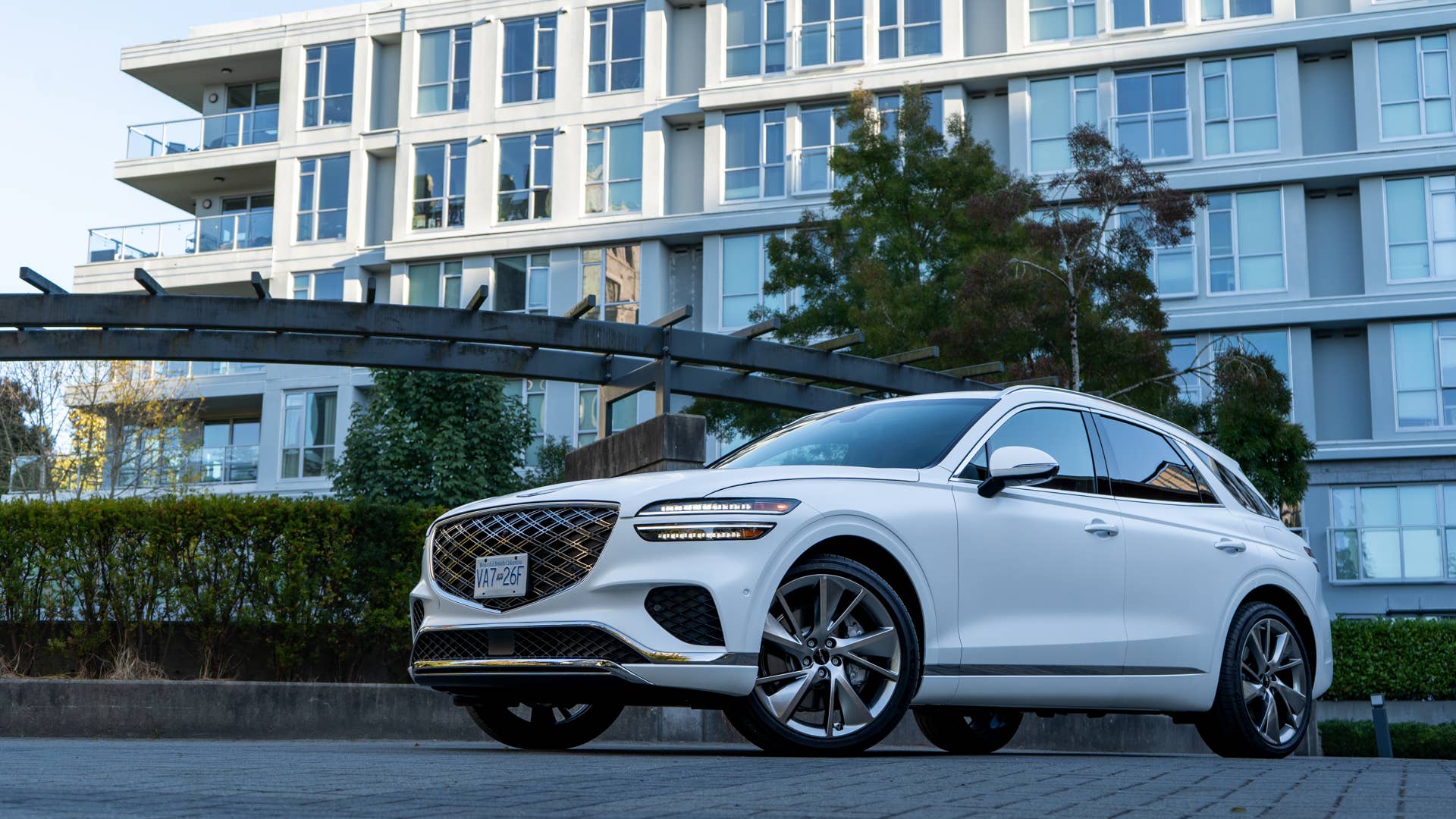
By the time I reached the ferry terminal, the 2027 Genesis GV70 had already made its point. It had handled Vancouver traffic, wet pavement, and the long highway run south without demanding much attention or any real effort, all with the same sense of ease you’d expect from a business-class flight. My passenger—my girlfriend’s father—and his luggage fit easily, the ride was supple, and the cabin did most of the talking. He had also ridden in the Mercedes-AMG GLC 63 S E Performance I tested earlier this year, and from the passenger seat of this GV70, he quickly decided the Genesis looked and felt better inside. We were off to a great start.
And while Genesis had substantially updated the GV70 for 2026, for its 2027 model year updates, it has concentrated on just a few small details: fewer badges, revised safety technology, Dolby Atmos, and minor exterior streamlining. I had already reviewed the 2026 GV70 2.5T Prestige and then driven all three available powertrains, and both experiences ultimately led me to an overall score of 9.4/10, convincing me that the 2.5T was the one to buy. The question this time, though, was whether changes this small could make an excellent luxury SUV better. They surely can, although not quite enough to make a 2026 owner especially jealous.
Cole Attisha
2027 Genesis GV70 2.5T Prestige specifications
Specification | 2027 Genesis GV70 2.5T Prestige |
|---|---|
Engine | 2.5-liter turbocharged inline-four |
Output | 300 hp and 311 lb-ft of torque |
Transmission | Eight-speed automatic |
Drivetrain | All-wheel drive |
Audio | 16-speaker Bang & Olufsen system with Dolby Atmos |
Canadian all-inclusive price | C$73,650 |
Matterhorn White Matte paint | C$2,100 |
Estimated configured price | C$75,750 before tax, registration, insurance, and licensing |
Closest U.S. trim | 2.5T Sport Prestige AWD, $61,550 before destination and options |
Thinking about selling your car? Get an instant cash offer online now. Click here to get started.
Cole Attisha
Design & Presence — 9.5/10: Less Badging, More Confidence
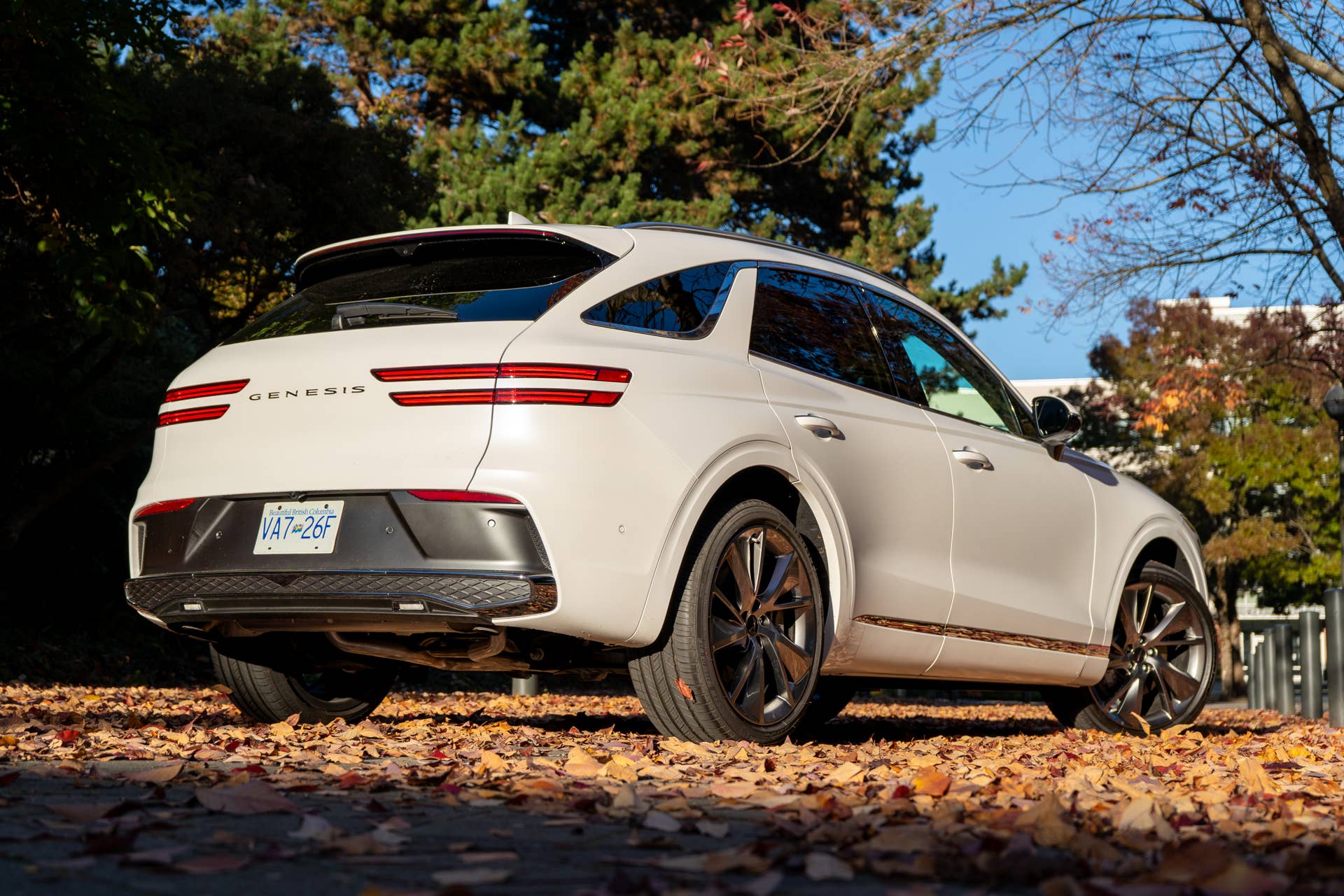
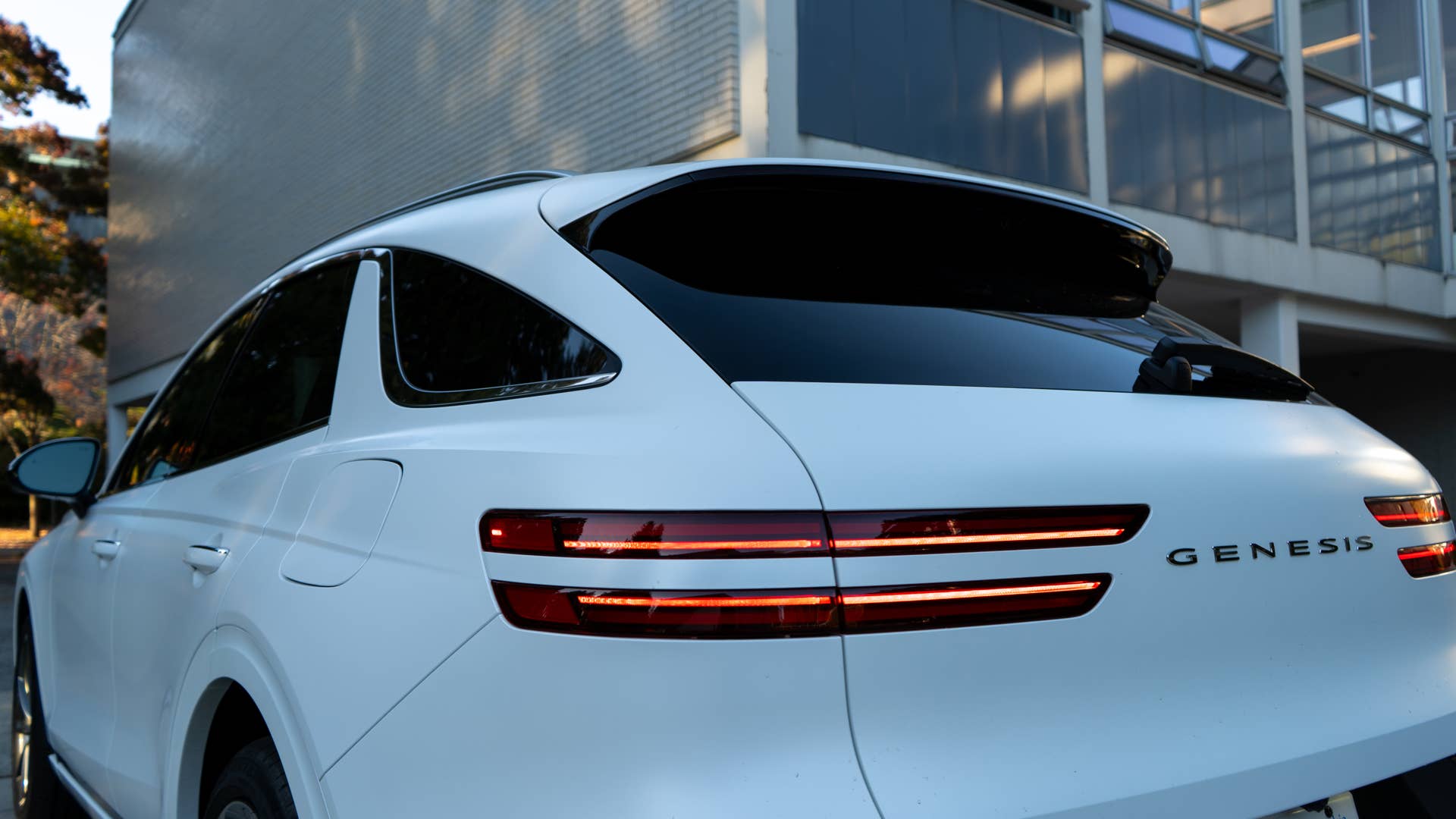
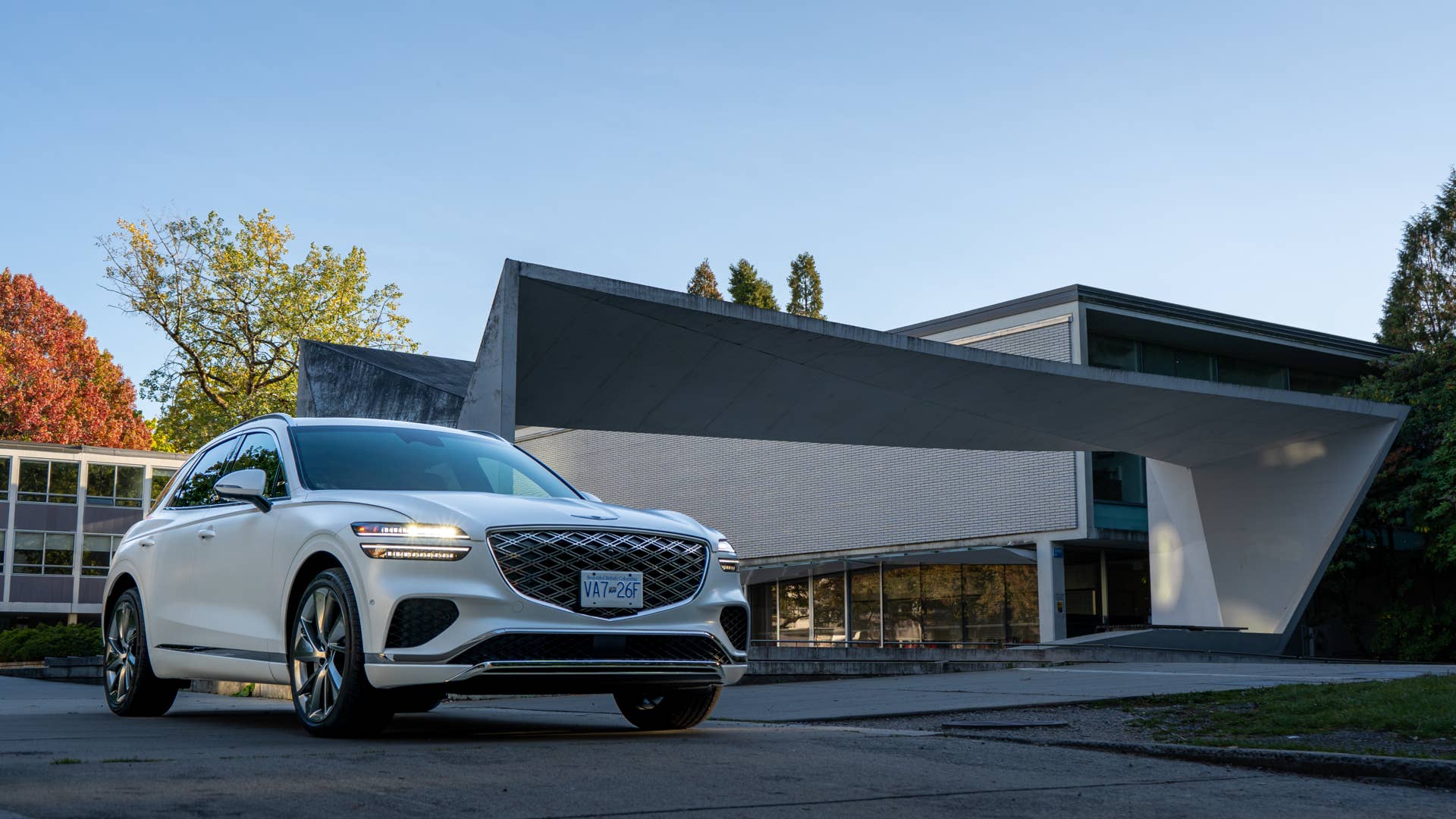
You may need a photo of last year’s GV70 to spot the most visible difference. Genesis has removed the GV70, 2.5T, and AWD lettering from the tailgate, leaving only the Genesis script beneath the rear window. The old badges never really bothered me, and I admittedly only noticed their absence after comparing this test car with my 2026 photos, but once I did, the improvement became difficult to ignore. The rear looks cleaner and more expensive, as though Genesis no longer feels the need to explain itself at every opportunity. It leaves passersby with more to figure out, which makes the design seem more self-assured.
Cole Attisha
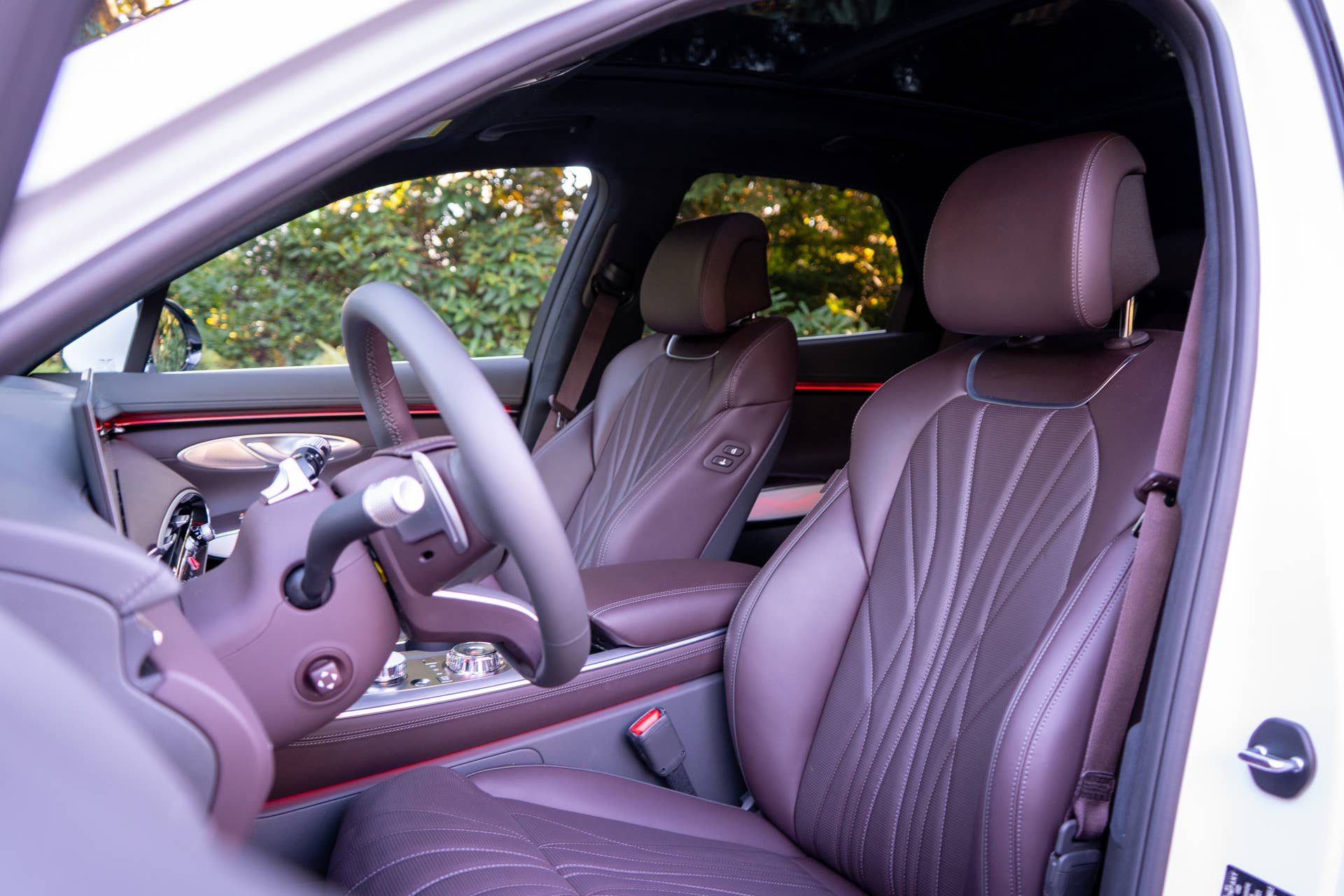
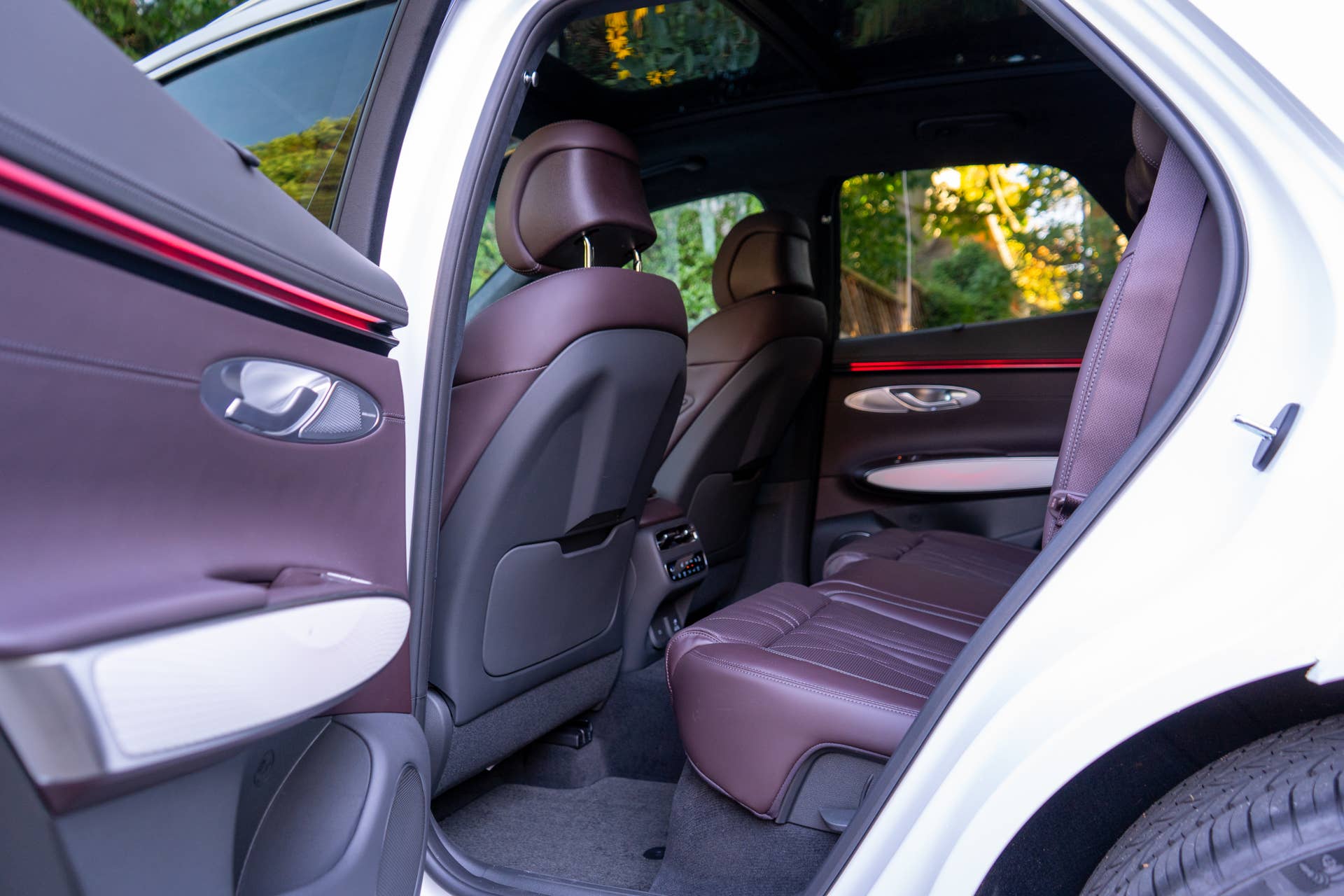
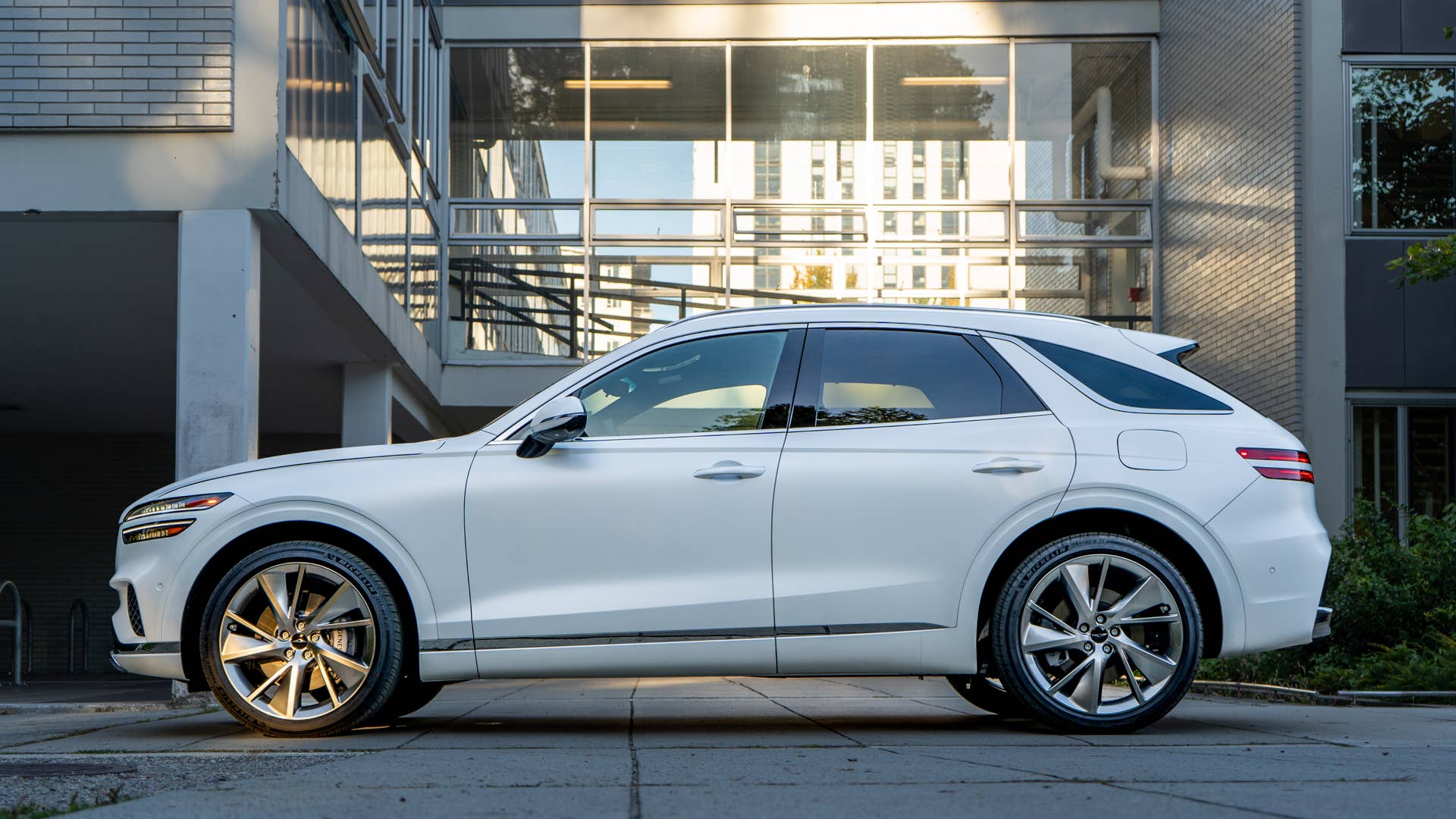
Its Matterhorn White Matte helped flatter its still-striking exterior styling, which I still firmly believe is the best in the business—or at least in this segment. White is usually among the least interesting and most technically difficult colors to photograph, but the satin finish added some much-appreciated depth to the GV70’s curves and two-line lighting. It looked fantastic in changing sun, cloud, and rain. Inside, Slate Grey and Velvet Burgundy Nappa leather created the richer half of the specification. The burgundy is dark enough to appear almost brown in certain light, while the grey upper sections and suede headliner keep it from overwhelming the cabin. Genesis continues to understand that luxury should feel tactile and visually interesting, not just shiny and decadent.
Shopping for a new car? Click here to get a great deal on your next vehicle. Powered by Carvana: no-haggle pricing, 100% online.
Cole Attisa
Interior & Comfort — 10/10: Still The Strongest Argument
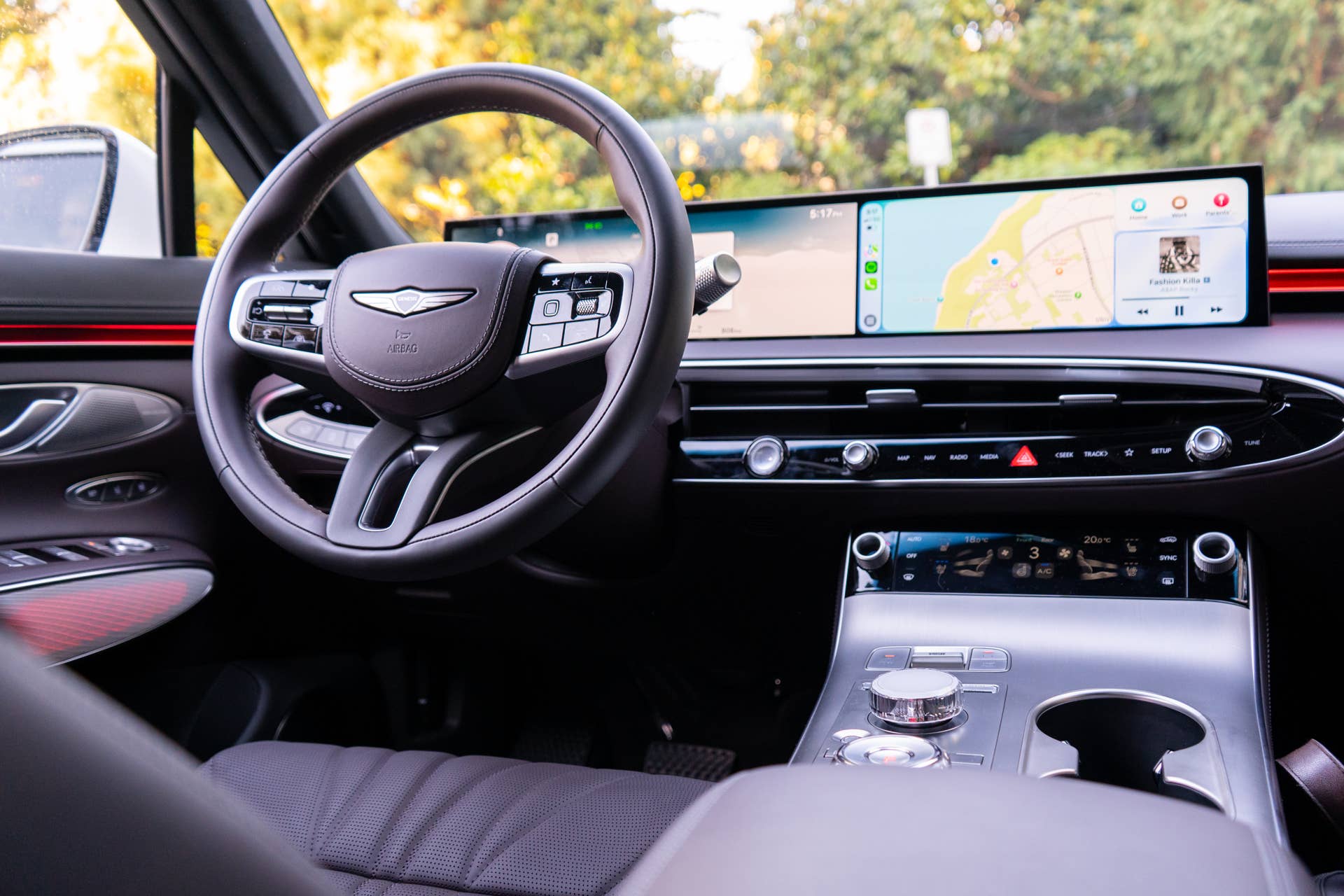
The 2026 update brought a 27-inch OLED display, redesigned steering wheel, and cleaner center fascia, so the 2027 cabin is familiar. Its shapes, materials, and controls still create more warmth than many compact luxury SUVs with better-known badges. The two-tone interior made this test car feel special before it even moved. Real aluminum speaker grilles, quilted Nappa leather, and the jewel-like rotary shifter provide the obvious theater, but the less decorative parts matter just as much. The driving position is natural, frequently used controls are straightforward, and the technology generally disappears once configured.
Cole Attisha
My ferry-terminal pickup run also supplied the kind of real-world test that matters more than a spec sheet: could it impress my girlfriend’s father? As he stepped inside, he was met with plenty of room, remained comfortable throughout the drive thanks to the Ergo-Motion seating, and came away talking about the design and quality rather than the screen’s size. His immediate comparison with the considerably more expensive AMG GLC was subjective, but revealing. Genesis no longer needs to be graded on a curve just because it costs less or has less history. The GV70’s interior can make a stronger first impression on its own terms.
Cole Attisha
Technology & Infotainment — 9/10: Dolby Atmos Strengthens The Experience
Dolby Atmos is the model-year update owners are most likely to notice from the driver’s seat. The 2.5T Prestige’s 16-speaker Bang & Olufsen system now supports the immersive audio format, and I tested it using Spotify Lossless Audio. Without a 2026 GV70 for an A/B comparison, I can’t assign every minuscule change in depth or placement to Atmos. Source quality and mixing affect the result, but the Bang & Olufsen system remains one of the GV70’s most memorable tech features, producing a broad soundstage without letting heavy bass substitute for rich sound quality.
Genesis has also updated the GV70’s comprehensive safety technology. Most of it faded into the background, which is exactly how driver assistance should behave. Lane-keeping assistance seemed to provide more useful feedback through the steering wheel, subtly helping my hands guide the car rather than vibrating the rim or issuing a stream of beeps, though not every interaction is seamless. The flush door handles sometimes hesitated to recognize my hand with the proximity key, requiring multiple attempts before unlocking. Auto Hold could also release more abruptly than I’d like. Both flaws are minor, but they stand out in a vehicle that otherwise works so hard to make routine actions feel effortless.
Cole Attisha
Performance & Driving Experience — 8.5/10: The 2.5T Remains The One To Buy
Mechanically, the 2027 2.5T Prestige preserves the formula I liked last year. Its turbocharged 2.5-liter four-cylinder produces 300 horsepower and 311 pound-feet of torque, routed through an eight-speed automatic transmission and standard all-wheel drive. Those numbers might not seem exceptional, especially beside the 375-hp 3.5T and the much more powerful Electrified GV70, but they are perfectly sufficient for comfortable around-town driving with the occasional more spirited jaunt. The 2.5T accelerates with useful urgency, the transmission generally selects the right gear right away, and the lighter engine helps the front end rotate more naturally than the V6 model does.
The GV70’s sense of balance remains its strongest advantage. It controls its body well enough to enjoy a twisty road, yet absorbs broken pavement without trying to prove its sporting intent on every city block. Steering is accurate, braking feels progressive, and the powertrain has enough reserve for passing without making the car’s personality all about speed. My earlier comparison produced a simple conclusion: the 2.5T is the GV70 to buy, the 3.5T is the one to lust after, and the Electrified GV70 is the fullest expression of the package if budget and charging are not concerns. Another week with the 2.5T didn’t change that. This engine allows the chassis, ride, and cabin to act as the main attractions.
Cole Attisha
Value & Ownership — 9/10: Canadian Prestige, U.S. Sport Prestige
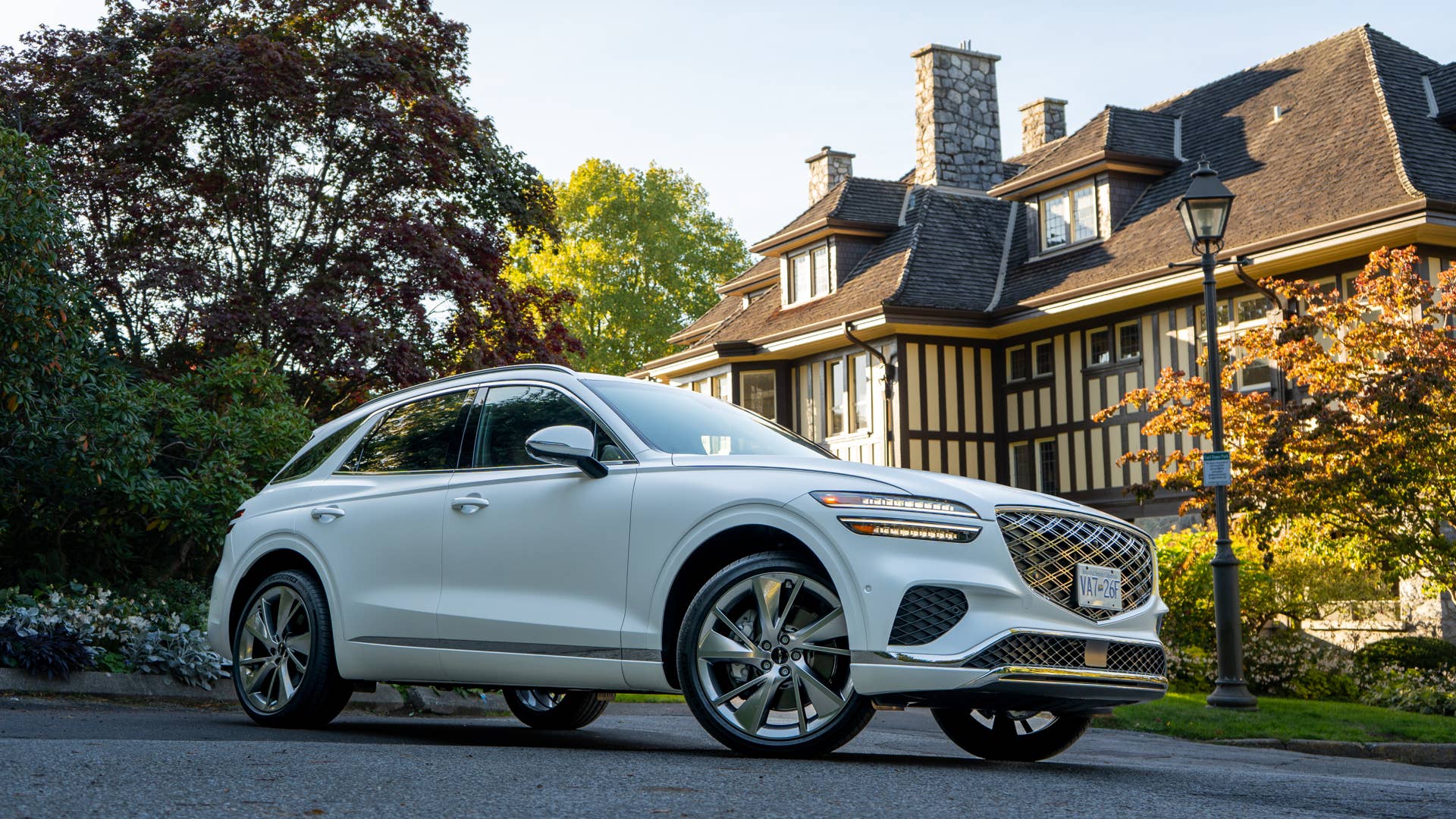
Genesis Canada lists the 2.5T Prestige at C$73,650. Matterhorn White Matte brings this specification to approximately C$75,750 before tax, registration, insurance, and licensing, assuming no accessories. American shoppers will not be able to find that exact trim name, as Genesis USA believes American buyers prefer a sporty look to match their classy SUV. The closest U.S. configuration is the 2.5T Sport Prestige AWD at $61,550 before destination and options. Equipment and visual details differ ever so slightly between markets, so the names aren’t directly interchangeable. Neither price tag makes the GV70 an inexpensive alternative in its segment, so its value comes from how completely it delivers the experience expected at that price. The cabin doesn’t feel like a consolation prize for a mainstream badge, the ride doesn’t ask for excuses, and the 2.5T doesn’t feel like a sacrifice.
Cole Attisha
Verdict — 9.4/10: The Right Way To Do A Carryover Year
The 2027 Genesis GV70 2.5T Prestige earns the same 9.4/10 overall score I gave the 2026 model. That’s not to say I’m indifferent to its updates—it simply reflects how little needed fixing. Removing badges doesn’t transform the ownership experience, and an owner could create a similar look on an older GV70 in an afternoon. Dolby Atmos doesn’t make the already excellent audio system essential if you were otherwise planning to buy a lower trim, and the revised assistance technology is most successful when you barely notice it. Together, however, these details make the GV70 feel even more closely resolved. The cleaner rear communicates confidence, the audio system deepens one of the cabin’s greatest strengths, and the safety aids assist without constantly announcing their presence. This was the best way Genesis could have executed a carryover year: not a reason for a recent owner to trade in, but evidence that Genesis is still paying attention after the major work is finished. The 2027 GV70 remains incredibly difficult to fault—and the 2.5T Prestige remains the version I would choose.
Autoblog aims to feature only the best products and services. If you buy something via one of our links, we may earn a commission.